analyzing the intervals of a function\npredict which statements are true about the intervals of\nthe…
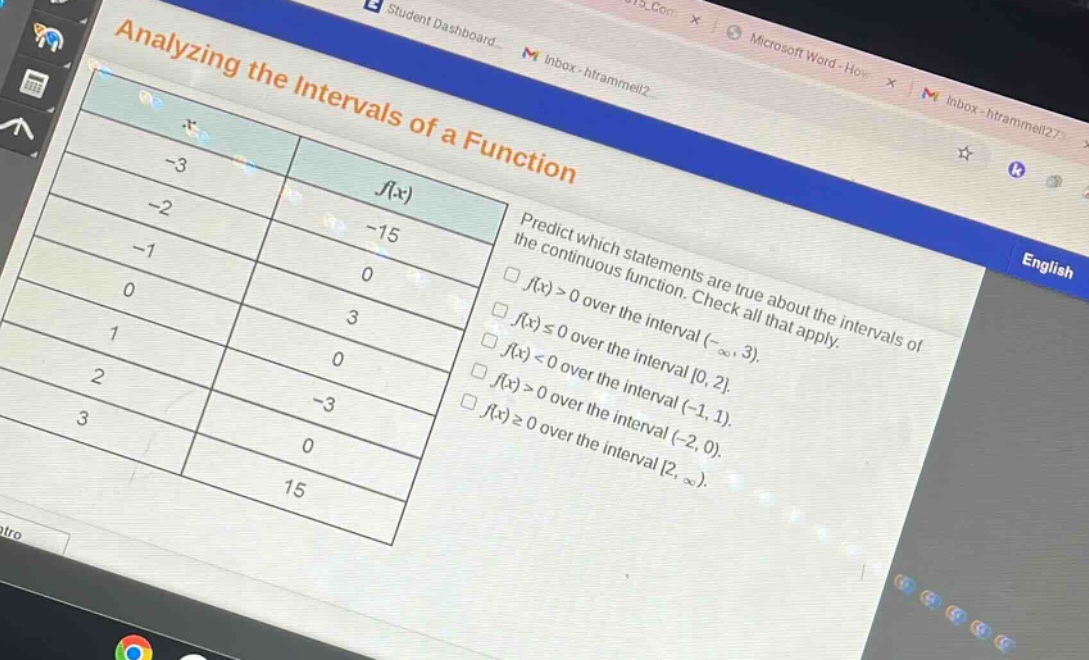
analyzing the intervals of a function\npredict which statements are true about the intervals of\nthe continuous function. check all that apply.\n$f(x)>0$ over the interval $(-\\infty,3)$.\n$f(x)\\leq0$ over the interval $0,2$.\n$f(x)<0$ over the interval $(-1,1)$.\n$f(x)>0$ over the interval $(-2,0)$.\n$f(x)\\geq0$ over the interval $2,\\infty)$.
Answer
Explanation:
Step1: Analyze (f(x)>0) over ((-\infty,3))
For (x = - 2), (f(-2)=-15<0). So (f(x)>0) over ((-\infty,3)) is false.
Step2: Analyze (f(x)\leq0) over ([0,2])
When (x = 0), (f(0) = 3>0). So (f(x)\leq0) over ([0,2]) is false.
Step3: Analyze (f(x)<0) over ((-1,1))
When (x=-1), (f(-1) = 0); when (x = 0), (f(0)=3>0). So (f(x)<0) over ((-1,1)) is false.
Step4: Analyze (f(x)>0) over ((-2,0))
When (x=-2), (f(-2)=-15<0); when (x = 0), (f(0)=3>0). Since the function is continuous, by the Intermediate - Value Theorem, there is a root in ((-2,0)). But when (x=-1), (f(-1) = 0). Let's check values: for (x=-1.5), assume (f(-1.5)) (using the fact that we can consider the polynomial nature (since it's a continuous function). But from the given table, when (x=-1), (f(-1) = 0), (x = 0), (f(0)=3). The function is continuous. For (x\in(-2,0)), (f(-2)=-15), (f(-1) = 0), (f(0)=3). The function is not always positive.
Step5: Analyze (f(x)\geq0) over ([2,\infty))
When (x = 2), (f(2)=-3<0). So (f(x)\geq0) over ([2,\infty)) is false.
Answer:
None of the statements are correct.