an angler hooks a trout and reels in his line at 4 in/s. assume the tip of the fishing rod is 11 ft above…
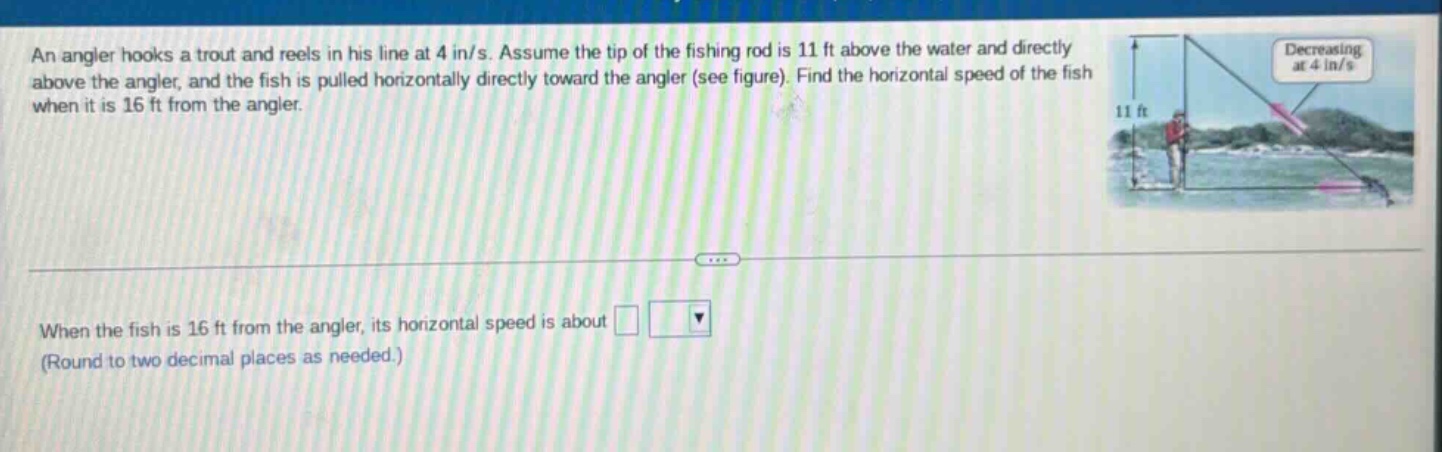
an angler hooks a trout and reels in his line at 4 in/s. assume the tip of the fishing rod is 11 ft above the water and directly above the angler, and the fish is pulled horizontally directly toward the angler (see figure). find the horizontal speed of the fish when it is 16 ft from the angler. when the fish is 16 ft from the angler, its horizontal speed is about (round to two decimal places as needed.)
Answer
Explanation:
Step1: Establish a right - triangle relationship
Let $y = 11$ ft (height of the fishing rod tip above water), $x$ be the horizontal distance of the fish from the angler, and $z$ be the length of the fishing line. By the Pythagorean theorem, $x^{2}+y^{2}=z^{2}$. Since $y = 11$, we have $x^{2}+121=z^{2}$.
Step2: Differentiate with respect to time $t$
Differentiating both sides of $x^{2}+121 = z^{2}$ with respect to $t$ gives $2x\frac{dx}{dt}=2z\frac{dz}{dt}$, which simplifies to $x\frac{dx}{dt}=z\frac{dz}{dt}$.
Step3: Find $z$ when $x = 16$
When $x = 16$, using $x^{2}+121=z^{2}$, we substitute $x$: $z=\sqrt{16^{2}+121}=\sqrt{256 + 121}=\sqrt{377}\approx19.42$.
Step4: Determine $\frac{dz}{dt}$
The angler reels in the line at a rate of $4$ in/s. Convert to ft/s: $\frac{dz}{dt}=-\frac{4}{12}=-\frac{1}{3}$ ft/s (negative because $z$ is decreasing).
Step5: Solve for $\frac{dx}{dt}$
Substitute $x = 16$, $z\approx19.42$, and $\frac{dz}{dt}=-\frac{1}{3}$ into $x\frac{dx}{dt}=z\frac{dz}{dt}$. We get $16\frac{dx}{dt}=19.42\times(-\frac{1}{3})$. Then $\frac{dx}{dt}=\frac{19.42\times(-\frac{1}{3})}{16}\approx - 0.40$ ft/s. The negative sign indicates the fish is moving towards the angler.
Answer:
$0.40$ ft/s