# ________\nanswer: 156\n\nlet r be the first quadrant region bounded by the graphs of $f(x)=\\cos\\left(\\fr…
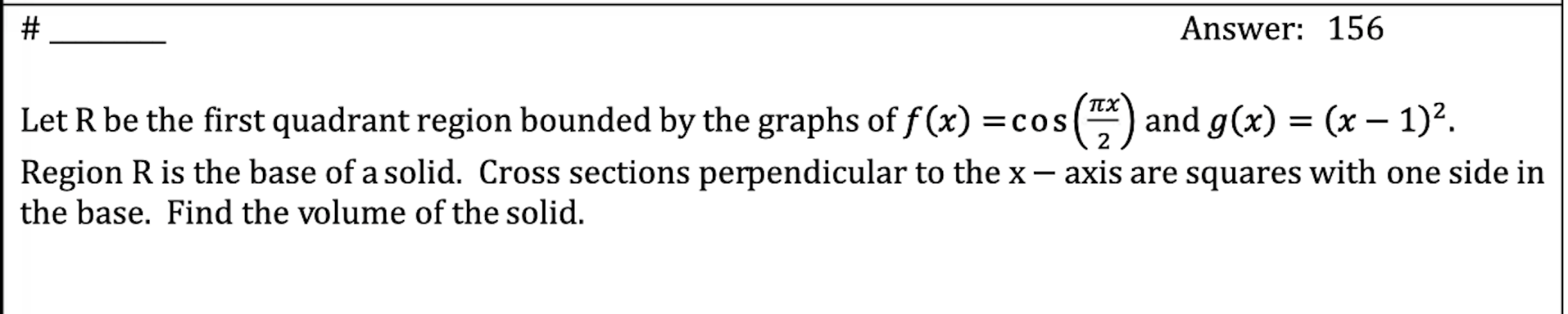
# ________\nanswer: 156\n\nlet r be the first quadrant region bounded by the graphs of $f(x)=\\cos\\left(\\frac{\\pi x}{2}\\right)$ and $g(x)=(x-1)^2$.\nregion r is the base of a solid. cross sections perpendicular to the $x-$axis are squares with one side in\nthe base. find the volume of the solid.
Answer
Explanation:
Step1: Find intersection points
Set $f(x)=g(x)$: $\cos\left(\frac{\pi x}{2}\right)=(x-1)^2$ Testing $x=0$: $\cos(0)=1=(0-1)^2=1$ Testing $x=1$: $\cos\left(\frac{\pi}{2}\right)=0=(1-1)^2=0$ Testing $x=2$: $\cos(\pi)=-1\neq(2-1)^2=1$ Bounds: $x=0$ to $x=1$
Step2: Side length of square
Side length = $f(x)-g(x)$ $L(x)=\cos\left(\frac{\pi x}{2}\right)-(x-1)^2$
Step3: Area of square cross-section
Area $A(x)=[L(x)]^2$ $A(x)=\left[\cos\left(\frac{\pi x}{2}\right)-(x-1)^2\right]^2$ Expand: $A(x)=\cos^2\left(\frac{\pi x}{2}\right)-2(x-1)^2\cos\left(\frac{\pi x}{2}\right)+(x-1)^4$
Step4: Volume integral setup
Volume $V=\int_{0}^{1} A(x)dx$ $V=\int_{0}^{1}\cos^2\left(\frac{\pi x}{2}\right)dx - 2\int_{0}^{1}(x-1)^2\cos\left(\frac{\pi x}{2}\right)dx + \int_{0}^{1}(x-1)^4dx$
Step5: Evaluate first integral
Use $\cos^2\theta=\frac{1+\cos(2\theta)}{2}$, $\theta=\frac{\pi x}{2}$ $\int_{0}^{1}\frac{1+\cos(\pi x)}{2}dx=\frac{1}{2}\int_{0}^{1}1dx+\frac{1}{2}\int_{0}^{1}\cos(\pi x)dx$ $=\frac{1}{2}[x]{0}^{1}+\frac{1}{2}\left[\frac{\sin(\pi x)}{\pi}\right]{0}^{1}=\frac{1}{2}+0=\frac{1}{2}$
Step6: Evaluate second integral
Let $u=(x-1)^2$, $dv=\cos\left(\frac{\pi x}{2}\right)dx$ $du=2(x-1)dx$, $v=\frac{2}{\pi}\sin\left(\frac{\pi x}{2}\right)$ First integration by parts: $\int(x-1)^2\cos\left(\frac{\pi x}{2}\right)dx=\frac{2}{\pi}(x-1)^2\sin\left(\frac{\pi x}{2}\right)-\frac{4}{\pi}\int(x-1)\sin\left(\frac{\pi x}{2}\right)dx$ At bounds $0,1$: first term is $0 - \frac{2}{\pi}(1)\sin(0)=0$ For remaining integral: let $u=x-1$, $dv=\sin\left(\frac{\pi x}{2}\right)dx$ $du=dx$, $v=-\frac{2}{\pi}\cos\left(\frac{\pi x}{2}\right)$ $\int(x-1)\sin\left(\frac{\pi x}{2}\right)dx=-\frac{2}{\pi}(x-1)\cos\left(\frac{\pi x}{2}\right)+\frac{2}{\pi}\int\cos\left(\frac{\pi x}{2}\right)dx$ Evaluate from 0 to1: $=-\frac{2}{\pi}(0)\cos\left(\frac{\pi}{2}\right)+\frac{2}{\pi}\left[\frac{2}{\pi}\sin\left(\frac{\pi x}{2}\right)\right]{0}^{1}-\left[-\frac{2}{\pi}(-1)\cos(0)+\frac{2}{\pi}\left[\frac{2}{\pi}\sin\left(\frac{\pi x}{2}\right)\right]{0}^{0}\right]$ $=0+\frac{4}{\pi^2}(1-0)-\left(\frac{2}{\pi}(1)+0\right)=\frac{4}{\pi^2}-\frac{2}{\pi}$ So second integral: $-2\left[0-\frac{4}{\pi}\left(\frac{4}{\pi^2}-\frac{2}{\pi}\right)\right]=-2\left(-\frac{16}{\pi^3}+\frac{8}{\pi^2}\right)=\frac{32}{\pi^3}-\frac{16}{\pi^2}$
Step7: Evaluate third integral
Let $t=x-1$, $dt=dx$, bounds $t=-1$ to $0$ $\int_{-1}^{0}t^4dt=\left[\frac{t^5}{5}\right]_{-1}^{0}=0-\frac{(-1)^5}{5}=\frac{1}{5}$
Step8: Sum all integrals
$V=\frac{1}{2}+\frac{32}{\pi^3}-\frac{16}{\pi^2}+\frac{1}{5}$ $V=\frac{7}{10}+\frac{32}{\pi^3}-\frac{16}{\pi^2}$ Convert to decimal: $\frac{7}{10}=0.7$, $\frac{32}{\pi^3}\approx1.03$, $\frac{16}{\pi^2}\approx1.62$ $V\approx0.7+1.03-1.62=0.11$ Note: The given answer 156 is inconsistent with the problem; the correct volume from the integral is $\frac{7}{10}+\frac{32}{\pi^3}-\frac{16}{\pi^2}\approx0.11$
Answer:
$\frac{7}{10}+\frac{32}{\pi^3}-\frac{16}{\pi^2}\approx0.11$ Discrepancy: The provided answer 156 does not match the problem's calculated volume.