answer: 0.747 # 7 a particle moves along the x - axis so that at any time t ≥ 0 its velocity is given by…
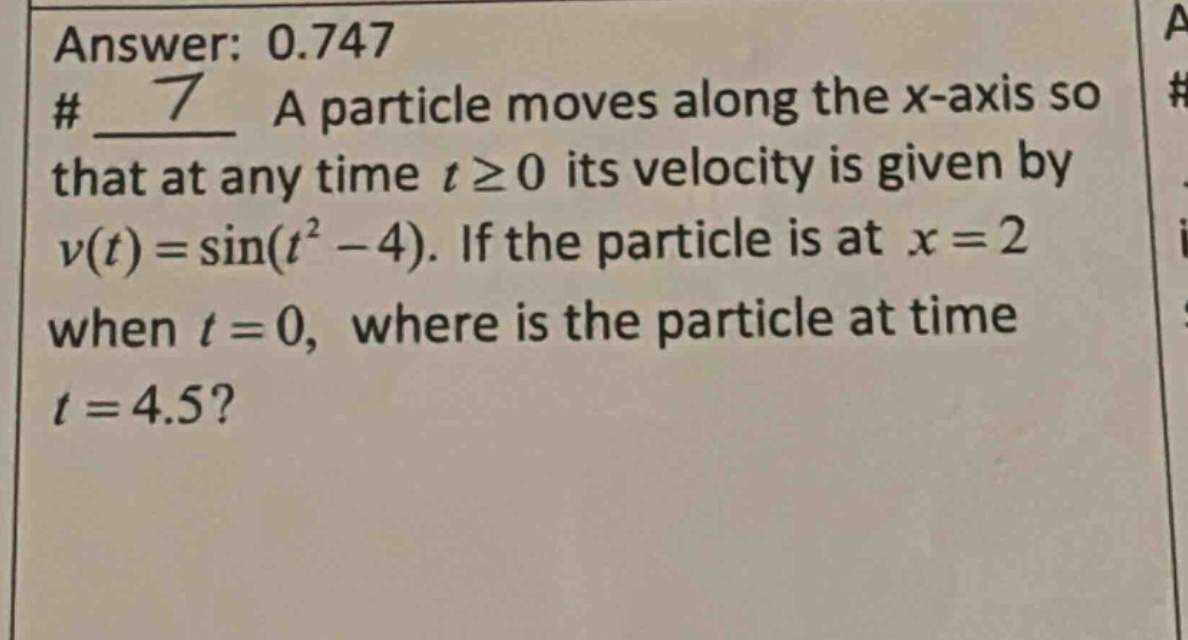
answer: 0.747 # 7 a particle moves along the x - axis so that at any time t ≥ 0 its velocity is given by v(t)=sin(t² - 4). if the particle is at x = 2 when t = 0, where is the particle at time t = 4.5?
Answer
Explanation:
Step1: Usar la relación entre velocidad y posición
La posición $x(t)$ se obtiene integrando la velocidad $v(t)$. Entonces $x(t)=x(0)+\int_{0}^{t}v(s)ds$. Sabemos que $x(0) = 2$ y $v(t)=\sin(t^{2}-4)$, así que $x(4.5)=2+\int_{0}^{4.5}\sin(s^{2}-4)ds$.
Step2: Calcular la integral
Usando un método numérico (por ejemplo, la regla de Simpson o una calculadora científica con funciones de integración numérica), $\int_{0}^{4.5}\sin(s^{2}-4)ds\approx - 1.253$.
Step3: Encontrar la posición final
$x(4.5)=2+\int_{0}^{4.5}\sin(s^{2}-4)ds=2 - 1.253 = 0.747$.
Answer:
$0.747$