answer all the following questions\n5. $f(x)=\frac{1}{3}x^{3}+3x^{2}+8x$\na. intervals of increasing\n\nb…
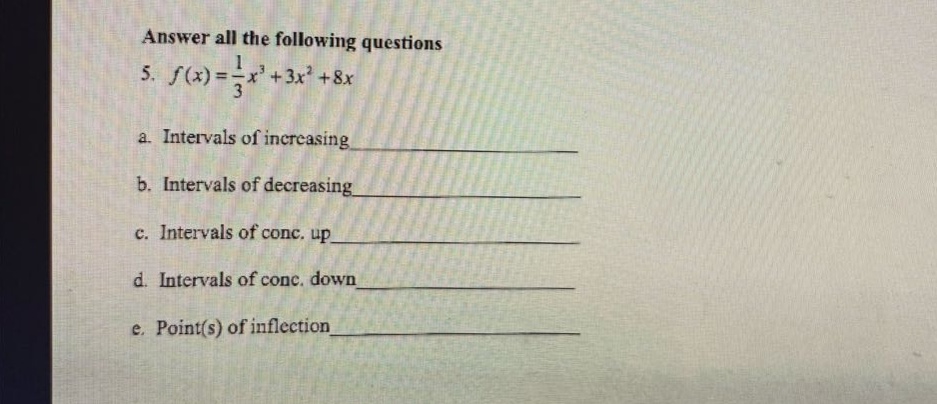
answer all the following questions\n5. $f(x)=\frac{1}{3}x^{3}+3x^{2}+8x$\na. intervals of increasing\n\nb. intervals of decreasing\n\nc. intervals of conc. up\n\nd. intervals of conc. down\n\ne. point(s) of inflection
Answer
Explanation:
Step1: Find the first - derivative
Differentiate $f(x)=\frac{1}{3}x^{3}+3x^{2}+8x$ using the power rule. The power rule states that if $y = ax^{n}$, then $y^\prime=anx^{n - 1}$. $f^\prime(x)=x^{2}+6x + 8$
Step2: Find the critical points
Set $f^\prime(x)=0$. So, $x^{2}+6x + 8 = 0$. Factor the quadratic equation: $(x + 2)(x+4)=0$. The solutions are $x=-2$ and $x=-4$.
Step3: Determine intervals of increasing and decreasing
Test the intervals $(-\infty,-4)$, $(-4,-2)$ and $(-2,\infty)$ using test - points. For $x=-5$ (in the interval $(-\infty,-4)$), $f^\prime(-5)=(-5)^{2}+6(-5)+8=25 - 30 + 8 = 3>0$, so $f(x)$ is increasing on $(-\infty,-4)$. For $x=-3$ (in the interval $(-4,-2)$), $f^\prime(-3)=(-3)^{2}+6(-3)+8=9 - 18 + 8=-1<0$, so $f(x)$ is decreasing on $(-4,-2)$. For $x=0$ (in the interval $(-2,\infty)$), $f^\prime(0)=0^{2}+6(0)+8 = 8>0$, so $f(x)$ is increasing on $(-2,\infty)$.
Step4: Find the second - derivative
Differentiate $f^\prime(x)=x^{2}+6x + 8$ to get $f^{\prime\prime}(x)=2x+6$.
Step5: Find the inflection points
Set $f^{\prime\prime}(x)=0$. So, $2x+6 = 0$, which gives $x=-3$.
Step6: Determine intervals of concavity
Test the intervals $(-\infty,-3)$ and $(-3,\infty)$ using test - points. For $x=-4$ (in the interval $(-\infty,-3)$), $f^{\prime\prime}(-4)=2(-4)+6=-2<0$, so $f(x)$ is concave down on $(-\infty,-3)$. For $x=-2$ (in the interval $(-3,\infty)$), $f^{\prime\prime}(-2)=2(-2)+6 = 2>0$, so $f(x)$ is concave up on $(-3,\infty)$.
Answer:
a. $(-\infty,-4)\cup(-2,\infty)$ b. $(-4,-2)$ c. $(-3,\infty)$ d. $(-\infty,-3)$ e. $x=-3$