answer the following questions for the function f(x)=x√(x² + 25) defined on the interval -4 ≤ x ≤ 4. f(x) is…
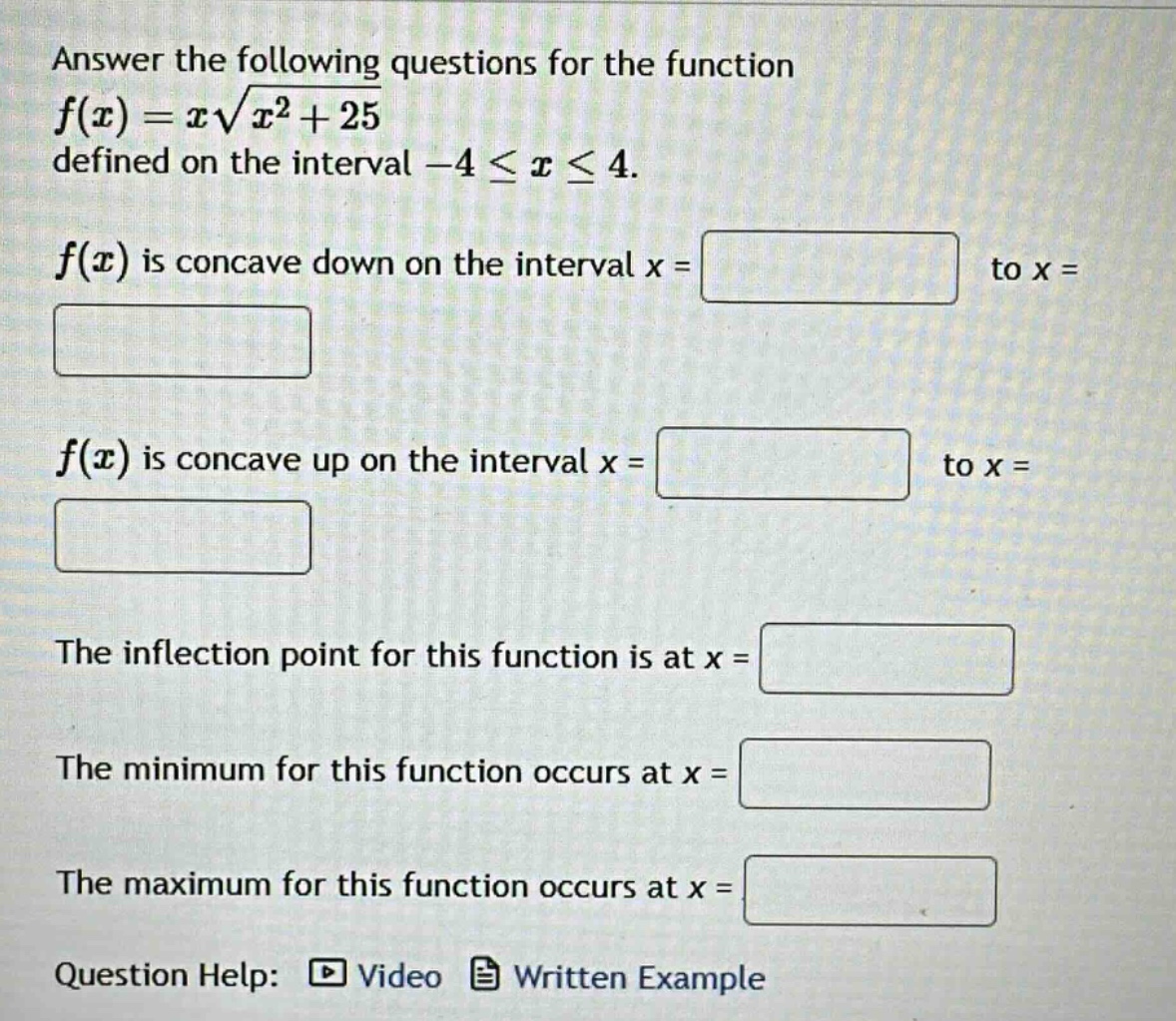
answer the following questions for the function f(x)=x√(x² + 25) defined on the interval -4 ≤ x ≤ 4. f(x) is concave down on the interval x = to x = f(x) is concave up on the interval x = to x = the inflection point for this function is at x = the minimum for this function occurs at x = the maximum for this function occurs at x = question help: video written example
Answer
Explanation:
Step1: Find the first - derivative
Use the product rule $(uv)^\prime = u^\prime v+uv^\prime$, where $u = x$ and $v=\sqrt{x^{2}+25}=(x^{2}+25)^{\frac{1}{2}}$. $u^\prime = 1$, $v^\prime=\frac{1}{2}(x^{2}+25)^{-\frac{1}{2}}\cdot2x=\frac{x}{\sqrt{x^{2}+25}}$. $f^\prime(x)=\sqrt{x^{2}+25}+\frac{x^{2}}{\sqrt{x^{2}+25}}=\frac{x^{2}+25 + x^{2}}{\sqrt{x^{2}+25}}=\frac{2x^{2}+25}{\sqrt{x^{2}+25}}$.
Step2: Find the second - derivative
Use the quotient rule $\left(\frac{u}{v}\right)^\prime=\frac{u^\prime v - uv^\prime}{v^{2}}$, where $u = 2x^{2}+25$, $u^\prime = 4x$, $v=\sqrt{x^{2}+25}$, $v^\prime=\frac{x}{\sqrt{x^{2}+25}}$. $f^{\prime\prime}(x)=\frac{4x\sqrt{x^{2}+25}-\frac{x(2x^{2}+25)}{\sqrt{x^{2}+25}}}{x^{2}+25}=\frac{4x(x^{2}+25)-x(2x^{2}+25)}{(x^{2}+25)^{\frac{3}{2}}}=\frac{4x^{3}+100x - 2x^{3}-25x}{(x^{2}+25)^{\frac{3}{2}}}=\frac{2x^{3}+75x}{(x^{2}+25)^{\frac{3}{2}}}=\frac{x(2x^{2}+75)}{(x^{2}+25)^{\frac{3}{2}}}$.
Step3: Find inflection points
Set $f^{\prime\prime}(x) = 0$. Since $2x^{2}+75>0$ for all real $x$, then $x(2x^{2}+75)=0$ gives $x = 0$.
Step4: Determine concavity
Test intervals in $f^{\prime\prime}(x)$ on the interval $[-4,4]$. For $x\in[-4,0)$, let $x=-1$. Then $f^{\prime\prime}(-1)=\frac{-1(2 + 75)}{(1 + 25)^{\frac{3}{2}}}<0$, so $f(x)$ is concave down on $[-4,0)$. For $x\in(0,4]$, let $x = 1$. Then $f^{\prime\prime}(1)=\frac{1(2 + 75)}{(1+25)^{\frac{3}{2}}}>0$, so $f(x)$ is concave up on $(0,4]$.
Step5: Find critical points of $f(x)$
Set $f^\prime(x)=0$. Since $2x^{2}+25>0$ for all real $x$, $f^\prime(x)$ has no real - valued roots. Evaluate $f(x)$ at the endpoints of the interval $[-4,4]$. $f(-4)=-4\sqrt{16 + 25}=-4\sqrt{41}$, $f(4)=4\sqrt{16 + 25}=4\sqrt{41}$.
Answer:
$f(x)$ is concave down on the interval $x=-4$ to $x = 0$. $f(x)$ is concave up on the interval $x = 0$ to $x = 4$. The inflection point for this function is at $x = 0$. The minimum for this function occurs at $x=-4$. The maximum for this function occurs at $x = 4$.