answer the questions below about the function whose derivative is f(x)=(x - 4)(x + 8)/(x + 2)(x - 5), x≠…
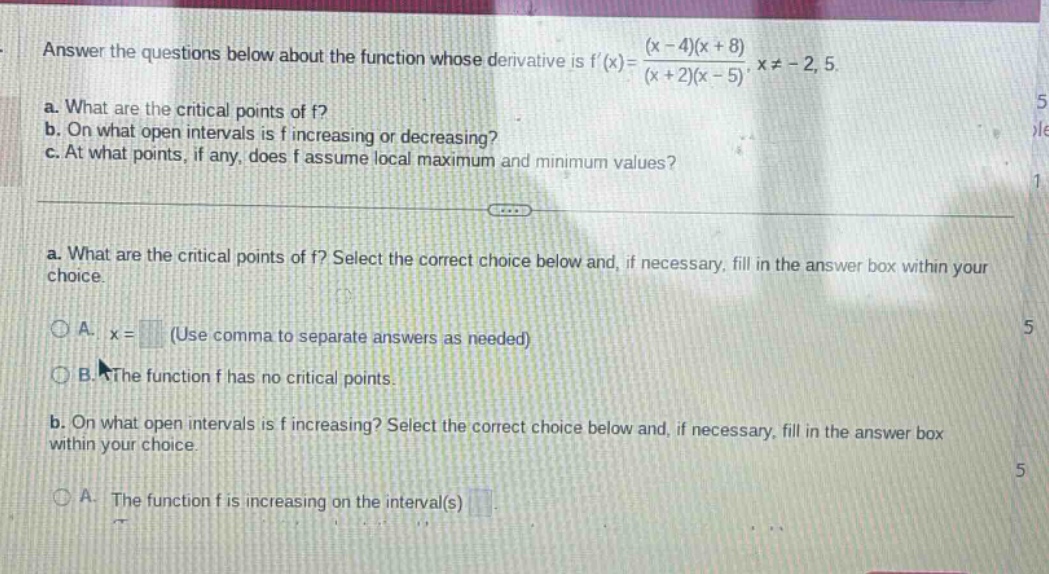
answer the questions below about the function whose derivative is f(x)=(x - 4)(x + 8)/(x + 2)(x - 5), x≠ - 2,5. a. what are the critical points of f? b. on what open intervals is f increasing or decreasing? c. at what points, if any, does f assume local maximum and minimum values? a. what are the critical points of f? select the correct choice below and, if necessary, fill in the answer box within your choice. a. x = (use comma to separate answers as needed) b. the function f has no critical points. b. on what open intervals is f increasing? select the correct choice below and, if necessary, fill in the answer box within your choice. a. the function f is increasing on the interval(s)
Answer
Explanation:
Step1: Find critical points
Set $f^{\prime}(x) = 0$, so $(x - 4)(x + 8)=0$. Also consider where $f^{\prime}(x)$ is undefined. $(x - 4)(x + 8)=0$ gives $x=4$ or $x=-8$. $f^{\prime}(x)$ is undefined at $x=-2$ and $x = 5$, but these are not in the domain of $f^{\prime}(x)$ where we are looking for critical - points from $f^{\prime}(x)=0$. So the critical points are $x=-8,4$.
Step2: Determine intervals of increase and decrease
Use test points in the intervals $(-\infty,-8)$, $(-8,4)$, and $(4,\infty)$. For the interval $(-\infty,-8)$, let $x=-9$. Then $f^{\prime}(-9)=\frac{(-9 - 4)(-9 + 8)}{(-9+2)(-9 - 5)}=\frac{(-13)(-1)}{(-7)(-14)}=\frac{13}{98}>0$, so $f$ is increasing on $(-\infty,-8)$. For the interval $(-8,4)$, let $x = 0$. Then $f^{\prime}(0)=\frac{(0 - 4)(0 + 8)}{(0 + 2)(0 - 5)}=\frac{(-4)\times8}{2\times(-5)}=\frac{-32}{-10}=\frac{16}{5}>0$, so $f$ is increasing on $(-8,4)$. For the interval $(4,\infty)$, let $x=5$. Then $f^{\prime}(x)$ is undefined at $x = 5$. Let $x=6$. Then $f^{\prime}(6)=\frac{(6 - 4)(6 + 8)}{(6 + 2)(6 - 5)}=\frac{2\times14}{8\times1}=\frac{7}{2}>0$, so $f$ is increasing on $(4,\infty)$. Since $f$ is increasing on $(-\infty,-8)\cup(-8,4)\cup(4,\infty)$, there are no local maximum or minimum values.
Step3: Answer part a
The critical points of $f$ are $x=-8,4$.
Step4: Answer part b
The function $f$ is increasing on $(-\infty,-8)\cup(-8,4)\cup(4,\infty)$.
Step5: Answer part c
The function $f$ has no local maximum or minimum values.
Answer:
a. $x=-8,4$ b. The function $f$ is increasing on $(-\infty,-8)\cup(-8,4)\cup(4,\infty)$ c. The function $f$ has no local maximum or minimum values.