answer as (x\rightarrowinfty,f(x)\rightarrowinfty) and as (x\rightarrow-infty,f(x)\rightarrowinfty) as…
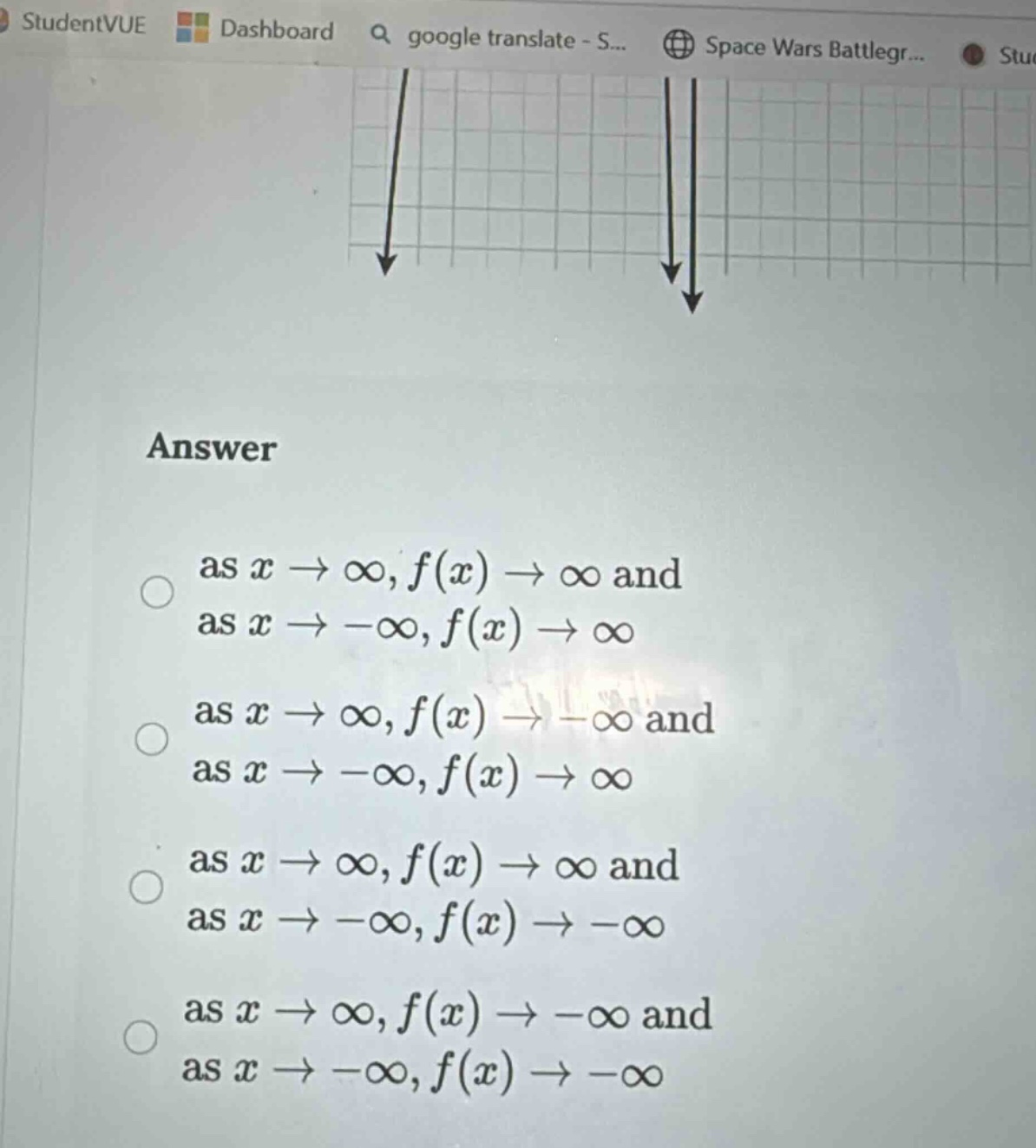
answer as (x\rightarrowinfty,f(x)\rightarrowinfty) and as (x\rightarrow-infty,f(x)\rightarrowinfty) as (x\rightarrowinfty,f(x)\rightarrow-infty) and as (x\rightarrow-infty,f(x)\rightarrowinfty) as (x\rightarrowinfty,f(x)\rightarrowinfty) and as (x\rightarrow-infty,f(x)\rightarrow-infty) as (x\rightarrowinfty,f(x)\rightarrow-infty) and as (x\rightarrow-infty,f(x)\rightarrow-infty)
Answer
Explanation:
Step1: Analyze end - behavior from graph
The arrows on the graph show that as (x) increases (moves to the right, (x\rightarrow\infty)), the function (y = f(x)) decreases (moves downwards, (f(x)\rightarrow-\infty)). Also, as (x) decreases (moves to the left, (x\rightarrow-\infty)), the function (y = f(x)) decreases (moves downwards, (f(x)\rightarrow-\infty)).
Answer:
as (x\rightarrow\infty), (f(x)\rightarrow-\infty) and as (x\rightarrow-\infty), (f(x)\rightarrow-\infty)