ap calculus ab\ncalculator required\nfrq: rate in / rate out\nversion b\npeople enter a line for an…
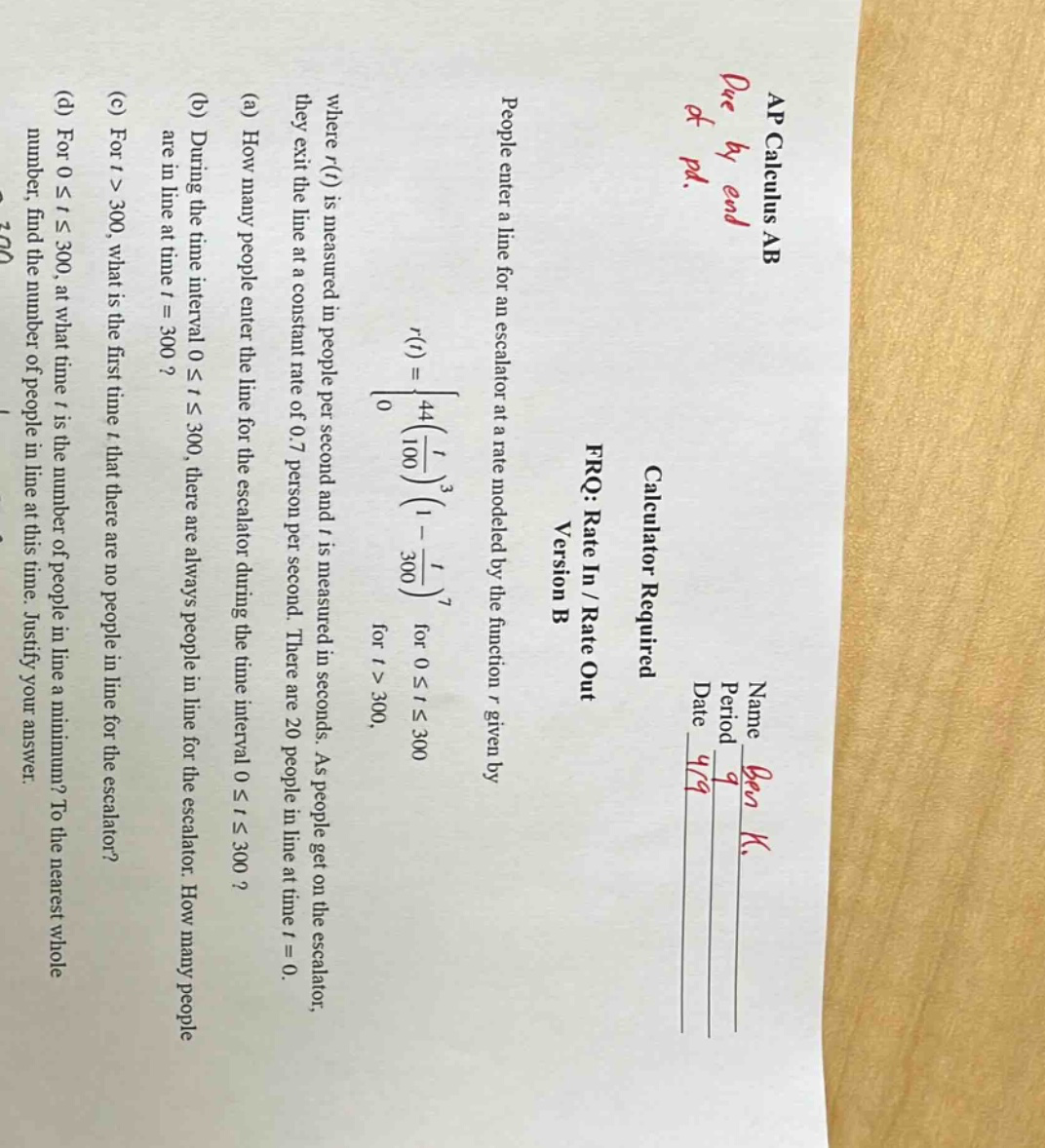
ap calculus ab\ncalculator required\nfrq: rate in / rate out\nversion b\npeople enter a line for an escalator at a rate modeled by the function r given by\nr(t) = { 44(1 - (t / 300)^3) for 0 ≤ t ≤ 300, 0 for t > 300 }\nwhere r(t) is measured in people per second and t is measured in seconds. as people get on the escalator,\nthey exit the line at a constant rate of 0.7 person per second. there are 20 people in line at time t = 0.\n(a) how many people enter the line for the escalator during the time interval 0 ≤ t ≤ 300?\n(b) during the time interval 0 ≤ t ≤ 300, there are always people in line for the escalator. how many people\nare in line at time t = 300?\n(c) for t > 300, what is the first time t that there are no people in line for the escalator?\n(d) for 0 ≤ t ≤ 300, at what time t is the number of people in line a minimum? to the nearest whole\nnumber, find the number of people in line at this time. justify your answer.
Answer
Explanation:
Step1: Find the number of people who enter in 0 ≤ t ≤ 300
We use the definite - integral formula for the rate function. The number of people (N_1) who enter the line in the time interval ([0,300]) is given by (\int_{0}^{300}r(t)dt). Here, (r(t) = 44\left(\frac{1}{100}\right)t^{3}\left(1-\frac{1}{300}t\right)^{7}) for (0\leq t\leq300). Using a calculator with integral - calculation capabilities (since the integral is non - elementary), (\int_{0}^{300}44\left(\frac{1}{100}\right)t^{3}\left(1 - \frac{1}{300}t\right)^{7}dt). Let (u=1-\frac{1}{300}t), then (t = 300(1 - u)) and (dt=-300du). When (t = 0), (u = 1); when (t = 300), (u = 0). The integral becomes (\int_{1}^{0}44\times\frac{1}{100}\times300^{3}(1 - u)^{3}u^{7}\times(- 300)du=\int_{0}^{1}44\times300^{4}\times(1 - u)^{3}u^{7}du). Using the beta - function or a calculator, we find that (\int_{0}^{300}r(t)dt = 1100).
Step2: Find the number of people who exit in 0 ≤ t ≤ 300
People exit at a constant rate of (0.7) person per second for (300) seconds. The number of people (N_2) who exit is (0.7\times300=210). The number of people in line at (t = 300) is (N = 20+N_1 - N_2) (since there were 20 people in line at (t = 0)). So (N=20 + 1100-210=910).
Step3: For (t>300), (r(t)=0)
The number of people in line is decreasing at a rate of (0.7) person per second. Let (t) be the time after (t = 300) when the number of people in line is 0. We set up the equation (910-0.7t = 0), then (t=\frac{910}{0.7}=1300). The total time (T) when there are no people in line is (300 + 1300=1600) seconds.
Step4: To find the minimum number of people in line
We know that the rate of change of the number of people in line (L(t)) is (L^\prime(t)=r(t)-0.7). We already know the behavior of (r(t)). The number of people in line at (t = 0) is (L(0)=20). After (t = 300), the number of people in line is decreasing linearly with a slope of (- 0.7). Since the number of people in line is increasing from (t = 0) to (t = 300) (because (r(t)>0.7) on average in ([0,300])) and then decreasing, the minimum number of people in line is 0 (when all people have left the line at (t = 1600)).
Answer:
(a) 1100 people enter the line in the time interval (0\leq t\leq300). (b) 910 people are in line at (t = 300). (c) (t = 1600) seconds is the first time there are no people in line for the escalator. (d) The minimum number of people in line is 0.