ap calculus bc mcq practice test b\n14. the polynomial function f has selected values of its second…
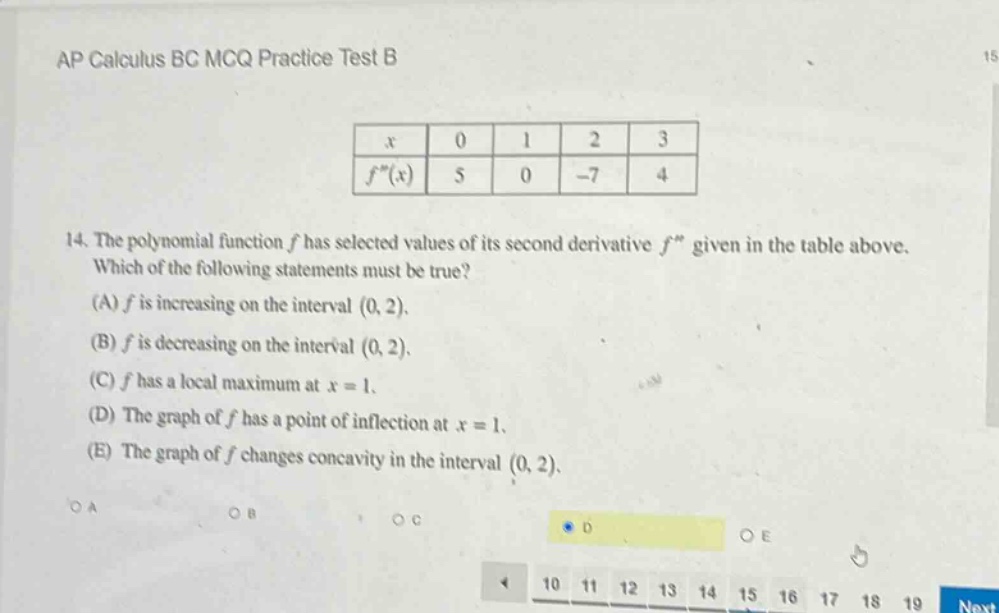
ap calculus bc mcq practice test b\n14. the polynomial function f has selected values of its second - derivative f given in the table above. which of the following statements must be true? (a) f is increasing on the interval (0, 2). (b) f is decreasing on the interval (0, 2). (c) f has a local maximum at x = 1. (d) the graph of f has a point of inflection at x = 1. (e) the graph of f changes concavity in the interval (0, 2).
Answer
Explanation:
Step1: Recall concavity and inflection - point concepts
The sign of the second - derivative $f''(x)$ determines the concavity of the function $y = f(x)$. If $f''(x)>0$, the function is concave up; if $f''(x)<0$, the function is concave down. An inflection point occurs where the concavity changes, i.e., where $f''(x)$ changes sign.
Step2: Analyze the values of $f''(x)$ in the interval $(0,2)$
We are given that $f''(0)=5>0$ and $f''(2)= - 7<0$. Since $f''(x)$ is a polynomial (because $f(x)$ is a polynomial), $f''(x)$ is continuous. By the Intermediate - Value Theorem, there must be a value $c\in(0,2)$ such that $f''(c) = 0$, and the concavity of $f(x)$ changes in the interval $(0,2)$.
Step3: Analyze each option
- Option A: The sign of $f'(x)$ determines if $f(x)$ is increasing or decreasing. We only know the sign of $f''(x)$, not $f'(x)$, so we cannot say that $f$ is increasing on $(0,2)$.
- Option B: Similarly, we cannot say that $f$ is decreasing on $(0,2)$ based on the sign of $f''(x)$.
- Option C: A local maximum occurs where $f'(x)$ changes from positive to negative. We do not have information about $f'(x)$ from the values of $f''(x)$ alone.
- Option D: Just because $f''(1) = 0$ does not necessarily mean there is an inflection point at $x = 1$. We need $f''(x)$ to change sign at $x = 1$. We don't know the sign of $f''(x)$ in a neighborhood of $x = 1$ other than the given points.
- Option E: Since $f''(0)=5>0$ and $f''(2)= - 7<0$ and $f''(x)$ is continuous (because $f(x)$ is a polynomial), the graph of $f$ changes concavity in the interval $(0,2)$.
Answer:
E