ap calculus bc mcq practice test b\n15. if f(x)=(ln x)^2, then f(√e)=\n(a) 1/e (b) 2/e (c) 1/(2√e) (d) 1/√e…
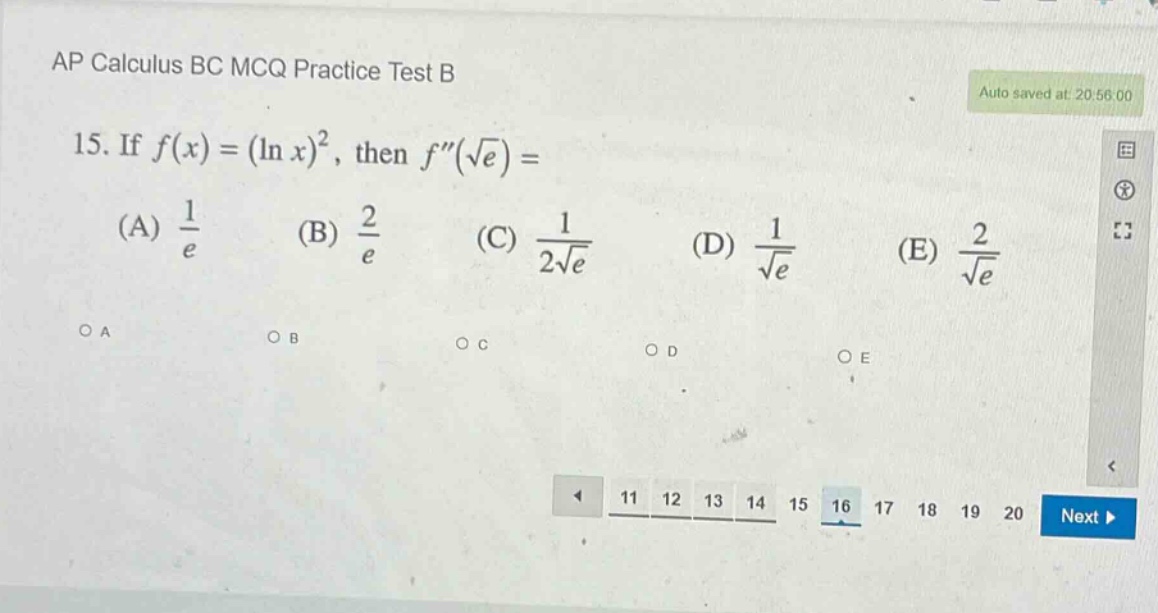
ap calculus bc mcq practice test b\n15. if f(x)=(ln x)^2, then f(√e)=\n(a) 1/e (b) 2/e (c) 1/(2√e) (d) 1/√e (e) 2/√e\n○a ○b ○c ○d ○e\n11 12 13 14 15 16 17 18 19 20 next
Answer
Explanation:
Step1: Find the first - derivative
Use the chain rule. If $y = u^{2}$ and $u=\ln x$, then $\frac{dy}{du} = 2u$ and $\frac{du}{dx}=\frac{1}{x}$. By the chain - rule $\frac{dy}{dx}=\frac{dy}{du}\cdot\frac{du}{dx}$. So $f^\prime(x)=2\ln x\cdot\frac{1}{x}=\frac{2\ln x}{x}$.
Step2: Find the second - derivative
Use the quotient rule $\left(\frac{u}{v}\right)^\prime=\frac{u^\prime v - uv^\prime}{v^{2}}$, where $u = 2\ln x$, $u^\prime=\frac{2}{x}$, and $v = x$, $v^\prime = 1$. Then $f^{\prime\prime}(x)=\frac{\frac{2}{x}\cdot x-2\ln x\cdot1}{x^{2}}=\frac{2 - 2\ln x}{x^{2}}$.
Step3: Evaluate at $x = \sqrt{e}$
Substitute $x=\sqrt{e}$ into $f^{\prime\prime}(x)$. Since $\ln\sqrt{e}=\frac{1}{2}$, then $f^{\prime\prime}(\sqrt{e})=\frac{2-2\times\frac{1}{2}}{(\sqrt{e})^{2}}=\frac{2 - 1}{e}=\frac{1}{e}$.
Answer:
A. $\frac{1}{e}$