ap calculus bc mcq practice test b\n17. let h be a differentiable function, and let f be the function…
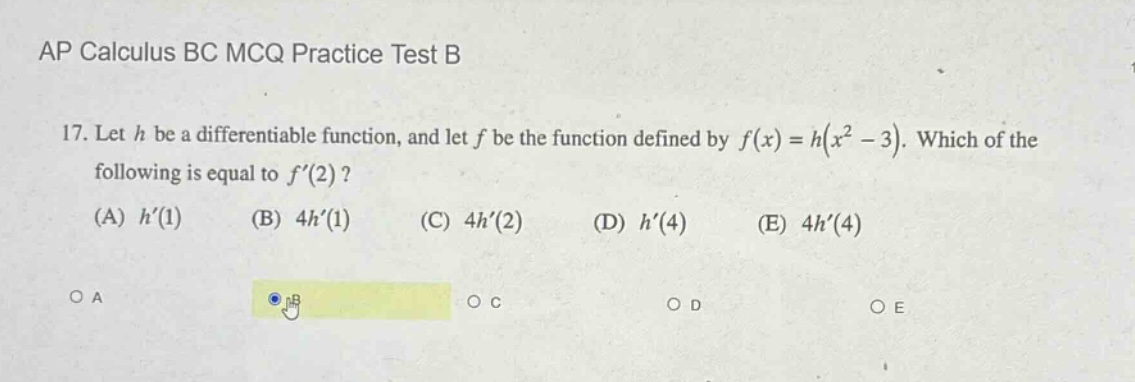
ap calculus bc mcq practice test b\n17. let h be a differentiable function, and let f be the function defined by f(x)=h(x² - 3). which of the following is equal to f(2)?\n(a) h(1) (b) 4h(1) (c) 4h(2) (d) h(4) (e) 4h(4)\no a o b o c o d o e
Answer
Explanation:
Step1: Apply chain - rule
The chain - rule states that if $y = f(u)$ and $u = g(x)$, then $y^\prime=f^\prime(u)\cdot g^\prime(x)$. Here, let $u = x^{2}-3$, so $f(x)=h(u)$ and $u = x^{2}-3$. Then $f^\prime(x)=h^\prime(u)\cdot u^\prime$. Since $u^\prime=\frac{d}{dx}(x^{2}-3)=2x$, we have $f^\prime(x)=h^\prime(x^{2}-3)\cdot2x$.
Step2: Evaluate $f^\prime(2)$
Substitute $x = 2$ into $f^\prime(x)$. When $x = 2$, $u=x^{2}-3=2^{2}-3 = 1$, and $f^\prime(2)=h^\prime(2^{2}-3)\cdot2\times2$. So $f^\prime(2)=h^\prime(1)\cdot4 = 4h^\prime(1)$.
Answer:
B. $4h^\prime(1)$