ap calculus bc mcq practice test b\n24. which of the following differential equations for a population p…
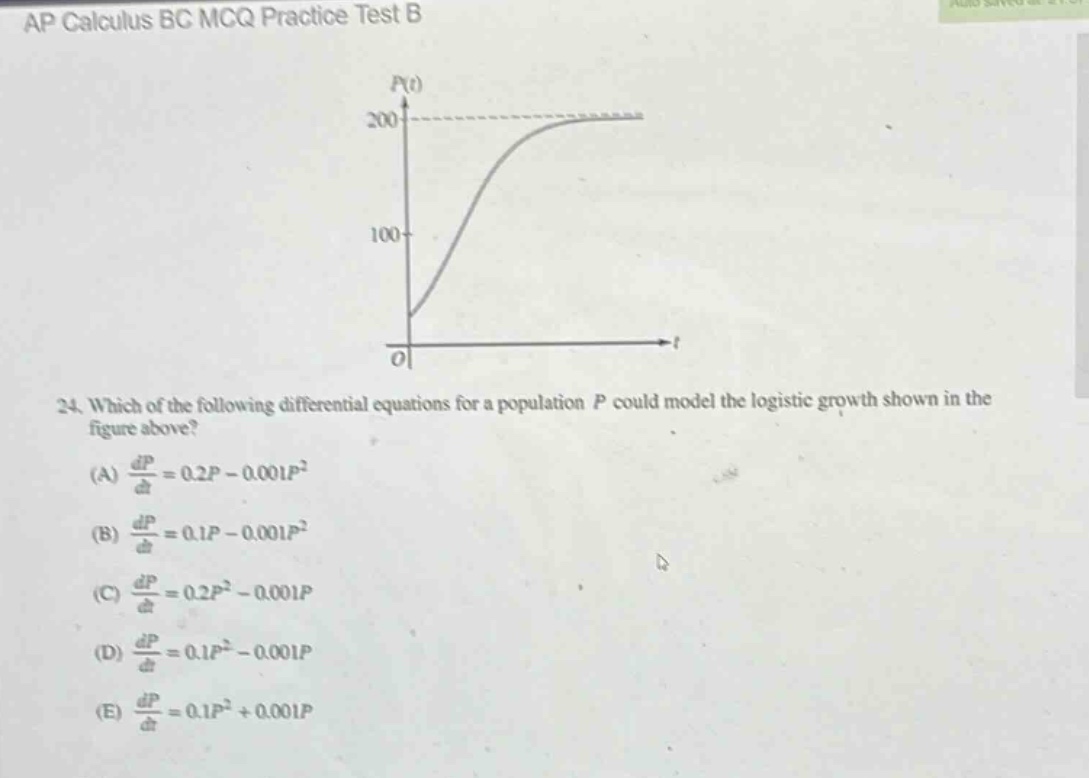
ap calculus bc mcq practice test b\n24. which of the following differential equations for a population p could model the logistic growth shown in the figure above?\n(a) dp/dt = 0.2p - 0.001p²\n(b) dp/dt = 0.1p - 0.001p²\n(c) dp/dt = 0.2p² - 0.001p\n(d) dp/dt = 0.1p² - 0.001p\n(e) dp/dt = 0.1p² + 0.001p
Answer
Explanation:
Step1: Recall logistic - growth formula
The general form of the logistic - growth differential equation is $\frac{dP}{dt}=kP(1 - \frac{P}{L})=\ kP-\frac{k}{L}P^{2}$, where $k$ is the growth rate constant and $L$ is the carrying capacity.
Step2: Identify the carrying capacity from the graph
From the graph, the carrying capacity $L = 200$ (the value that $P(t)$ approaches as $t\rightarrow\infty$).
Step3: Rewrite the logistic - growth formula
Substituting $L = 200$ into $\frac{dP}{dt}=kP-\frac{k}{L}P^{2}$, we get $\frac{dP}{dt}=kP-\frac{k}{200}P^{2}$.
Step4: Check each option
For option (A): $\frac{dP}{dt}=0.2P - 0.001P^{2}$, where $k = 0.2$ and $\frac{k}{200}=\frac{0.2}{200}=0.001$. This equation is in the correct form of the logistic - growth differential equation. For option (B): $\frac{dP}{dt}=0.1P - 0.001P^{2}$, if $\frac{k}{200}=0.001$, then $k = 0.2\neq0.1$. For option (C): $\frac{dP}{dt}=0.2P^{2}-0.001P$ is not in the form of the logistic - growth differential equation $\frac{dP}{dt}=kP-\frac{k}{L}P^{2}$. For option (D): $\frac{dP}{dt}=0.1P^{2}-0.001P$ is not in the form of the logistic - growth differential equation $\frac{dP}{dt}=kP-\frac{k}{L}P^{2}$. For option (E): $\frac{dP}{dt}=0.1P^{2}+0.001P$ is not in the form of the logistic - growth differential equation $\frac{dP}{dt}=kP-\frac{k}{L}P^{2}$.
Answer:
A. $\frac{dP}{dt}=0.2P - 0.001P^{2}$