ap calculus bc mcq practice test b\n85. a particle moves on the x - axis with velocity given by v(t)=3t^4…
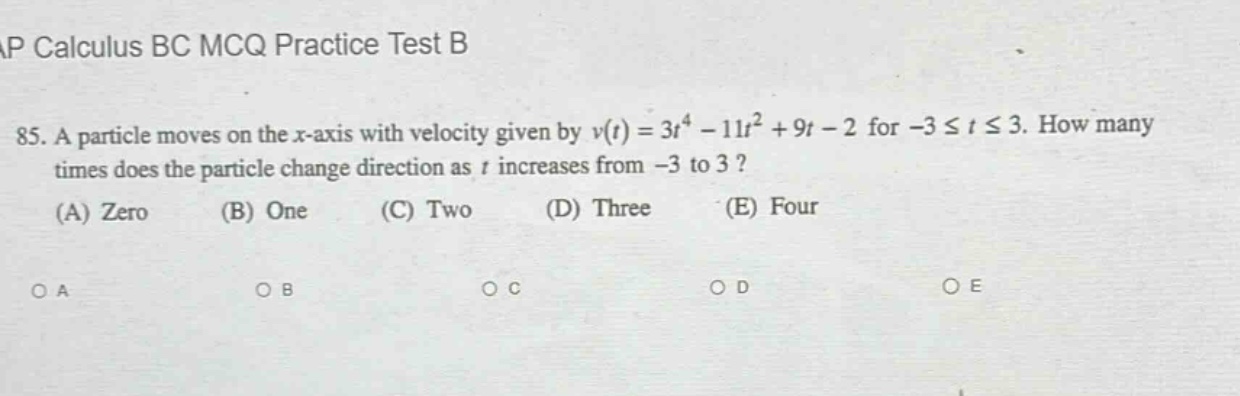
ap calculus bc mcq practice test b\n85. a particle moves on the x - axis with velocity given by v(t)=3t^4 - 11t^2 + 9t - 2 for - 3 ≤ t ≤ 3. how many times does the particle change direction as t increases from - 3 to 3?\n(a) zero (b) one (c) two (d) three (e) four\noa ob oc od oe
Answer
Explanation:
Step1: Recall the condition for direction - change
The particle changes direction when the velocity function $v(t)$ changes sign. This occurs when $v(t)=0$. So, we need to find the roots of the equation $v(t)=3t^{4}-11t^{2}+9t - 2 = 0$ in the interval $[-3,3]$.
Step2: Try some simple values of $t$
Let's try some simple values of $t$ like $t = 0,1,- 1$ etc. When $t = 1$, $v(1)=3\times1^{4}-11\times1^{2}+9\times1 - 2=3 - 11 + 9 - 2=-1$. When $t = 2$, $v(2)=3\times2^{4}-11\times2^{2}+9\times2 - 2=3\times16-11\times4 + 18 - 2=48-44 + 18 - 2=20$. Since $v(1)<0$ and $v(2)>0$, by the Intermediate - Value Theorem, there is a root of $v(t)$ in the interval $(1,2)$.
Step3: Analyze the derivative of $v(t)$
First, find the derivative $v^\prime(t)=12t^{3}-22t + 9$. We can also use a graphing utility or continue to test values. By testing more values or using a graphing calculator, we find that $v(t)$ has three roots in the interval $[-3,3]$. Each root of $v(t)$ where the sign changes corresponds to a direction - change of the particle.
Answer:
D. Three