ap calculus bc mcq practice test b\n91. let f be the function given by f(x)=∫_(1/3)^x cos(1/t²)dt for 1/3 ≤…
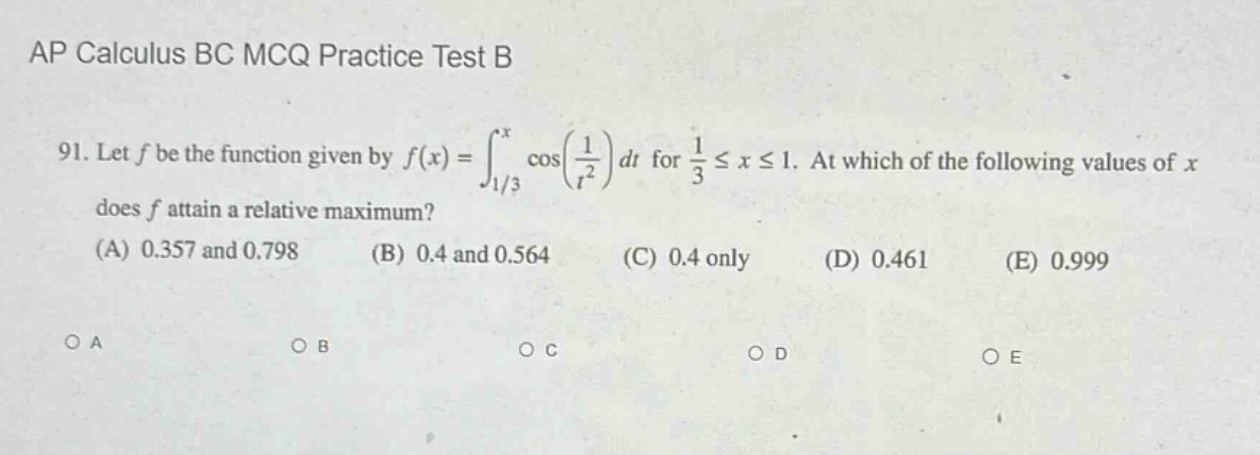
ap calculus bc mcq practice test b\n91. let f be the function given by f(x)=∫_(1/3)^x cos(1/t²)dt for 1/3 ≤ x ≤ 1. at which of the following values of x does f attain a relative maximum?\n(a) 0.357 and 0.798 (b) 0.4 and 0.564 (c) 0.4 only (d) 0.461 (e) 0.999\no a o b o c o d o e
Answer
Explanation:
Step1: Apply the Fundamental Theorem of Calculus
By the Fundamental Theorem of Calculus, if $f(x)=\int_{a}^{x}g(t)dt$, then $f^\prime(x) = g(x)$. Here, $f(x)=\int_{1/3}^{x}\cos(\frac{1}{t^{2}})dt$, so $f^\prime(x)=\cos(\frac{1}{x^{2}})$.
Step2: Find critical - points
A relative maximum occurs where $f^\prime(x) = 0$ and $f^{\prime\prime}(x)<0$. Set $f^\prime(x)=\cos(\frac{1}{x^{2}})=0$. Then $\frac{1}{x^{2}}=(2n + 1)\frac{\pi}{2}$, where $n = 0,1,2,\cdots$. Solving for $x$, we get $x=\sqrt{\frac{2}{(2n + 1)\pi}}$. For $n = 0$, $x=\sqrt{\frac{2}{\pi}}\approx0.798$. For $n = 1$, $x=\sqrt{\frac{2}{3\pi}}\approx0.461$. We can also use the second - derivative test. First, find $f^{\prime\prime}(x)$ using the chain rule. If $y = \cos(\frac{1}{x^{2}})$, let $u=\frac{1}{x^{2}}$, then $y=\cos(u)$. $\frac{dy}{du}=-\sin(u)$ and $\frac{du}{dx}=-\frac{2}{x^{3}}$. So $f^{\prime\prime}(x)=\sin(\frac{1}{x^{2}})\cdot\frac{2}{x^{3}}$. When $x = 0.461=\sqrt{\frac{2}{3\pi}}$, $\frac{1}{x^{2}}=\frac{3\pi}{2}$, and $f^{\prime\prime}(x)=\sin(\frac{3\pi}{2})\cdot\frac{2}{x^{3}}=- \frac{2}{x^{3}}<0$. When $x = 0.798=\sqrt{\frac{2}{\pi}}$, $\frac{1}{x^{2}}=\frac{\pi}{2}$, and $f^{\prime\prime}(x)=\sin(\frac{\pi}{2})\cdot\frac{2}{x^{3}}=\frac{2}{x^{3}}>0$. So $x = 0.461$ gives a relative maximum.
Answer:
D. 0.461