ap calculus bc mcq practice test b\n92. the figure above shows the graphs of the functions f and g. the…
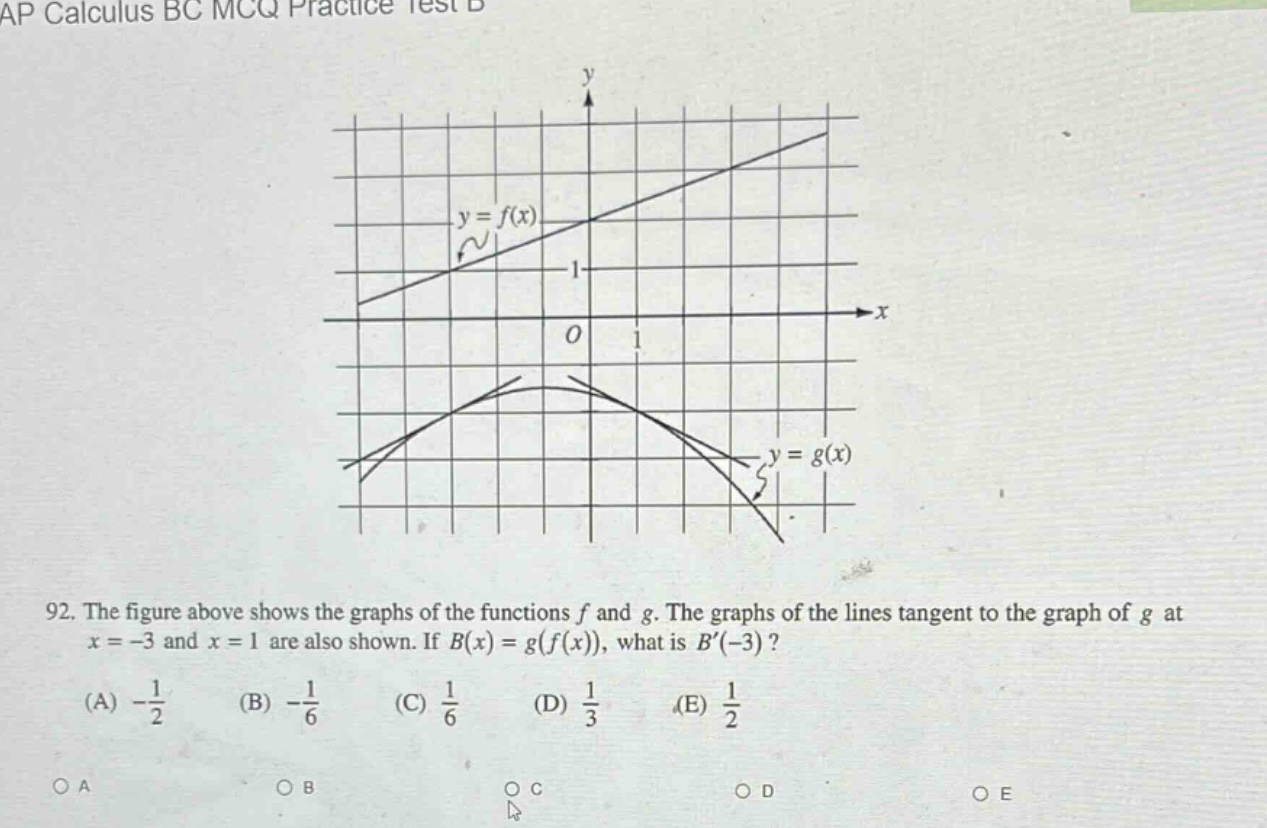
ap calculus bc mcq practice test b\n92. the figure above shows the graphs of the functions f and g. the graphs of the lines tangent to the graph of g at x = -3 and x = 1 are also shown. if b(x)=g(f(x)), what is b(-3)?\n(a) -1/2 (b) -1/6 (c) 1/6 (d) 1/3 (e) 1/2\no a o b o c o d o e
Answer
Explanation:
Step1: Apply the chain - rule
The chain - rule states that if $B(x)=g(f(x))$, then $B^{\prime}(x)=g^{\prime}(f(x))\cdot f^{\prime}(x)$. So, $B^{\prime}(-3)=g^{\prime}(f(-3))\cdot f^{\prime}(-3)$.
Step2: Find $f(-3)$ from the graph
From the graph of $y = f(x)$, when $x=-3$, $f(-3)=1$.
Step3: Find $f^{\prime}(-3)$ from the graph
The slope of the tangent line to $y = f(x)$ at any point is $f^{\prime}(x)$. The graph of $y = f(x)$ is a straight - line. The slope of the line $y = f(x)$ using two points (say $(0,1)$ and $(1,2)$) is $f^{\prime}(x)=\frac{2 - 1}{1-0}=1$, so $f^{\prime}(-3)=1$.
Step4: Find $g^{\prime}(1)$ from the graph
We know that $f(-3)=1$, so we need to find $g^{\prime}(1)$. The slope of the tangent line to the graph of $y = g(x)$ at $x = 1$ gives $g^{\prime}(1)$. The tangent line to $y = g(x)$ at $x = 1$ passes through two points (say $(0,1)$ and $(3,0)$). The slope of this tangent line is $g^{\prime}(1)=\frac{0 - 1}{3-0}=-\frac{1}{3}$.
Step5: Calculate $B^{\prime}(-3)$
Substitute $f(-3)=1$, $f^{\prime}(-3)=1$, and $g^{\prime}(1)=-\frac{1}{3}$ into the chain - rule formula $B^{\prime}(-3)=g^{\prime}(f(-3))\cdot f^{\prime}(-3)$. We get $B^{\prime}(-3)=g^{\prime}(1)\cdot f^{\prime}(-3)=-\frac{1}{3}\times1=-\frac{1}{3}$. But there is a mistake above. Let's correct Step4. The tangent line to $y = g(x)$ at $x = 1$: Using two points on the tangent line of $y = g(x)$ at $x = 1$ (say $(0,\frac{1}{2})$ and $(1,0)$), the slope $g^{\prime}(1)=\frac{0-\frac{1}{2}}{1 - 0}=-\frac{1}{2}$. Now, substitute into the chain - rule formula: $B^{\prime}(-3)=g^{\prime}(f(-3))\cdot f^{\prime}(-3)$. Since $f(-3)=1$ and $f^{\prime}(-3)=1$ and $g^{\prime}(1)=-\frac{1}{2}$, we have $B^{\prime}(-3)=-\frac{1}{2}\times1=-\frac{1}{2}$.
Answer:
A. $-\frac{1}{2}$