ap precalculus\n1. let f(x)=sec(1/2 x). which of the following is a vertical asymptote on the graph of f?\na…
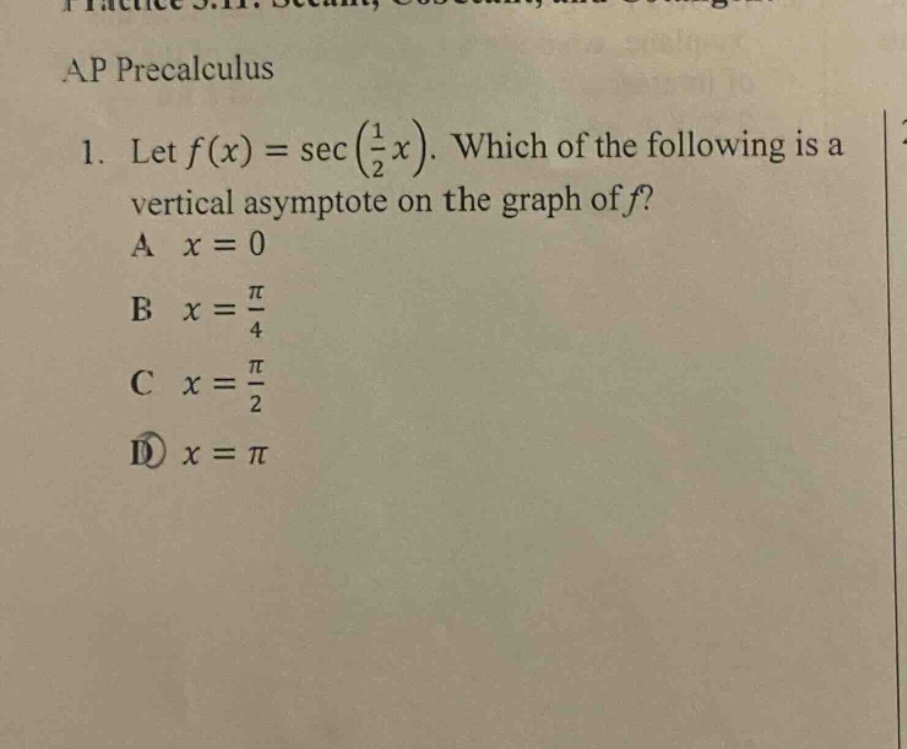
ap precalculus\n1. let f(x)=sec(1/2 x). which of the following is a vertical asymptote on the graph of f?\na x = 0\nb x = π/4\nc x = π/2\nd x = π
Answer
Explanation:
Step1: Recall secant - cosine relationship
The secant function is defined as $\sec t=\frac{1}{\cos t}$. So, $f(x)=\sec(\frac{1}{2}x)=\frac{1}{\cos(\frac{1}{2}x)}$.
Step2: Find when cosine is zero
Vertical asymptotes of $y = f(x)$ occur when $\cos(\frac{1}{2}x)=0$. We know that $\cos t = 0$ when $t=(2n + 1)\frac{\pi}{2},n\in\mathbb{Z}$. Let $t=\frac{1}{2}x$, then $\frac{1}{2}x=(2n + 1)\frac{\pi}{2}$.
Step3: Solve for x
Multiply both sides of the equation $\frac{1}{2}x=(2n + 1)\frac{\pi}{2}$ by 2 to get $x=(2n + 1)\pi$. When $n = 0$, $x=\pi$.
Answer:
D. $x=\pi$