ap precalculus - mixed six - unit 3 review\nno calculator\nthree functions f, g, and h are introduced in #1…
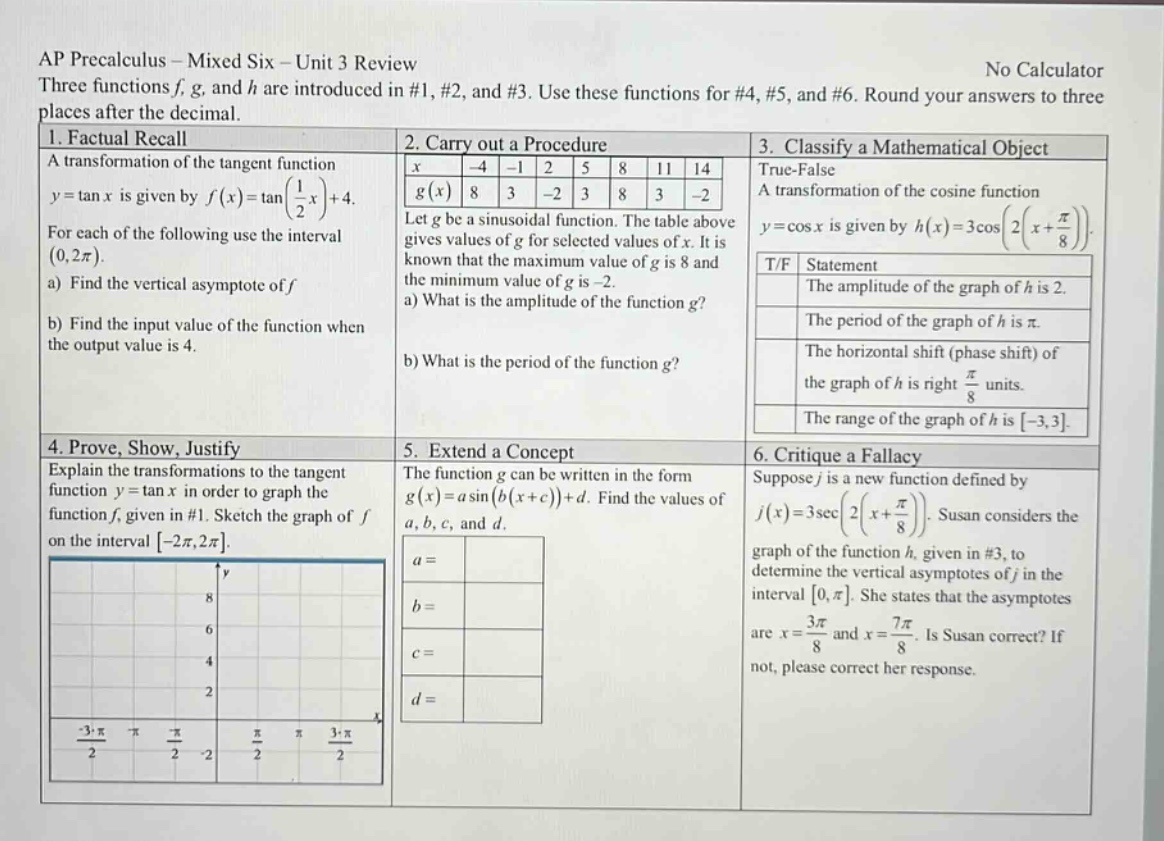
ap precalculus - mixed six - unit 3 review\nno calculator\nthree functions f, g, and h are introduced in #1, #2, and #3. use these functions for #4, #5, and #6. round your answers to three places after the decimal.\n1. factual recall\na transformation of the tangent function\n$y = \\tan x$ is given by $f(x)=\\tan(\\frac{1}{2}x)+4$.\nfor each of the following use the interval $(0,2\\pi)$.\na) find the vertical asymptote of f\nb) find the input value of the function when the output value is 4.\n2. carry out a procedure\nlet g be a sinusoidal function. the table above gives values of g for selected values of x. it is known that the maximum value of g is 8 and the minimum value of g is - 2.\na) what is the amplitude of the function g?\nb) what is the period of the function g?\n3. classify a mathematical object\ntrue - false\na transformation of the cosine function\n$y = \\cos x$ is given by $h(x)=3\\cos(2(x + \\frac{\\pi}{8}))$.\nt/f statement\nthe amplitude of the graph of h is 2.\nthe period of the graph of h is $\\pi$.\nthe horizontal shift (phase shift) of the graph of h is right $\\frac{\\pi}{8}$ units.\nthe range of the graph of h is $-3,3$.\n4. prove, show, justify\nexplain the transformations to the tangent function y = tan x in order to graph the function f, given in #1. sketch the graph of f on the interval $-2\\pi,2\\pi$.\n5. extend a concept\nthe function g can be written in the form $g(x)=a\\sin(b(x + c))+d$. find the values of a, b, c, and d.\n$a =$\n$b =$\n$c =$\n$d =$\n6. critique a fallacy\nsuppose j is a new function defined by $j(x)=3\\sec(2(x + \\frac{\\pi}{8}))$. susan considers the graph of the function h, given in #3, to determine the vertical asymptotes of j in the interval $0,\\pi$. she states that the asymptotes are $x = \\frac{3\\pi}{8}$ and $x = \\frac{7\\pi}{8}$. is susan correct? if not, please correct her response.
Answer
Explanation:
Step1: Recall vertical - asymptote formula for tangent function
The vertical asymptotes of (y = \tan(kx)) occur at (kx=\frac{\pi}{2}+n\pi), (n\in\mathbb{Z}). For (f(x)=\tan(\frac{1}{2}x)+4), we set (\frac{1}{2}x=\frac{\pi}{2}+n\pi). Solving for (x) gives (x=\pi + 2n\pi). In the interval ((0,2\pi)), when (n = 0), (x=\pi).
Step2: Solve for input when output is 4
Set (f(x)=4), so (\tan(\frac{1}{2}x)+4 = 4), then (\tan(\frac{1}{2}x)=0). The solutions of (\tan t = 0) are (t=n\pi), (n\in\mathbb{Z}). So (\frac{1}{2}x=n\pi), and (x = 2n\pi). In the interval ((0,2\pi)), when (n = 1), (x = 2\pi) (but this is not in the open - interval ((0,2\pi)), when (n=0), there is no solution in the open interval ((0,2\pi))).
Answer:
a) (x=\pi) b) No solution in ((0,2\pi))
Explanation:
Step1: Calculate amplitude of (g(x))
The amplitude (A) of a sinusoidal function (y = A\sin(bx + c)+d) is given by (A=\frac{\text{Max}-\text{Min}}{2}). Given (\text{Max}(g)=8) and (\text{Min}(g)=- 2), then (A=\frac{8 - (-2)}{2}=\frac{10}{2}=5).
Step2: Find the period of (g(x))
The period of a sinusoidal function can be found by looking at the (x) - values where the function repeats. From the table, the function (g(x)) has a pattern that repeats every (6) units of (x) (e.g., from (x=-4) to (x = 2), (g(-4)=8) and (g(2)= - 2), and from (x = 2) to (x=8), the pattern repeats). So the period (T = 6).
Answer:
a) (5) b) (6)
Explanation:
Step1: Recall amplitude formula for (y = A\cos(Bx + C))
For the function (h(x)=3\cos(2(x+\frac{\pi}{8}))), the amplitude (A) is the absolute value of the coefficient of the cosine function. So (A = 3), not (2), so the statement "The amplitude of the graph of (h) is (2)" is False.
Step2: Recall period formula for (y = A\cos(Bx + C))
The period (T) of (y=\cos(Bx)) is (T=\frac{2\pi}{B}). For (h(x)=3\cos(2(x+\frac{\pi}{8}))), (B = 2), so (T=\frac{2\pi}{2}=\pi), the statement "The period of the graph of (h) is (\pi)" is True.
Step3: Recall phase - shift formula for (y = A\cos(Bx + C))
The phase - shift of (y = A\cos(Bx + C)) is (-\frac{C}{B}). For (h(x)=3\cos(2(x+\frac{\pi}{8}))=3\cos(2x+\frac{\pi}{4})), the phase - shift is (-\frac{\pi}{8}) (a left - shift of (\frac{\pi}{8}) units), so the statement "The horizontal shift (phase shift) of the graph of (h) is right (\frac{\pi}{8}) units" is False.
Step4: Recall range formula for (y = A\cos(Bx + C))
The range of (y = A\cos(Bx + C)) is ([-A,A]). For (h(x)=3\cos(2(x+\frac{\pi}{8}))), (A = 3), so the range is ([-3,3]), the statement "The range of the graph of (h) is ([-3,3])" is True.
Answer:
The amplitude of the graph of (h) is (2): False The period of the graph of (h) is (\pi): True The horizontal shift (phase shift) of the graph of (h) is right (\frac{\pi}{8}) units: False The range of the graph of (h) is ([-3,3]): True
Explanation:
The function (y = \tan x) is transformed to (f(x)=\tan(\frac{1}{2}x)+4). The transformation (y=\tan x\to y = \tan(\frac{1}{2}x)) is a horizontal stretch by a factor of (2) (since the period of (y=\tan x) is (\pi) and the period of (y=\tan(\frac{1}{2}x)) is (2\pi)), and the (+4) is a vertical shift of (4) units up. To sketch the graph of (f(x)) on ([-2\pi,2\pi]), we first mark the vertical asymptotes of (y=\tan(\frac{1}{2}x)) which are (x=\pi+2n\pi). In the interval ([-2\pi,2\pi]), the vertical asymptotes are (x =-\pi) and (x=\pi). Then we can plot some key points of (y = \tan(\frac{1}{2}x)) (e.g., when (x = 0), (y = 0), then shift these points up by (4) units.
Answer:
Explanation of transformations: Horizontal stretch by a factor of 2 and vertical shift 4 units up. Sketch: Mark asymptotes (x =-\pi) and (x=\pi) in ([-2\pi,2\pi]), plot key - points of (y=\tan(\frac{1}{2}x)) and shift up 4 units.
Explanation:
Step1: Find (a)
The amplitude (a) of (g(x)=a\sin(b(x + c))+d) is (a = 5) (from part 2a).
Step2: Find (b)
The period (T=\frac{2\pi}{b}), and since (T = 6), then (b=\frac{2\pi}{6}=\frac{\pi}{3}).
Step3: Find (c)
We can use a point - by - point analysis. Let's assume the function is of the form (y=a\sin(bx+bc)+d). We know the mid - line (y = d=\frac{8+( - 2)}{2}=3). Let's use the fact that the function has a maximum at some point. If we assume the standard form of a sine function (y = a\sin(bx + c)+d) and we know (a = 5), (b=\frac{\pi}{3}), (d = 3). By looking at the table and the general form of the sine function, we can find (c). If we consider the phase - shift, and assume the function starts its cycle at a known point. Let (x = 2) be a point where the function is at a minimum. For (y = 5\sin(\frac{\pi}{3}(x + c))+3), when (x = 2), (y=-2). Then (-2=5\sin(\frac{\pi}{3}(2 + c))+3), (\sin(\frac{\pi}{3}(2 + c))=-1), (\frac{\pi}{3}(2 + c)=\frac{3\pi}{2}+2n\pi), (2 + c=\frac{9}{2}+6n), (c=\frac{5}{2}+6n). Let (n = 0), (c=\frac{5}{2}).
Step4: Find (d)
The mid - line of the sinusoidal function (g(x)) is (d=\frac{\text{Max}+\text{Min}}{2}=\frac{8+( - 2)}{2}=3).
Answer:
(a = 5) (b=\frac{\pi}{3}) (c=\frac{5}{2}) (d = 3)
Explanation:
The function (h(x)=3\cos(2(x+\frac{\pi}{8}))) and (j(x)=3\sec(2(x+\frac{\pi}{8}))=\frac{3}{\cos(2(x+\frac{\pi}{8}))}). The vertical asymptotes of (j(x)) occur where (\cos(2(x+\frac{\pi}{8})) = 0). So (2(x+\frac{\pi}{8})=\frac{\pi}{2}+n\pi), (2x+\frac{\pi}{4}=\frac{\pi}{2}+n\pi), (2x=\frac{\pi}{4}+n\pi), (x=\frac{\pi}{8}+\frac{n\pi}{2}). In the interval ([0,\pi]), when (n = 0), (x=\frac{\pi}{8}), when (n = 1), (x=\frac{5\pi}{8}). Susan is not correct.
Answer:
Susan is not correct. The vertical asymptotes of (j(x)) in ([0,\pi]) are (x=\frac{\pi}{8}) and (x=\frac{5\pi}{8}).