applications\n1 a ball is attached to a spring, which is stretched and then let go. the height of the ball…
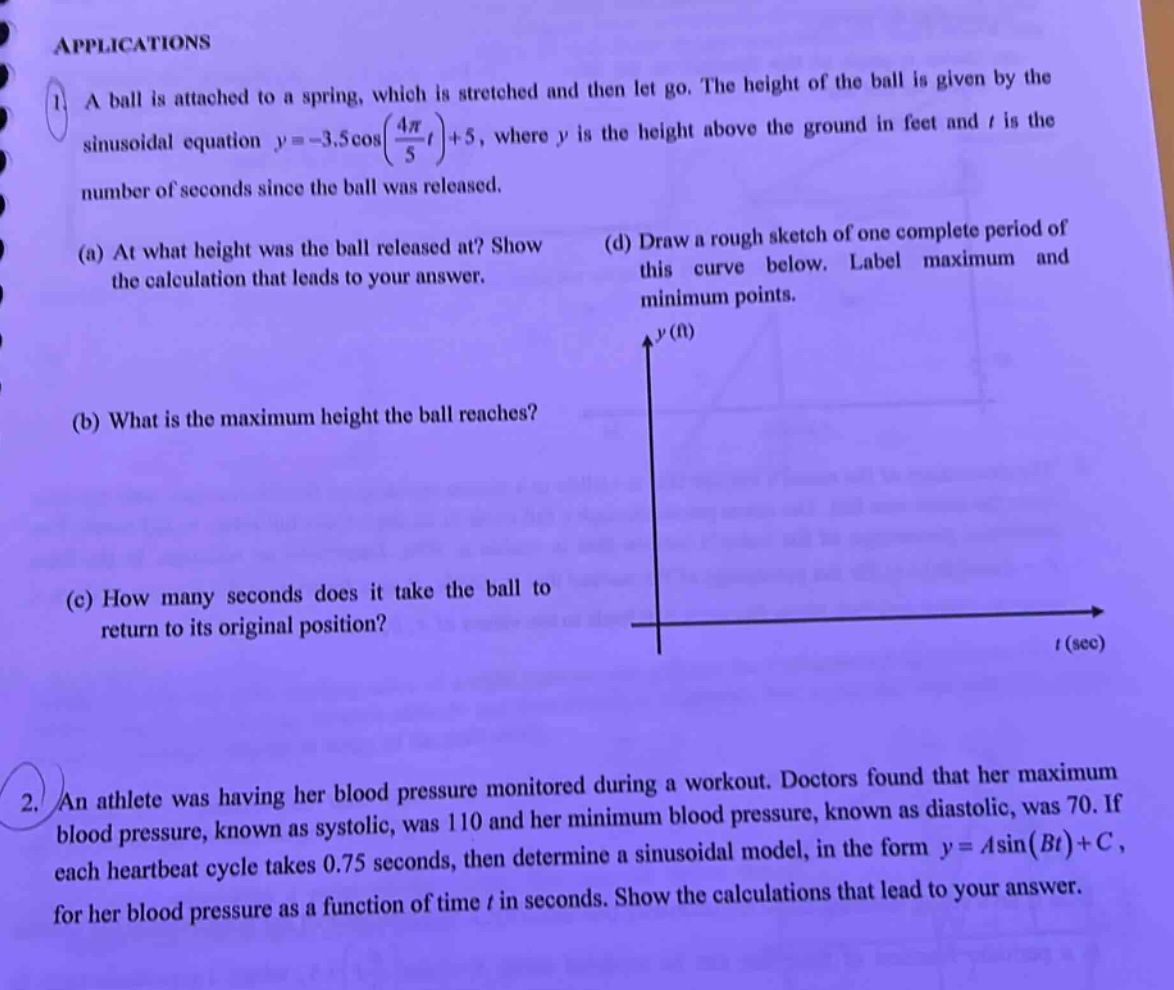
applications\n1 a ball is attached to a spring, which is stretched and then let go. the height of the ball is given by the sinusoidal equation y = - 3.5cos((4π/5)t)+5, where y is the height above the ground in feet and t is the number of seconds since the ball was released.\n(a) at what height was the ball released at? show the calculation that leads to your answer.\n(b) what is the maximum height the ball reaches?\n(c) how many seconds does it take the ball to return to its original position?\n(d) draw a rough sketch of one complete period of this curve below. label maximum and minimum points.\n2 an athlete was having her blood - pressure monitored during a workout. doctors found that her maximum blood pressure, known as systolic, was 110 and her minimum blood pressure, known as diastolic, was 70. if each heartbeat cycle takes 0.75 seconds, then determine a sinusoidal model, in the form y = asin(bt)+c, for her blood pressure as a function of time t in seconds. show the calculations that lead to your answer.
Answer
Explanation:
Step1: Find the height at release (t = 0)
When (t = 0), we substitute into (y=-3.5\cos(\frac{4\pi}{5}t)+5). Since (\cos(0)=1), we have (y=-3.5\times1 + 5). [y=-3.5 + 5=1.5]
Step2: Find the maximum height
The range of the cosine - function is ([- 1,1]). For (y=-3.5\cos(\frac{4\pi}{5}t)+5), when (\cos(\frac{4\pi}{5}t)=-1), we get the maximum value of (y). [y=-3.5\times(-1)+5=3.5 + 5 = 8.5]
Step3: Find the period (time to return to original position)
The general form of a cosine function is (y = A\cos(Bt)+C), and the period (T) is given by (T=\frac{2\pi}{B}). Here, (B = \frac{4\pi}{5}), so (T=\frac{2\pi}{\frac{4\pi}{5}}). [T=\frac{2\pi\times5}{4\pi}=\frac{5}{2}=2.5]
Step4: Determine the sinusoidal model for blood - pressure
The amplitude (A=\frac{\text{max}-\text{min}}{2}), where (\text{max} = 110) and (\text{min}=70). So (A=\frac{110 - 70}{2}=\frac{40}{2}=20). The vertical shift (C=\frac{\text{max}+\text{min}}{2}=\frac{110 + 70}{2}=\frac{180}{2}=90). The period (T = 0.75), and since (T=\frac{2\pi}{B}), then (B=\frac{2\pi}{T}=\frac{2\pi}{0.75}=\frac{8\pi}{3}). The sinusoidal model is (y = 20\sin(\frac{8\pi}{3}t)+90).
Answer:
(a) 1.5 feet (b) 8.5 feet (c) 2.5 seconds (d) For (y=-3.5\cos(\frac{4\pi}{5}t)+5), the period (T = 2.5) seconds. The maximum value of (y) is 8.5 (when (\cos(\frac{4\pi}{5}t)=-1)) and the minimum value of (y) is (1.5) (when (\cos(\frac{4\pi}{5}t)=1)). Sketch a cosine - curve with amplitude (3.5), vertical shift (5), period (2.5) seconds, mark the maximum point at ((1.25,8.5)) and the minimum point at ((0,1.5)) and ((2.5,1.5)) (one - period is from (t = 0) to (t = 2.5)). 2. (y = 20\sin(\frac{8\pi}{3}t)+90)