applying the integral test. use the integral test to determine if the series converge or diverge. be sure to…
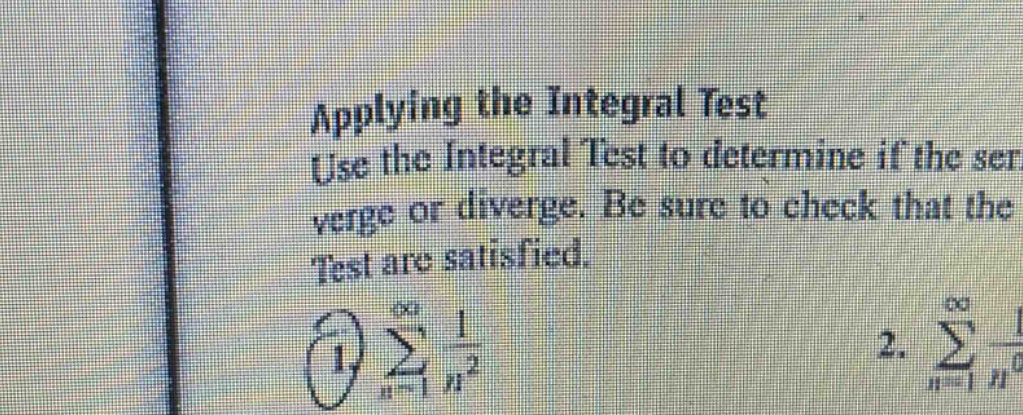
applying the integral test. use the integral test to determine if the series converge or diverge. be sure to check that the test are satisfied. 1. $sum_{n = 1}^{infty}\frac{1}{n^{2}}$ 2. $sum_{n = 1}^{infty}\frac{1}{n^{0}}$
Answer
Explanation:
Step1: Define the function
Let $f(x)=\frac{1}{x^{2}}$. This function is positive, continuous, and decreasing for $x\geq1$. The derivative $f^\prime(x)=-\frac{2}{x^{3}}<0$ for $x > 0$, so it is decreasing.
Step2: Set up the improper - integral
We consider the improper integral $\int_{1}^{\infty}\frac{1}{x^{2}}dx=\lim_{t\rightarrow\infty}\int_{1}^{t}x^{- 2}dx$.
Step3: Evaluate the integral
Using the power - rule for integration $\int x^{n}dx=\frac{x^{n + 1}}{n+1}+C$ ($n\neq - 1$), we have $\lim_{t\rightarrow\infty}\int_{1}^{t}x^{-2}dx=\lim_{t\rightarrow\infty}\left[- \frac{1}{x}\right]_{1}^{t}$.
Step4: Calculate the limit
$\lim_{t\rightarrow\infty}\left(-\frac{1}{t}+\frac{1}{1}\right)=0 + 1=1$. Since the improper integral $\int_{1}^{\infty}\frac{1}{x^{2}}dx$ converges, by the Integral Test, the series $\sum_{n = 1}^{\infty}\frac{1}{n^{2}}$ converges.
Answer:
The series $\sum_{n = 1}^{\infty}\frac{1}{n^{2}}$ converges.