as x approaches ∞, which of the following is true about the behavior of the integrand (8 + cos 2x)/x^7?\na…
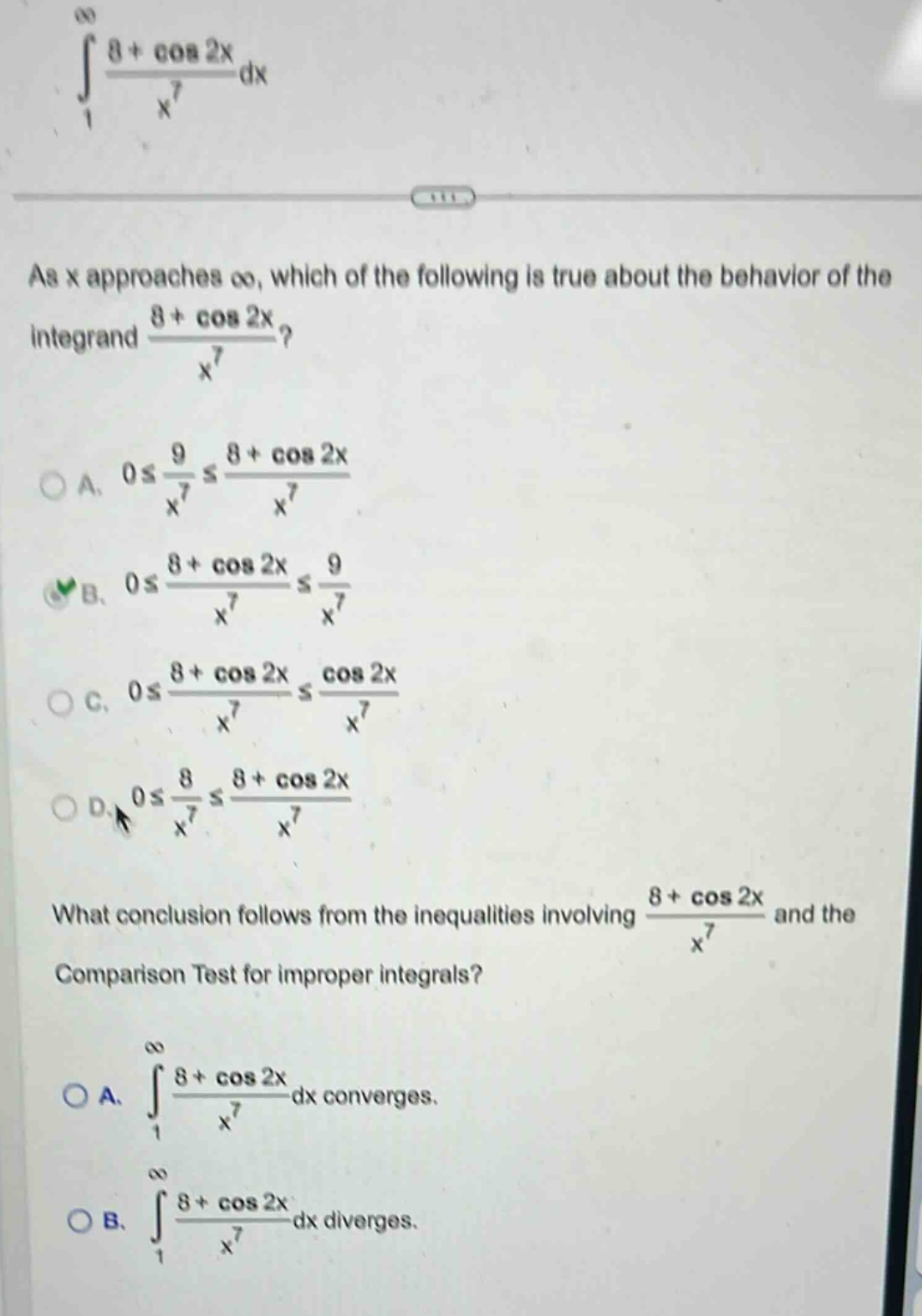
as x approaches ∞, which of the following is true about the behavior of the integrand (8 + cos 2x)/x^7?\na. 0 ≤ 9/x^7 ≤ (8 + cos 2x)/x^7\nb. 0 ≤ (8 + cos 2x)/x^7 ≤ 9/x^7\nc. 0 ≤ (8 + cos 2x)/x^7 ≤ (cos 2x)/x^7\nd. 0 ≤ 8/x^7 ≤ (8 + cos 2x)/x^7\nwhat conclusion follows from the inequalities involving (8 + cos 2x)/x^7 and the comparison test for improper integrals?\na. ∫(from 1 to ∞) (8 + cos 2x)/x^7 dx converges.\nb. ∫(from 1 to ∞) (8 + cos 2x)/x^7 dx diverges.
Answer
Explanation:
Step1: Analyze range of cosine function
We know that $- 1\leqslant\cos(2x)\leqslant1$. Adding 8 to each part of the inequality gives $8 - 1\leqslant8+\cos(2x)\leqslant8 + 1$, so $7\leqslant8+\cos(2x)\leqslant9$. Since $x>0$ (as we are considering the integral from $x = 1$ to $\infty$), dividing each part of the inequality by $x^{7}$ gives $0\leqslant\frac{8+\cos(2x)}{x^{7}}\leqslant\frac{9}{x^{7}}$.
Step2: Recall p - integral test
The integral $\int_{1}^{\infty}\frac{1}{x^{p}}dx$ converges if $p>1$ and diverges if $p\leqslant1$. For the integral $\int_{1}^{\infty}\frac{9}{x^{7}}dx$, we can factor out the constant 9, and since $p = 7>1$, $\int_{1}^{\infty}\frac{9}{x^{7}}dx=9\int_{1}^{\infty}\frac{1}{x^{7}}dx$ converges.
Step3: Apply comparison test for improper integrals
The comparison test for improper integrals states that if $0\leqslant f(x)\leqslant g(x)$ for all $x\geqslant a$ and $\int_{a}^{\infty}g(x)dx$ converges, then $\int_{a}^{\infty}f(x)dx$ converges. Here, $f(x)=\frac{8+\cos(2x)}{x^{7}}$ and $g(x)=\frac{9}{x^{7}}$, $a = 1$. Since $\int_{1}^{\infty}\frac{9}{x^{7}}dx$ converges, $\int_{1}^{\infty}\frac{8+\cos(2x)}{x^{7}}dx$ converges.
Answer:
For the first part: B. $0\leqslant\frac{8+\cos(2x)}{x^{7}}\leqslant\frac{9}{x^{7}}$ For the second part: A. $\int_{1}^{\infty}\frac{8+\cos(2x)}{x^{7}}dx$ converges.