9. as x approaches infinity, which function would have the greatest rate of change? a) f(x) = 8x b) f(x) =…
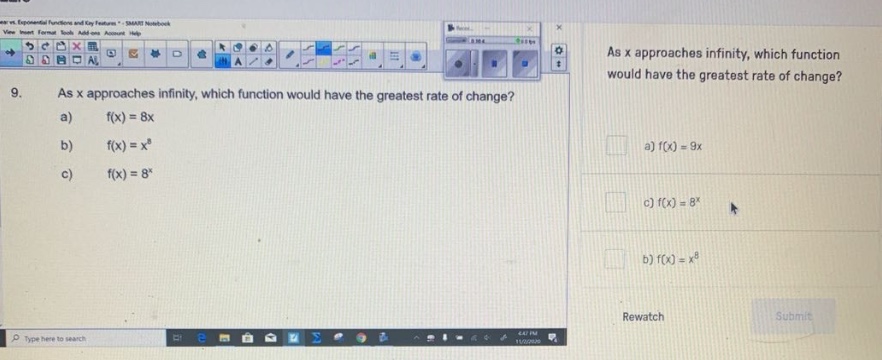
9. as x approaches infinity, which function would have the greatest rate of change? a) f(x) = 8x b) f(x) = x^8 c) f(x) = 8^x as x approaches infinity, which function would have the greatest rate of change? a) f(x) = 9x c) f(x) = 8^x b) f(x) = x^8 rewatch submit
Answer
Explanation:
Step1: Recall rate - of - change concept
The rate of change of a function is given by its derivative.
Step2: Differentiate (f(x)=8x)
Using the power - rule ((x^n)^\prime=nx^{n - 1}), for (f(x)=8x), (f^\prime(x)=8).
Step3: Differentiate (f(x)=x^8)
By the power - rule, (f^\prime(x)=8x^{7}). As (x\rightarrow\infty), (f^\prime(x)\rightarrow\infty).
Step4: Differentiate (f(x)=8^x)
The derivative of (y = a^x) is (y^\prime=a^x\ln a). So for (f(x)=8^x), (f^\prime(x)=8^x\ln8). As (x\rightarrow\infty), (8^x\ln8\rightarrow\infty).
Step5: Compare the growth rates
We know that exponential functions (a^x) ((a>1)) grow faster than polynomial functions (x^n) as (x\rightarrow\infty). Among (y = 8x) (a linear function), (y=x^8) (a polynomial function), and (y = 8^x) (an exponential function), the exponential function (y = 8^x) has the fastest - growing derivative as (x\rightarrow\infty).
Answer:
c) (f(x)=8^x)