a) approximate the area under graph (a) of f(x)=1/x² over the interval 2,6 by computing the area of each…
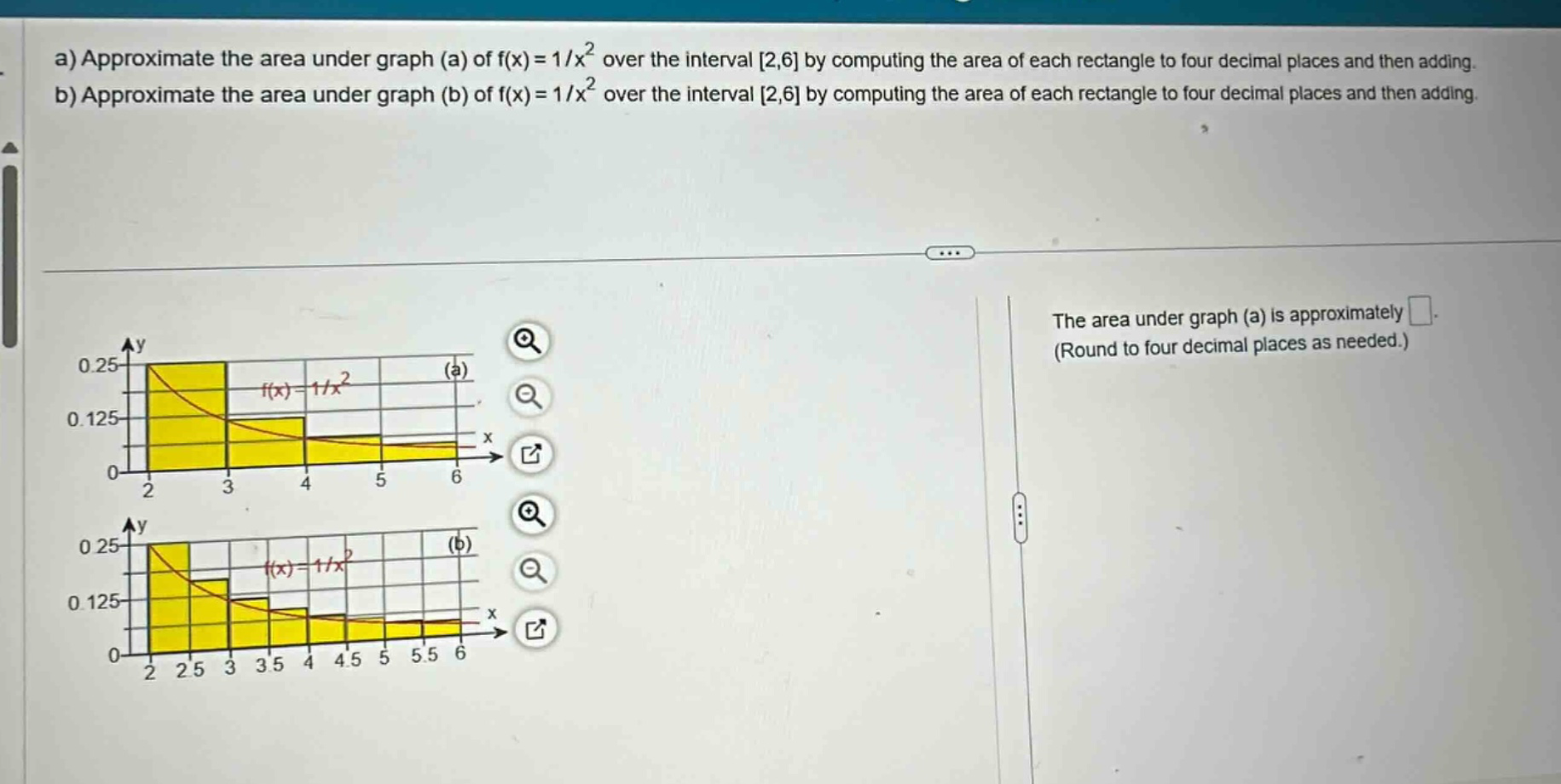
a) approximate the area under graph (a) of f(x)=1/x² over the interval 2,6 by computing the area of each rectangle to four decimal places and then adding. b) approximate the area under graph (b) of f(x)=1/x² over the interval 2,6 by computing the area of each rectangle to four decimal places and then adding. the area under graph (a) is approximately □. (round to four decimal places as needed.)
Answer
Explanation:
Step1: Determine width of rectangles for graph (a)
The interval is [2,6]. There are 3 rectangles. Width $\Delta x=\frac{6 - 2}{3}=\frac{4}{3}\approx1.3333$.
Step2: Calculate area of each rectangle for graph (a)
For the first rectangle: $x_1 = 2$, $f(x_1)=\frac{1}{2^2}=0.25$, area $A_1=f(x_1)\times\Delta x=0.25\times1.3333 = 0.3333$. For the second rectangle: $x_2=2 + 1.3333=3.3333$, $f(x_2)=\frac{1}{(3.3333)^2}\approx0.09$, area $A_2=f(x_2)\times\Delta x=0.09\times1.3333 = 0.12$. For the third rectangle: $x_3=3.3333+1.3333 = 4.6666$, $f(x_3)=\frac{1}{(4.6666)^2}\approx0.045$, area $A_3=f(x_3)\times\Delta x=0.045\times1.3333=0.06$.
Step3: Sum up areas for graph (a)
$A=a_1 + a_2+a_3=0.3333+0.12 + 0.06=0.5133$.
Answer:
0.5133