approximate the shaded area below. f1(x)=4 - x^2 rhs4 = ? lhs4 =
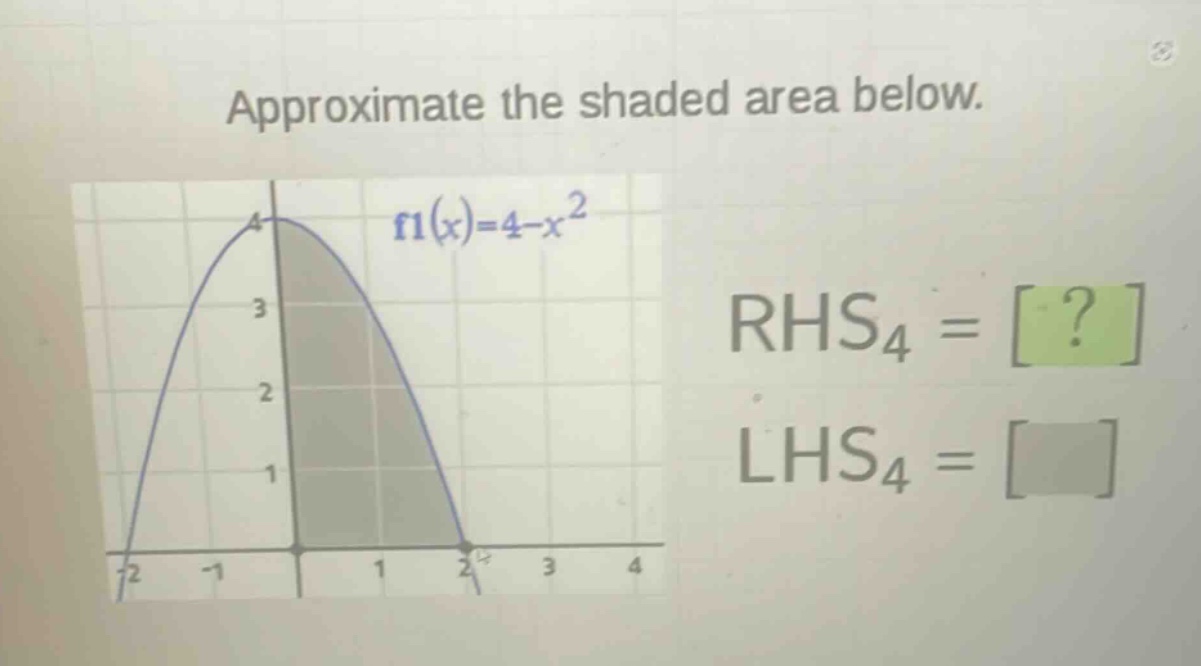
approximate the shaded area below. f1(x)=4 - x^2 rhs4 = ? lhs4 =
Answer
Explanation:
Step1: Define the interval and subinterval width
The shaded area is under the curve $f(x) = 4 - x^2$ from $x=0$ to $x=2$. The interval is $[a, b] = [0, 2]$. The number of subintervals is $n=4$. The width of each subinterval is $\Delta x = \frac{b-a}{n}$. $$ \Delta x = \frac{2-0}{4} = \frac{2}{4} = 0.5 $$ The subintervals are $[0, 0.5]$, $[0.5, 1]$, $[1, 1.5]$, $[1.5, 2]$.
Step2: Calculate the Right Hand Sum (RHS$_4$)
Use the right endpoints of the subintervals: $0.5, 1, 1.5, 2$. Evaluate the function at these points. $f(0.5) = 4 - (0.5)^2 = 4 - 0.25 = 3.75$ $f(1) = 4 - (1)^2 = 4 - 1 = 3$ $f(1.5) = 4 - (1.5)^2 = 4 - 2.25 = 1.75$ $f(2) = 4 - (2)^2 = 4 - 4 = 0$ The RHS$_4$ is the sum of the areas of the rectangles: $RHS_4 = \Delta x [f(0.5) + f(1) + f(1.5) + f(2)]$. $$ RHS_4 = 0.5 [3.75 + 3 + 1.75 + 0] = 0.5 [8.5] = 4.25 $$
Step3: Calculate the Left Hand Sum (LHS$_4$)
Use the left endpoints of the subintervals: $0, 0.5, 1, 1.5$. Evaluate the function at these points. $f(0) = 4 - (0)^2 = 4 - 0 = 4$ $f(0.5) = 4 - (0.5)^2 = 4 - 0.25 = 3.75$ $f(1) = 4 - (1)^2 = 4 - 1 = 3$ $f(1.5) = 4 - (1.5)^2 = 4 - 2.25 = 1.75$ The LHS$_4$ is the sum of the areas of the rectangles: $LHS_4 = \Delta x [f(0) + f(0.5) + f(1) + f(1.5)]$. $$ LHS_4 = 0.5 [4 + 3.75 + 3 + 1.75] = 0.5 [12.5] = 6.25 $$
Answer:
$RHS_4 = 4.25$ $LHS_4 = 6.25$