the area of the region bounded by the curve ( y = e^{2x} ), the ( x )-axis, the ( y )-axis, and the line ( x…
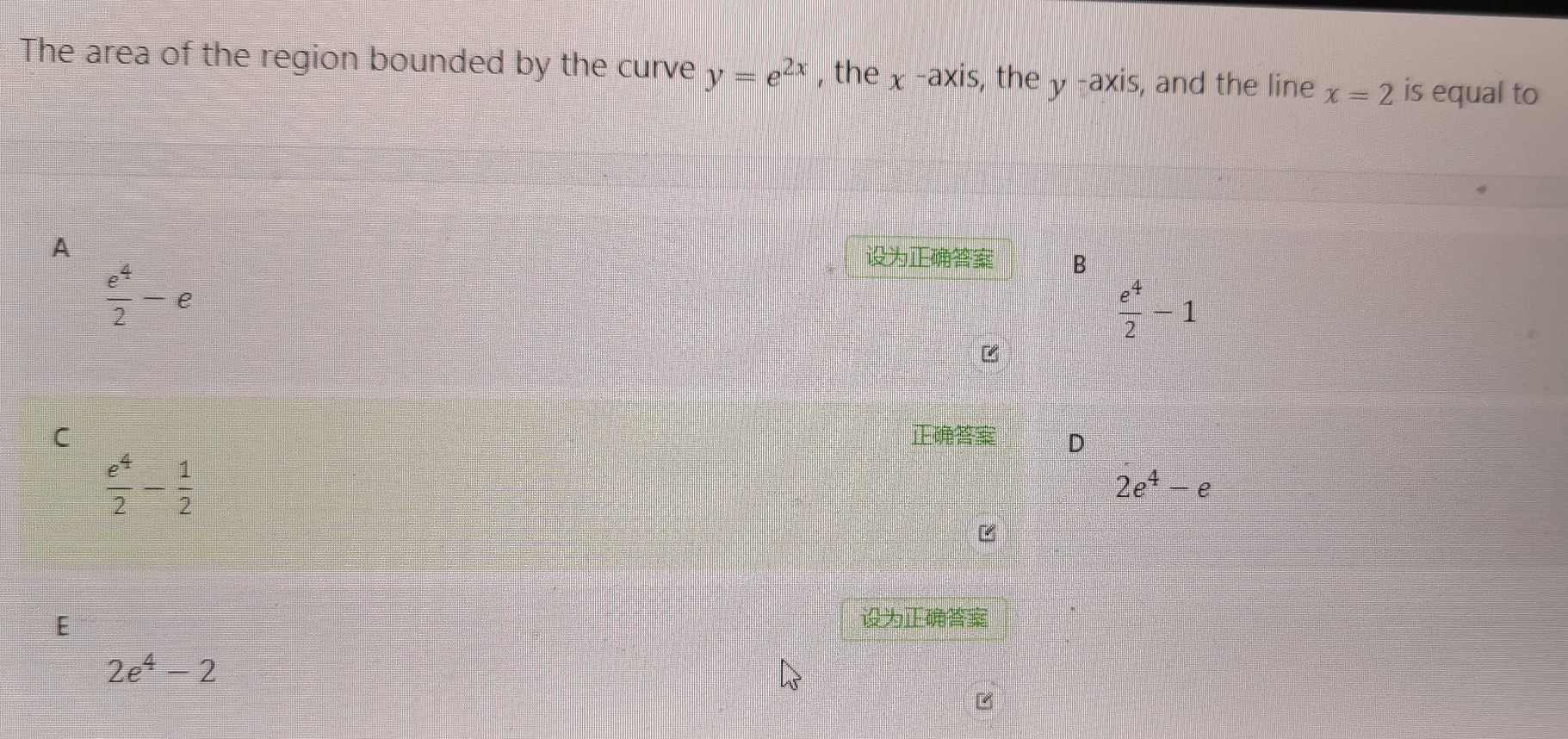
the area of the region bounded by the curve ( y = e^{2x} ), the ( x )-axis, the ( y )-axis, and the line ( x = 2 ) is equal to\na ( \frac{e^{4}}{2}-e )\nb ( \frac{e^{4}}{2}-1 )\nc ( \frac{e^{4}}{2}-\frac{1}{2} )\nd ( 2e^{4}-e )\ne ( 2e^{4}-2 )
Answer
Explanation:
Step1: Use the formula for the area under a curve
The area (A) under the curve (y = f(x)) from (x = a) to (x = b) is given by (A=\int_{a}^{b}f(x)dx). Here, (f(x)=e^{2x}), (a = 0), and (b = 2). So, (A=\int_{0}^{2}e^{2x}dx).
Step2: Integrate (e^{2x})
We know that (\int e^{kx}dx=\frac{1}{k}e^{kx}+C) (where (k = 2) in our case). So, (\int_{0}^{2}e^{2x}dx=\left[\frac{1}{2}e^{2x}\right]_{0}^{2}).
Step3: Evaluate the definite - integral
Using the fundamental theorem of calculus (\left[\frac{1}{2}e^{2x}\right]_{0}^{2}=\frac{1}{2}e^{2\times2}-\frac{1}{2}e^{2\times0}). Since (e^{0}=1), we have (\frac{1}{2}e^{4}-\frac{1}{2}\times1=\frac{e^{4}}{2}-\frac{1}{2}).
Answer:
C. (\frac{e^{4}}{2}-\frac{1}{2})