arithmetic functions question 10, 6.4.77 part 5 of 8 hw score: 53.33%, 8 of 15 points points: 0 of 1 use the…
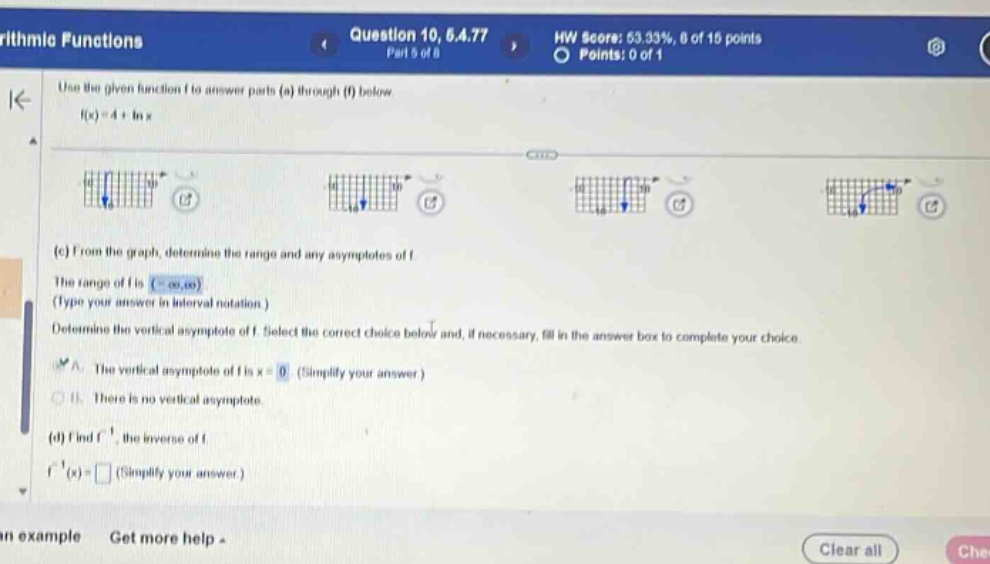
arithmetic functions question 10, 6.4.77 part 5 of 8 hw score: 53.33%, 8 of 15 points points: 0 of 1 use the given function f to answer parts (a) through (f) below. f(x)=4 + ln x (c) from the graph, determine the range and any asymptotes of f. the range of f is (-∞,∞) (type your answer in interval notation.) determine the vertical asymptote of f. select the correct choice below and, if necessary, fill in the answer box to complete your choice. a. the vertical asymptote of f is x = 0 (simplify your answer.) b. there is no vertical asymptote. (d) find f⁻¹, the inverse of f. f⁻¹(x)= (simplify your answer.)
Answer
Explanation:
Step1: Recall inverse - function steps
Let (y = f(x)=4+\ln x). First, swap (x) and (y): (x = 4+\ln y).
Step2: Solve for (y)
Subtract 4 from both sides: (x - 4=\ln y).
Step3: Use exponential property
Since (x - 4=\ln y), by the property (y = e^{\ln y}), we have (y = e^{x - 4}). So (f^{-1}(x)=e^{x - 4}).
Answer:
(e^{x - 4})