assignment 6.1: graphs of the sine and cosine functions\nscore: 10/12 answered: 11/12\n× question 12\nscore…
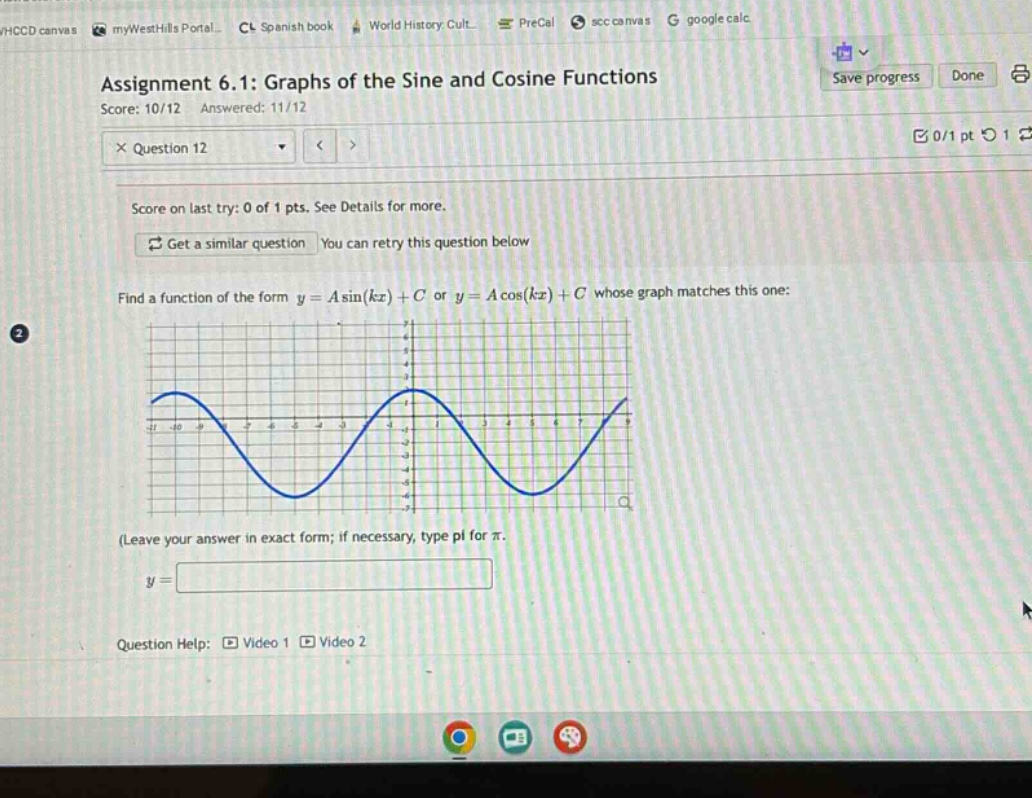
assignment 6.1: graphs of the sine and cosine functions\nscore: 10/12 answered: 11/12\n× question 12\nscore on last try: 0 of 1 pts. see details for more.\nget a similar question you can retry this question below\nfind a function of the form (y = asin(kx)+c) or (y = acos(kx)+c) whose graph matches this one:\n(leave your answer in exact form; if necessary, type pi for (pi).\n(y=)\nquestion help: video 1 video 2
Answer
Explanation:
Step1: Determine the amplitude $A$
The amplitude is half the vertical distance between the maximum and minimum values of the function. If the maximum value is $y_{max}$ and the minimum value is $y_{min}$, then $A=\frac{y_{max}-y_{min}}{2}$. From the graph, assume $y_{max} = 3$ and $y_{min}=- 3$, so $A = 3$.
Step2: Determine the vertical - shift $C$
The vertical - shift $C$ is the average of the maximum and minimum values of the function. $C=\frac{y_{max}+y_{min}}{2}$. Since $y_{max} = 3$ and $y_{min}=-3$, $C = 0$.
Step3: Determine the period and $k$
The period $T$ is the horizontal distance between two consecutive maxima (or minima). Suppose the period $T$ from the graph is $4$. The formula for the period of $y = A\sin(kx)+C$ or $y = A\cos(kx)+C$ is $T=\frac{2\pi}{k}$. If $T = 4$, then $4=\frac{2\pi}{k}$, and solving for $k$ gives $k=\frac{\pi}{2}$.
Step4: Choose the function form
Since the graph starts at a maximum (like the cosine function $y=\cos(x)$ starts at $y = 1$ when $x = 0$), we choose the cosine - form. The function is $y = A\cos(kx)+C$.
Answer:
$y = 3\cos\left(\frac{\pi}{2}x\right)$