assignment\nidentify the period and vertical shift. then sketch a graph of at least two cycles of the…
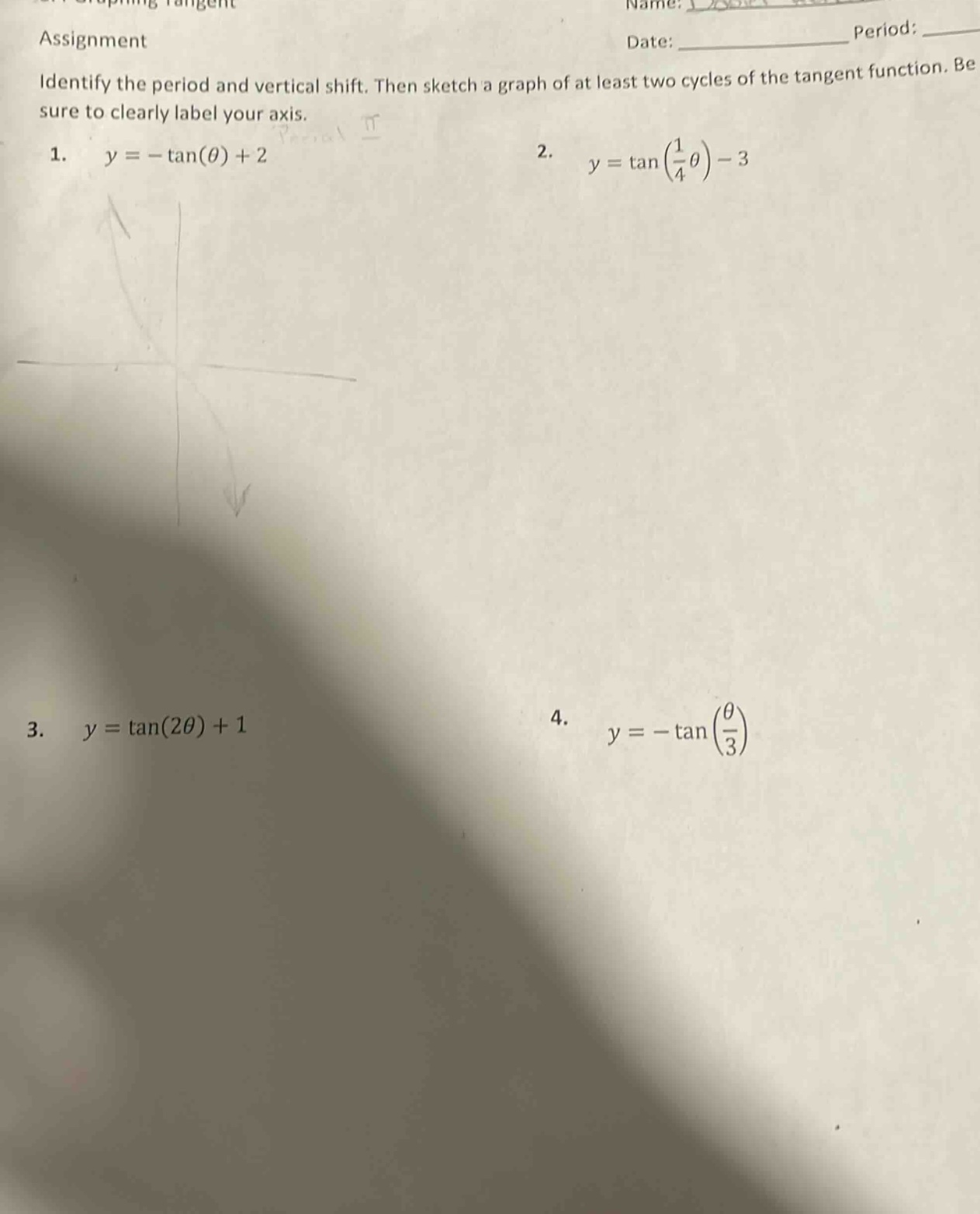
assignment\nidentify the period and vertical shift. then sketch a graph of at least two cycles of the tangent function. be sure to clearly label your axis.\n1. y = -tan(θ) + 2\n2. y = tan(1/4θ) - 3\n3. y = tan(2θ) + 1\n4. y = -tan(θ/3)
Answer
- For (y =-\tan(\theta)+2):
- Period:
- The general form of the tangent - function is (y = A\tan(B\theta - C)+D). For the tangent function (y=\tan(\theta)), the period is (\pi). When (B = 1) (in (y =-\tan(\theta)+2), (B = 1)), the period (T=\frac{\pi}{|B|}). So, (T=\frac{\pi}{|1|}=\pi).
- Vertical Shift:
- In the equation (y =-\tan(\theta)+2), the value of (D = 2). So, the vertical shift is (2) units up.
- Period:
- For (y=\tan(\frac{1}{4}\theta)-3):
- Period:
- Using the formula (T=\frac{\pi}{|B|}), where (B=\frac{1}{4}). Then (T=\frac{\pi}{\left|\frac{1}{4}\right|}=4\pi).
- Vertical Shift:
- In the equation (y=\tan(\frac{1}{4}\theta)-3), the value of (D=-3). So, the vertical shift is (3) units down.
- Period:
- For (y = \tan(2\theta)+1):
- Period:
- Using the formula (T=\frac{\pi}{|B|}), where (B = 2). Then (T=\frac{\pi}{|2|}=\frac{\pi}{2}).
- Vertical Shift:
- In the equation (y=\tan(2\theta)+1), the value of (D = 1). So, the vertical shift is (1) unit up.
- Period:
- For (y=-\tan(\frac{\theta}{3})):
- Period:
- Using the formula (T=\frac{\pi}{|B|}), where (B=\frac{1}{3}). Then (T=\frac{\pi}{\left|\frac{1}{3}\right|}=3\pi).
- Vertical Shift:
- In the equation (y=-\tan(\frac{\theta}{3})), the value of (D = 0). So, there is no vertical shift.
- Period:
Explanation:
Step1: Recall period formula
For (y = A\tan(B\theta - C)+D), period (T=\frac{\pi}{|B|}).
Step2: Identify (B) values
For (y =-\tan(\theta)+2), (B = 1); for (y=\tan(\frac{1}{4}\theta)-3), (B=\frac{1}{4}); for (y=\tan(2\theta)+1), (B = 2); for (y=-\tan(\frac{\theta}{3})), (B=\frac{1}{3}).
Step3: Calculate periods
For (y =-\tan(\theta)+2), (T=\frac{\pi}{|1|}=\pi); for (y=\tan(\frac{1}{4}\theta)-3), (T = 4\pi); for (y=\tan(2\theta)+1), (T=\frac{\pi}{2}); for (y=-\tan(\frac{\theta}{3})), (T = 3\pi).
Step4: Identify vertical - shift
The vertical shift is given by (D). For (y =-\tan(\theta)+2), (D = 2) (2 units up); for (y=\tan(\frac{1}{4}\theta)-3), (D=-3) (3 units down); for (y=\tan(2\theta)+1), (D = 1) (1 unit up); for (y=-\tan(\frac{\theta}{3})), (D = 0) (no vertical shift).
Answer:
- Period: (\pi), Vertical Shift: 2 units up
- Period: (4\pi), Vertical Shift: 3 units down
- Period: (\frac{\pi}{2}), Vertical Shift: 1 unit up
- Period: (3\pi), Vertical Shift: 0 (no vertical shift)