assume the entire graph of f(x) is shown below. use the graph to to complete parts a through c. a. compare f…
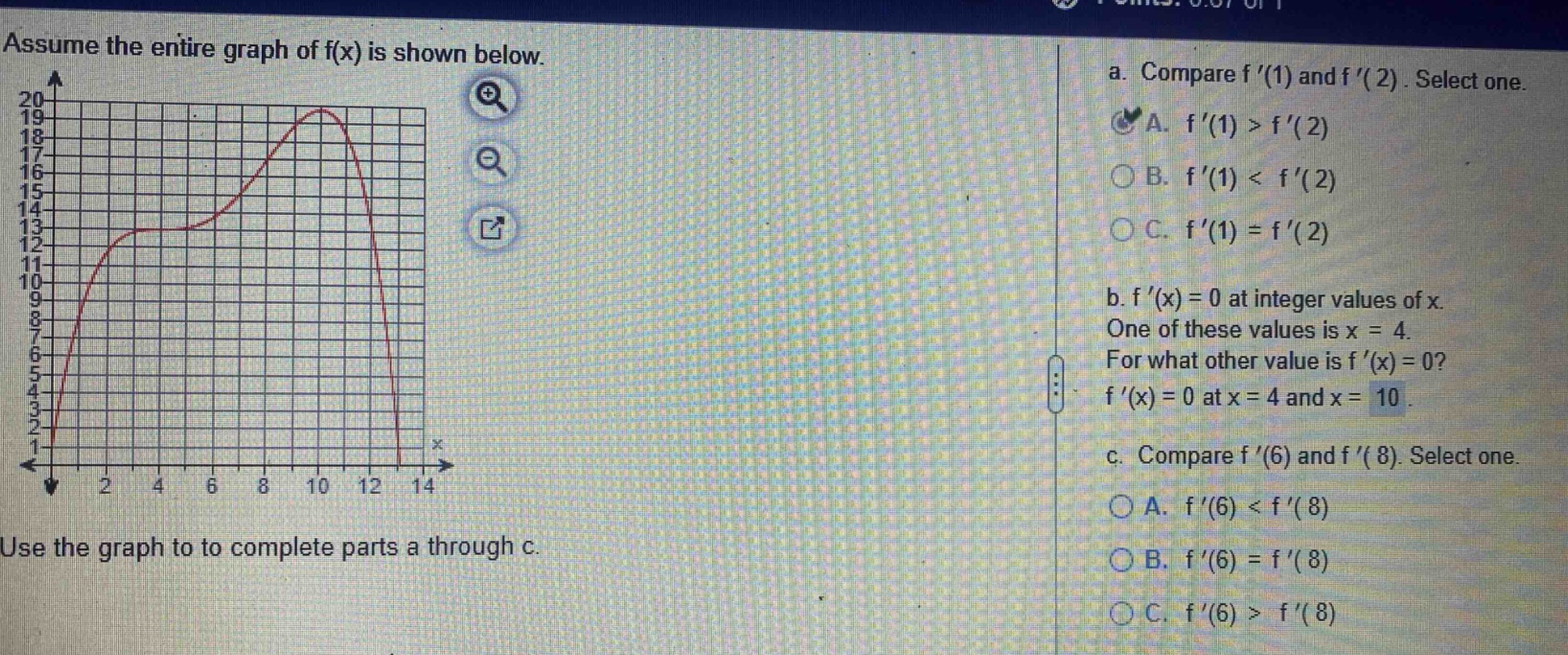
assume the entire graph of f(x) is shown below. use the graph to to complete parts a through c. a. compare f (1) and f (2). select one. a. f (1) > f (2) b. f (1) < f (2) c. f (1) = f (2) b. f (x) = 0 at integer values of x. one of these values is x = 4. for what other value is f (x) = 0? f (x) = 0 at x = 4 and x = 10. c. compare f (6) and f (8). select one. a. f (6) < f (8) b. f (6) = f (8) c. f (6) > f (8)
Answer
Explanation:
Step1: Recall derivative - slope relationship
The derivative $f^{\prime}(x)$ at a point is the slope of the tangent line to the graph of $y = f(x)$ at that point.
Step2: Analyze $f^{\prime}(1)$ and $f^{\prime}(2)$
At $x = 1$, the graph is increasing with a relatively steep slope. At $x = 2$, the graph is still increasing but with a less - steep slope. So, $f^{\prime}(1)>f^{\prime}(2)$.
Step3: Find where $f^{\prime}(x)=0$
The derivative $f^{\prime}(x) = 0$ at points where the tangent line to the graph of $y = f(x)$ is horizontal. From the graph, we can see that the tangent is horizontal at $x = 4$ and $x = 10$.
Step4: Analyze $f^{\prime}(6)$ and $f^{\prime}(8)$
At $x = 6$, the graph is increasing, so $f^{\prime}(6)>0$. At $x = 8$, the graph is decreasing, so $f^{\prime}(8)<0$. Thus, $f^{\prime}(6)>f^{\prime}(8)$.
Answer:
a. A. $f^{\prime}(1)>f^{\prime}(2)$ b. $10$ c. C. $f^{\prime}(6)>f^{\prime}(8)$