assume that the recursively defined sequence converges and find its limit. a1 = 2, an+1 = 12 / (1 + an) the…
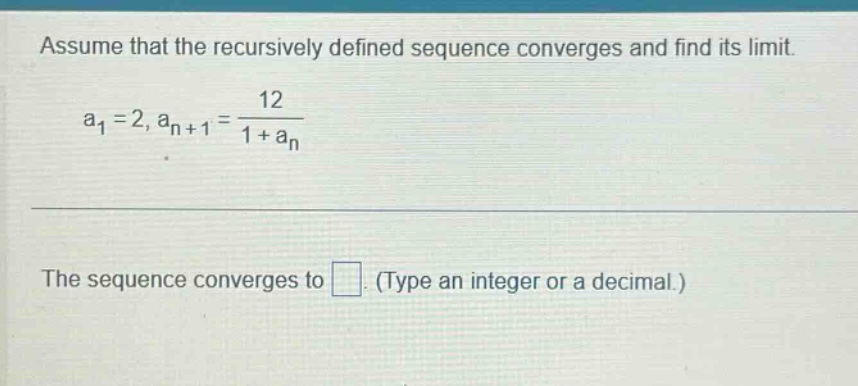
assume that the recursively defined sequence converges and find its limit. a1 = 2, an+1 = 12 / (1 + an) the sequence converges to . (type an integer or a decimal.)
Answer
Explanation:
Step1: Let the limit be (L).
Since (\lim_{n\rightarrow\infty}a_{n}=\lim_{n\rightarrow\infty}a_{n + 1}=L), and (a_{n+1}=\frac{12}{1 + a_{n}}), we have (L=\frac{12}{1 + L}).
Step2: Rearrange the equation.
Cross - multiply to get (L(1 + L)=12), which simplifies to (L^{2}+L - 12=0).
Step3: Solve the quadratic equation.
For a quadratic equation (ax^{2}+bx + c = 0) (here (a = 1), (b = 1), (c=-12)), use the quadratic formula (x=\frac{-b\pm\sqrt{b^{2}-4ac}}{2a}). So (L=\frac{-1\pm\sqrt{1^{2}-4\times1\times(-12)}}{2\times1}=\frac{-1\pm\sqrt{1 + 48}}{2}=\frac{-1\pm\sqrt{49}}{2}=\frac{-1\pm7}{2}).
Step4: Select the valid solution.
We get two solutions (L_1=\frac{-1 + 7}{2}=3) and (L_2=\frac{-1 - 7}{2}=-4). Since (a_1 = 2>0) and the recurrence relation (a_{n+1}=\frac{12}{1 + a_{n}}) will keep the terms non - negative for non - negative initial terms, we reject (L=-4).
Answer:
3