assume that the sequence shown below converges and find its limit. \n√13, √13 - √13, √13 - √13 - √13, √13…
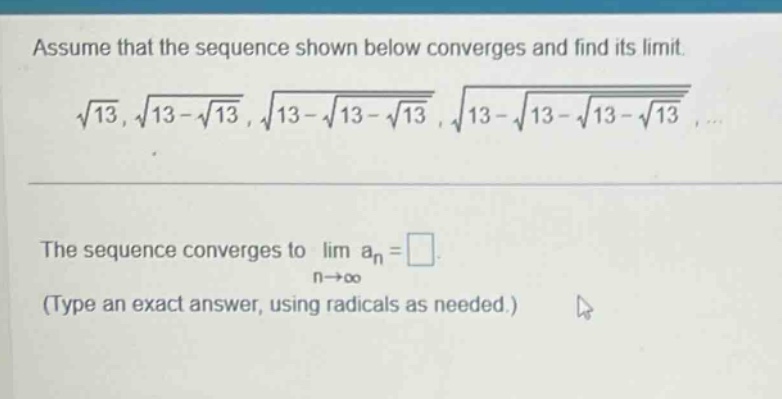
assume that the sequence shown below converges and find its limit. \n√13, √13 - √13, √13 - √13 - √13, √13 - √13 - √13 - √13 \nthe sequence converges to lim aₙ = \n(type an exact answer, using radicals as needed.)
Answer
Explanation:
Step1: Let the limit be (L)
Let (\lim_{n\rightarrow\infty}a_{n}=L). Since (\lim_{n\rightarrow\infty}a_{n}=\lim_{n\rightarrow\infty}a_{n + 1}), and the sequence has the recurrence - relation (a_{n+1}=\sqrt{13 - a_{n}}) (for (n\geq1) with (a_1 = \sqrt{13})).
Step2: Take the limit on both sides
We have (L=\sqrt{13 - L}). Square both sides to get (L^{2}=13 - L).
Step3: Rearrange to a quadratic equation
Rearrange the equation (L^{2}+L - 13=0).
Step4: Use the quadratic formula
The quadratic formula for (ax^{2}+bx + c = 0) is (x=\frac{-b\pm\sqrt{b^{2}-4ac}}{2a}). Here, (a = 1), (b = 1), and (c=-13). So (L=\frac{-1\pm\sqrt{1^{2}-4\times1\times(-13)}}{2\times1}=\frac{-1\pm\sqrt{1 + 52}}{2}=\frac{-1\pm\sqrt{53}}{2}).
Step5: Determine the valid solution
Since (a_{n}>0) for all (n) (because the square - root of a non - negative number is non - negative), we reject the solution (L=\frac{-1-\sqrt{53}}{2}) (which is negative).
Answer:
(\frac{-1 + \sqrt{53}}{2})