assume that the world population at the beginning of year 2000 was 6.08 billion, and by the beginning of…
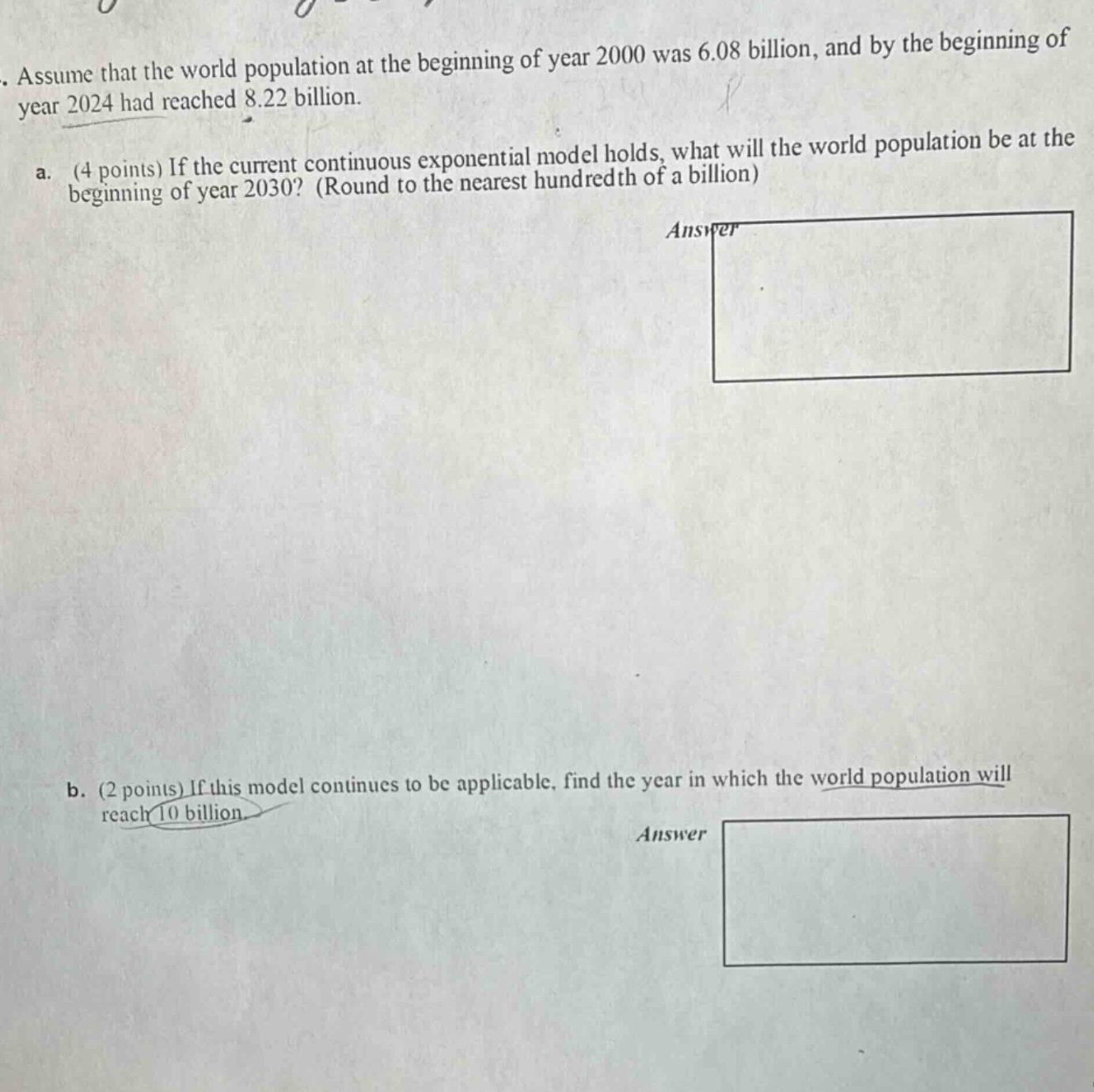
assume that the world population at the beginning of year 2000 was 6.08 billion, and by the beginning of year 2024 had reached 8.22 billion. a. (4 points) if the current continuous exponential model holds, what will the world population be at the beginning of year 2030? (round to the nearest hundredth of a billion) answer b. (2 points) if this model continues to be applicable, find the year in which the world population will reach 10 billion. answer
Answer
Explanation:
Step1: Find the growth - rate constant $k$
The continuous - exponential growth model is $P(t)=P_0e^{kt}$, where $P_0$ is the initial population, $P(t)$ is the population at time $t$, and $k$ is the growth - rate constant. Let $t = 0$ correspond to the year 2000, so $P_0=6.08$ billion. In 2024 ($t = 24$), $P(24)=8.22$ billion. Substitute into the formula: $8.22 = 6.08e^{24k}$. Then, $\frac{8.22}{6.08}=e^{24k}$. Taking the natural logarithm of both sides, $\ln(\frac{8.22}{6.08})=\ln(e^{24k})$. Since $\ln(e^{24k}) = 24k$, we have $k=\frac{\ln(\frac{8.22}{6.08})}{24}\approx\frac{\ln(1.352)}{24}\approx\frac{0.302}{24}\approx0.0126$.
Step2: Predict the population in 2030
For 2030, $t = 30$. Using the formula $P(t)=P_0e^{kt}$ with $P_0 = 6.08$, $k\approx0.0126$, and $t = 30$, we get $P(30)=6.08e^{0.0126\times30}=6.08e^{0.378}$. Since $e^{0.378}\approx1.459$, then $P(30)=6.08\times1.459\approx8.87$ billion.
Step3: Find the year when the population reaches 10 billion
Set $P(t)=10$, $P_0 = 6.08$, and $k\approx0.0126$ in the formula $P(t)=P_0e^{kt}$. So, $10 = 6.08e^{0.0126t}$. Then, $\frac{10}{6.08}=e^{0.0126t}$, or $\ln(\frac{10}{6.08})=\ln(e^{0.0126t})$. Since $\ln(e^{0.0126t}) = 0.0126t$, we have $t=\frac{\ln(\frac{10}{6.08})}{0.0126}\approx\frac{\ln(1.645)}{0.0126}\approx\frac{0.498}{0.0126}\approx39.52$. Since $t = 0$ corresponds to 2000, the year is approximately $2000 + 40=2040$.
Answer:
a. $8.87$ billion b. 2040