$y = -(3)^{x+5}$\nwhat is the asymptote?\n$x = 5$\n$x = -5$\n$y = 0$\n$y = -5$
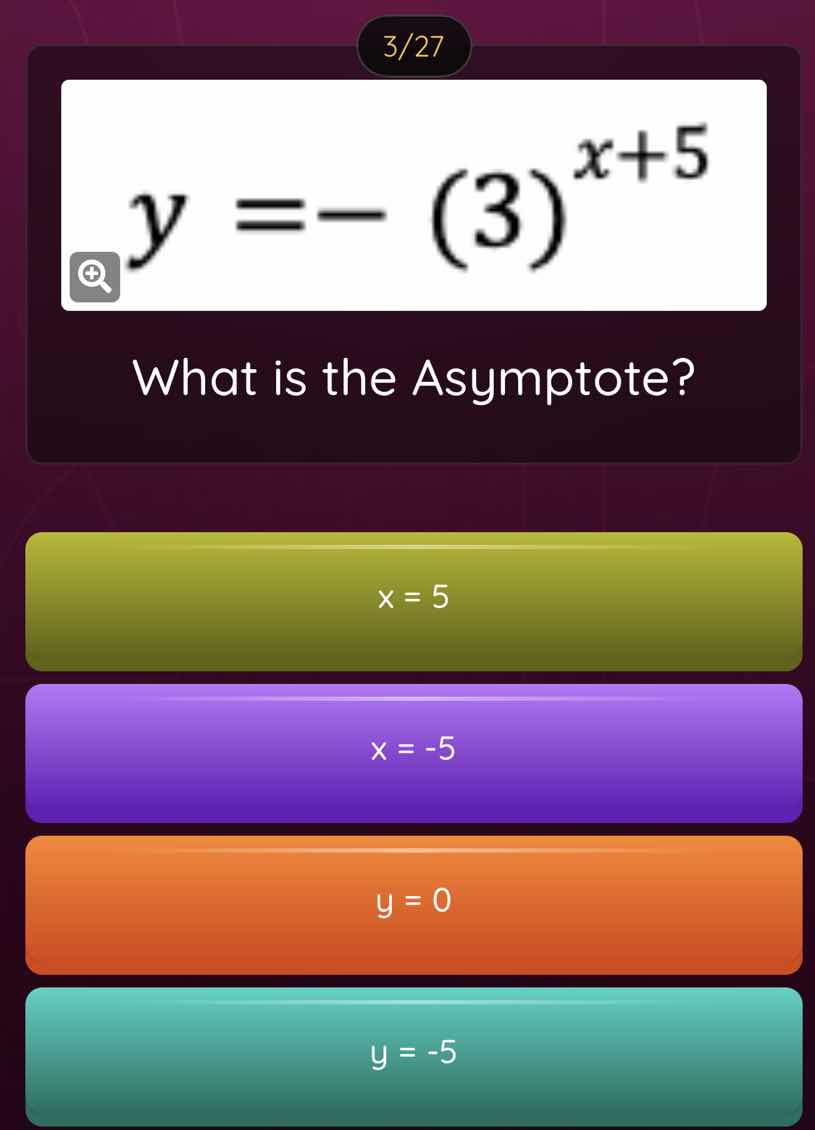
$y = -(3)^{x+5}$\nwhat is the asymptote?\n$x = 5$\n$x = -5$\n$y = 0$\n$y = -5$
Answer
Explanation:
Step1: Recall exponential function asymptote
For a basic exponential function $y = b^x$ (where $b>0, b\neq1$), the horizontal asymptote is $y=0$, as $\lim_{x\to-\infty} b^x = 0$.
Step2: Analyze transformed function
The given function is $y = -3^{x+5}$. This is a transformation of $y=3^x$: shifted left 5 units and reflected over the x-axis. The limit $\lim_{x\to-\infty} -3^{x+5} = -0 = 0$.
Step3: Identify the asymptote
The horizontal asymptote remains $y=0$ because the vertical shift and reflection do not change the end behavior as $x$ approaches negative infinity.
Answer:
C. y = 0