attempt 1: 10 attempts remaining. (a) consider the error in using the approximation e^(-x)≈1 - x on the…
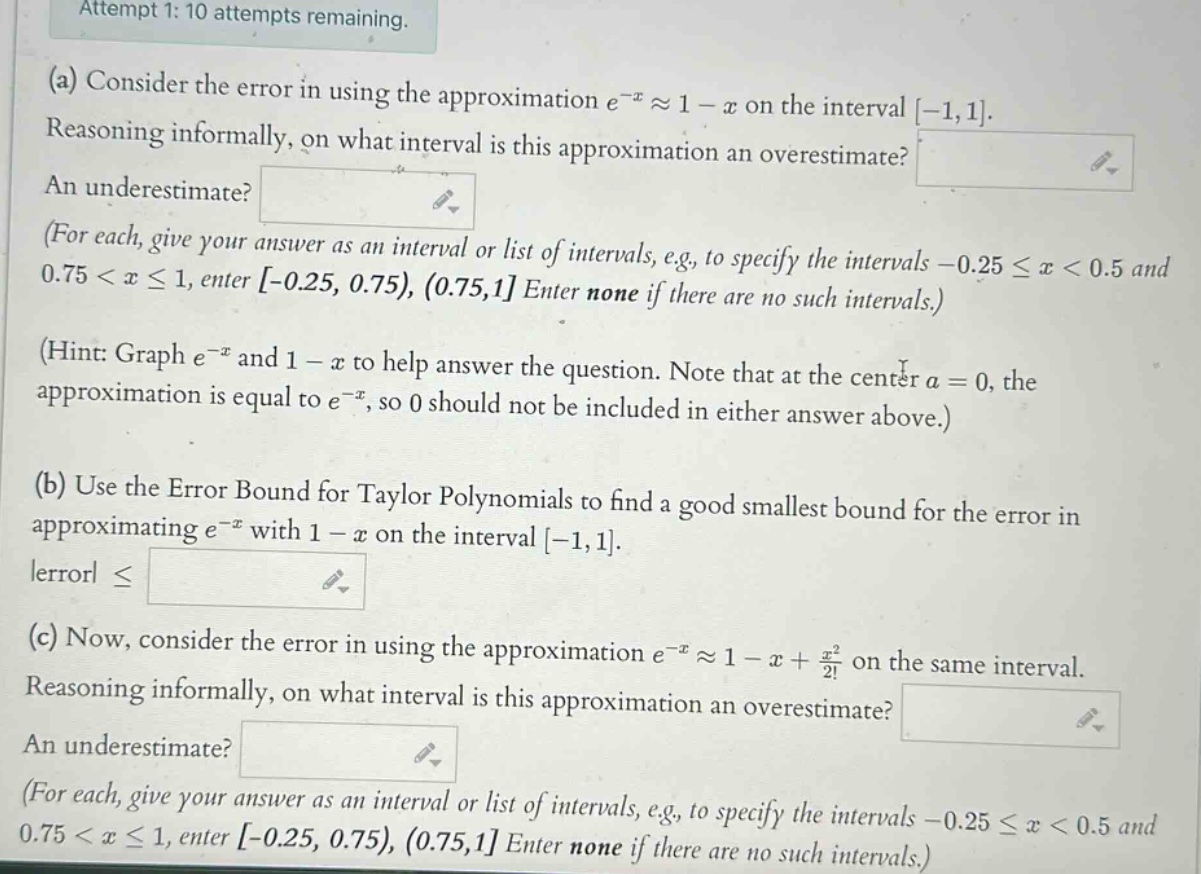
attempt 1: 10 attempts remaining. (a) consider the error in using the approximation e^(-x)≈1 - x on the interval -1,1. reasoning informally, on what interval is this approximation an overestimate? an underestimate? (for each, give your answer as an interval or list of intervals, e.g., to specify the intervals -0.25≤x<0.5 and 0.75<x≤1, enter -0.25, 0.75), (0.75,1 enter none if there are no such intervals.) (hint: graph e^(-x) and 1 - x to help answer the question. note that at the center a = 0, the approximation is equal to e^(-x), so 0 should not be included in either answer above.) (b) use the error bound for taylor polynomials to find a good smallest bound for the error in approximating e^(-x) with 1 - x on the interval -1,1. |error|≤ (c) now, consider the error in using the approximation e^(-x)≈1 - x + x^2/2! on the same interval. reasoning informally, on what interval is this approximation an overestimate? an underestimate? (for each, give your answer as an interval or list of intervals, e.g., to specify the intervals -0.25≤x<0.5 and 0.75<x≤1, enter -0.25, 0.75), (0.75,1 enter none if there are no such intervals.)
Answer
Explanation:
Step1: Analyze $e^{-x}\approx1 - x$ for over - and under - estimates
Let $f(x)=e^{-x}$ and $g(x)=1 - x$. The Taylor series of $e^{-x}$ centered at $a = 0$ is $e^{-x}=\sum_{n = 0}^{\infty}\frac{(-x)^n}{n!}=1 - x+\frac{x^2}{2!}-\frac{x^3}{3!}+\cdots$. We can also consider the difference $h(x)=e^{-x}-(1 - x)=\frac{x^2}{2!}-\frac{x^3}{3!}+\cdots$. For $x\in(- 1,0)$, $h(x)>0$ (since the first non - zero term $\frac{x^2}{2!}>0$ when $x\neq0$), so $e^{-x}>1 - x$ and $1 - x$ is an underestimate. For $x\in(0,1)$, $h(x)>0$, so $e^{-x}>1 - x$ and $1 - x$ is an underestimate. Overestimate: none Underestimate: $(-1,0)\cup(0,1)$
Step2: Use Taylor error bound for $e^{-x}\approx1 - x$
The Taylor polynomial of degree $n$ for $y = e^{-x}$ centered at $a = 0$ is $P_n(x)=\sum_{k = 0}^{n}\frac{(-x)^k}{k!}$. Here $n = 1$, $P_1(x)=1 - x$. The error bound for the Taylor polynomial $|R_n(x)|\leq\frac{M}{(n + 1)!}|x - a|^{n+1}$, where $M$ is an upper bound of $|f^{(n + 1)}(t)|$ for $t$ between $a$ and $x$. The second - derivative of $f(x)=e^{-x}$ is $f''(x)=e^{-x}$. On the interval $[-1,1]$, the maximum value of $|f''(x)|$ occurs at $x=-1$ and $|f''(x)| = e$. With $n = 1$, $a = 0$ and $|x|\leq1$, the error bound $|R_1(x)|\leq\frac{e}{2!}|x|^2$. The maximum value of $\frac{e}{2!}|x|^2$ on $[-1,1]$ occurs at $x=\pm1$, so $|R_1(x)|\leq\frac{e}{2}\approx1.359$
Step3: Analyze $e^{-x}\approx1 - x+\frac{x^2}{2}$ for over - and under - estimates
Let $f(x)=e^{-x}$ and $g(x)=1 - x+\frac{x^2}{2}$. The difference $h(x)=e^{-x}-(1 - x+\frac{x^2}{2})=-\frac{x^3}{6}+\frac{x^4}{24}-\cdots$. For $x\in(-1,0)$, $h(x)<0$, so $e^{-x}<1 - x+\frac{x^2}{2}$ and $1 - x+\frac{x^2}{2}$ is an overestimate. For $x\in(0,1)$, $h(x)>0$, so $e^{-x}>1 - x+\frac{x^2}{2}$ and $1 - x+\frac{x^2}{2}$ is an underestimate. Overestimate: $(-1,0)$ Underestimate: $(0,1)$
Answer:
(a) Overestimate: none; Underestimate: $(-1,0)\cup(0,1)$ (b) $\frac{e}{2}$ (c) Overestimate: $(-1,0)$; Underestimate: $(0,1)$