attempt 1: 10 attempts remaining. consider the function f(x)=12(3.3^x)+16(0.33^x) on the domain -4,4…
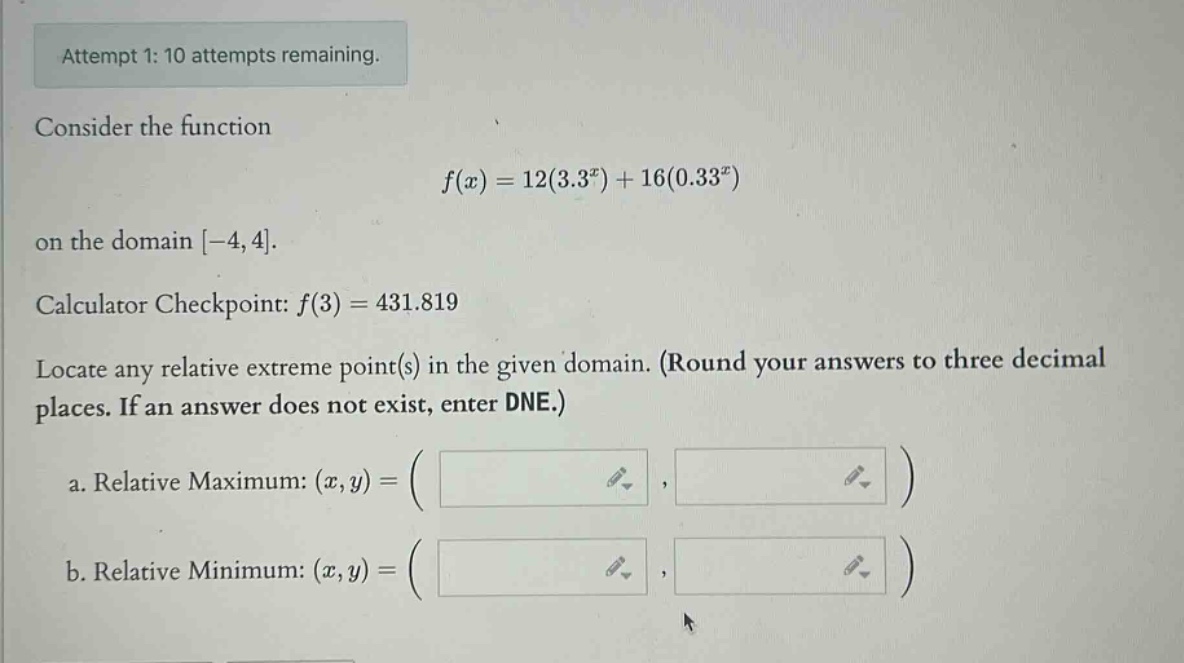
attempt 1: 10 attempts remaining. consider the function f(x)=12(3.3^x)+16(0.33^x) on the domain -4,4. calculator checkpoint: f(3)=431.819 locate any relative extreme point(s) in the given domain. (round your answers to three decimal places. if an answer does not exist, enter dne.) a. relative maximum: (x,y)=( ) b. relative minimum: (x,y)=( )
Answer
Explanation:
Step1: Find the derivative of $f(x)$
Using the formula $(a^x)^\prime=a^x\ln a$, we have $f^\prime(x)=12\times3.3^x\ln(3.3)+16\times0.33^x\ln(0.33)$.
Step2: Set $f^\prime(x) = 0$
$12\times3.3^x\ln(3.3)+16\times0.33^x\ln(0.33)=0$. Let $y = 3.3^x$, then $0.33^x=\frac{1}{10^x}\times3.3^x=\frac{y}{10^x}$. The equation becomes $12y\ln(3.3)+16\times\frac{y}{10^x}\ln(0.33)=0$. Since $y = 3.3^x>0$ for all real - valued $x$, we can divide both sides by $y$: $12\ln(3.3)+\frac{16}{10^x}\ln(0.33)=0$. Then $\frac{16}{10^x}\ln(0.33)=- 12\ln(3.3)$. So, $\frac{10^x}{16}=\frac{\ln(3.3)}{-\ln(0.33)}$. Since $-\ln(0.33)=\ln(\frac{1}{0.33})=\ln(\frac{10}{3.3})$, we have $\frac{10^x}{16}=\frac{\ln(3.3)}{\ln(\frac{10}{3.3})}$. Cross - multiply to get $10^x\ln(\frac{10}{3.3}) = 16\ln(3.3)$. Using the property of logarithms, we can solve for $x$: [ \begin{align*} x&=\log_{10}\left(\frac{16\ln(3.3)}{\ln(\frac{10}{3.3})}\right)\ x&\approx\log_{10}\left(\frac{16\times1.1939}{2.3026 - 1.1939}\right)\ x&\approx\log_{10}\left(\frac{19.1024}{1.1087}\right)\ x&\approx\log_{10}(17.2205)\ x&\approx1.236 \end{align*} ]
Step3: Evaluate $f(x)$ at critical point and endpoints
Evaluate $f(x)$ at $x=-4,x = 1.236,x = 4$. $f(-4)=12\times3.3^{-4}+16\times0.33^{-4}=12\times\frac{1}{3.3^4}+16\times3.3^4\approx12\times\frac{1}{118.5921}+16\times118.5921\approx0.101+1897.474=1897.575$. $f(1.236)=12\times3.3^{1.236}+16\times0.33^{1.236}\approx12\times4.079+16\times0.245\approx48.948 + 3.92=52.868$. $f(4)=12\times3.3^{4}+16\times0.33^{4}=12\times118.5921+16\times\frac{1}{118.5921}\approx1423.105+0.135 = 1423.24$.
Answer:
a. Relative Maximum: $(x,y)=(-4,1897.575)$ b. Relative Minimum: $(x,y)=(1.236,52.868)$