attempt 1: 10 attempts remaining. a. find the derivative of the function f(x)=g(h(x)), given the functions…
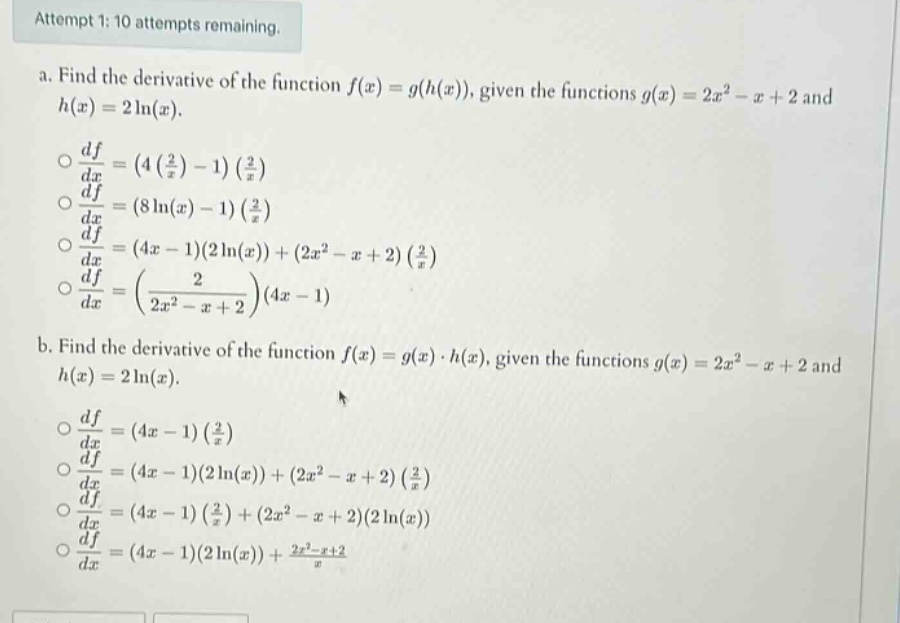
attempt 1: 10 attempts remaining. a. find the derivative of the function f(x)=g(h(x)), given the functions g(x)=2x² - x + 2 and h(x)=2ln(x). o df/dx=(4(2/x)-1)(2/x) o df/dx=(8ln(x)-1)(2/x) o df/dx=(4x - 1)(2ln(x))+(2x² - x + 2)(2/x) o df/dx=(2/(2x² - x + 2))(4x - 1) b. find the derivative of the function f(x)=g(x)·h(x), given the functions g(x)=2x² - x + 2 and h(x)=2ln(x). o df/dx=(4x - 1)(2/x) o df/dx=(4x - 1)(2ln(x))+(2x² - x + 2)(2/x) o df/dx=(4x - 1)(2/x)+(2x² - x + 2)(2ln(x)) o df/dx=(4x - 1)(2ln(x))+(2x² - x + 2)/x
Answer
Explanation:
Step1: Recall chain - rule for part a
The chain - rule states that if $y = g(u)$ and $u = h(x)$, then $\frac{dy}{dx}=\frac{dg}{du}\cdot\frac{du}{dx}$. First, find the derivative of $g(x)=2x^{2}-x + 2$, so $g^\prime(x)=4x - 1$. The derivative of $h(x)=2\ln(x)$ is $h^\prime(x)=\frac{2}{x}$. Then, by the chain - rule, if $f(x)=g(h(x))$, $\frac{df}{dx}=g^\prime(h(x))\cdot h^\prime(x)$. Substituting $u = h(x)=2\ln(x)$ into $g^\prime(u)$ gives $g^\prime(h(x))=4(2\ln(x))-1 = 8\ln(x)-1$. So $\frac{df}{dx}=(8\ln(x)-1)\frac{2}{x}$.
Step2: Recall product - rule for part b
The product - rule states that if $y = g(x)\cdot h(x)$, then $y^\prime=g^\prime(x)h(x)+g(x)h^\prime(x)$. We know that $g^\prime(x)=4x - 1$, $h(x)=2\ln(x)$, $g(x)=2x^{2}-x + 2$, and $h^\prime(x)=\frac{2}{x}$. So $\frac{df}{dx}=(4x - 1)(2\ln(x))+(2x^{2}-x + 2)\frac{2}{x}$.
Answer:
a. $\frac{df}{dx}=(8\ln(x)-1)\frac{2}{x}$ b. $\frac{df}{dx}=(4x - 1)(2\ln(x))+(2x^{2}-x + 2)\frac{2}{x}$