attempt 1: 10 attempts remaining. find the derivative of f(x) = 3(5^x)/sqrt(x - 2). f(x) = 6ln(5)(5^x)sqrt(x…
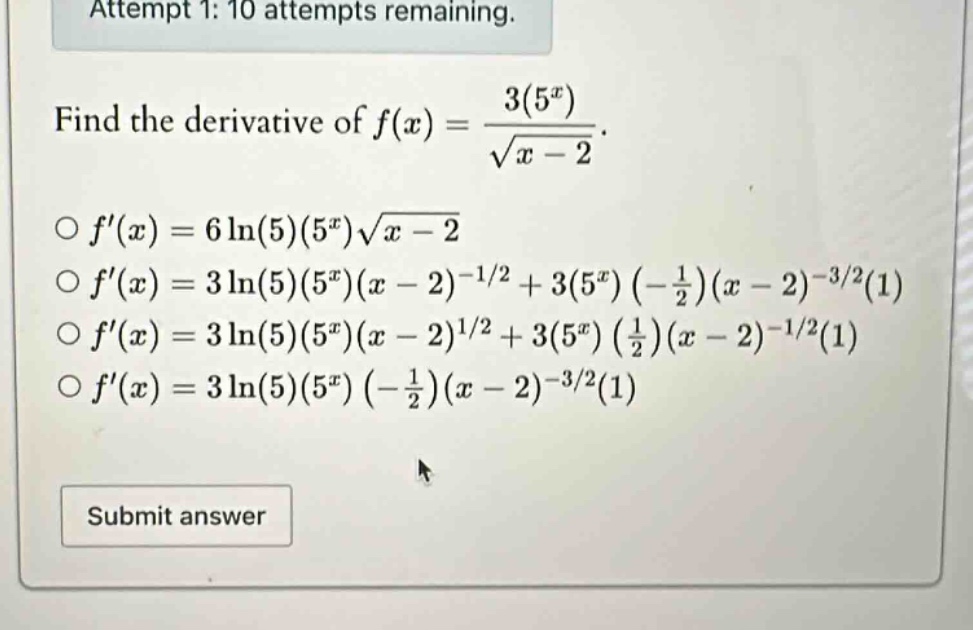
attempt 1: 10 attempts remaining. find the derivative of f(x) = 3(5^x)/sqrt(x - 2). f(x) = 6ln(5)(5^x)sqrt(x - 2) f(x) = 3ln(5)(5^x)(x - 2)^(-1/2) + 3(5^x)(-1/2)(x - 2)^(-3/2)(1) f(x) = 3ln(5)(5^x)(x - 2)^(1/2) + 3(5^x)(1/2)(x - 2)^(-1/2)(1) f(x) = 3ln(5)(5^x)(-1/2)(x - 2)^(-3/2)(1) submit answer
Answer
Explanation:
Step1: Apply quotient - rule
The quotient - rule states that if $y=\frac{u}{v}$, then $y'=\frac{u'v - uv'}{v^{2}}$. Here, $u = 3(5^{x})$ and $v=\sqrt{x - 2}=(x - 2)^{\frac{1}{2}}$.
Step2: Find $u'$
The derivative of $a^{x}$ is $a^{x}\ln(a)$. So, if $u = 3(5^{x})$, then $u'=3\times5^{x}\ln(5)$.
Step3: Find $v'$
Using the power - rule $(x^{n})'=nx^{n - 1}$, if $v=(x - 2)^{\frac{1}{2}}$, then $v'=\frac{1}{2}(x - 2)^{-\frac{1}{2}}\times1$.
Step4: Calculate $f'(x)$
$f'(x)=\frac{u'v - uv'}{v^{2}}=\frac{3\ln(5)(5^{x})(x - 2)^{\frac{1}{2}}-3(5^{x})\times\frac{1}{2}(x - 2)^{-\frac{1}{2}}\times1}{(x - 2)}$. Simplifying, we get $f'(x)=3\ln(5)(5^{x})(x - 2)^{-\frac{1}{2}}+3(5^{x})(-\frac{1}{2})(x - 2)^{-\frac{3}{2}}(1)$.
Answer:
$f'(x)=3\ln(5)(5^{x})(x - 2)^{-1/2}+3(5^{x})(-\frac{1}{2})(x - 2)^{-3/2}(1)$