attempt 1: 10 attempts remaining. in the following, use the power series ln(1 - x)=-∑(n = 1 to ∞) x^n/n, for…
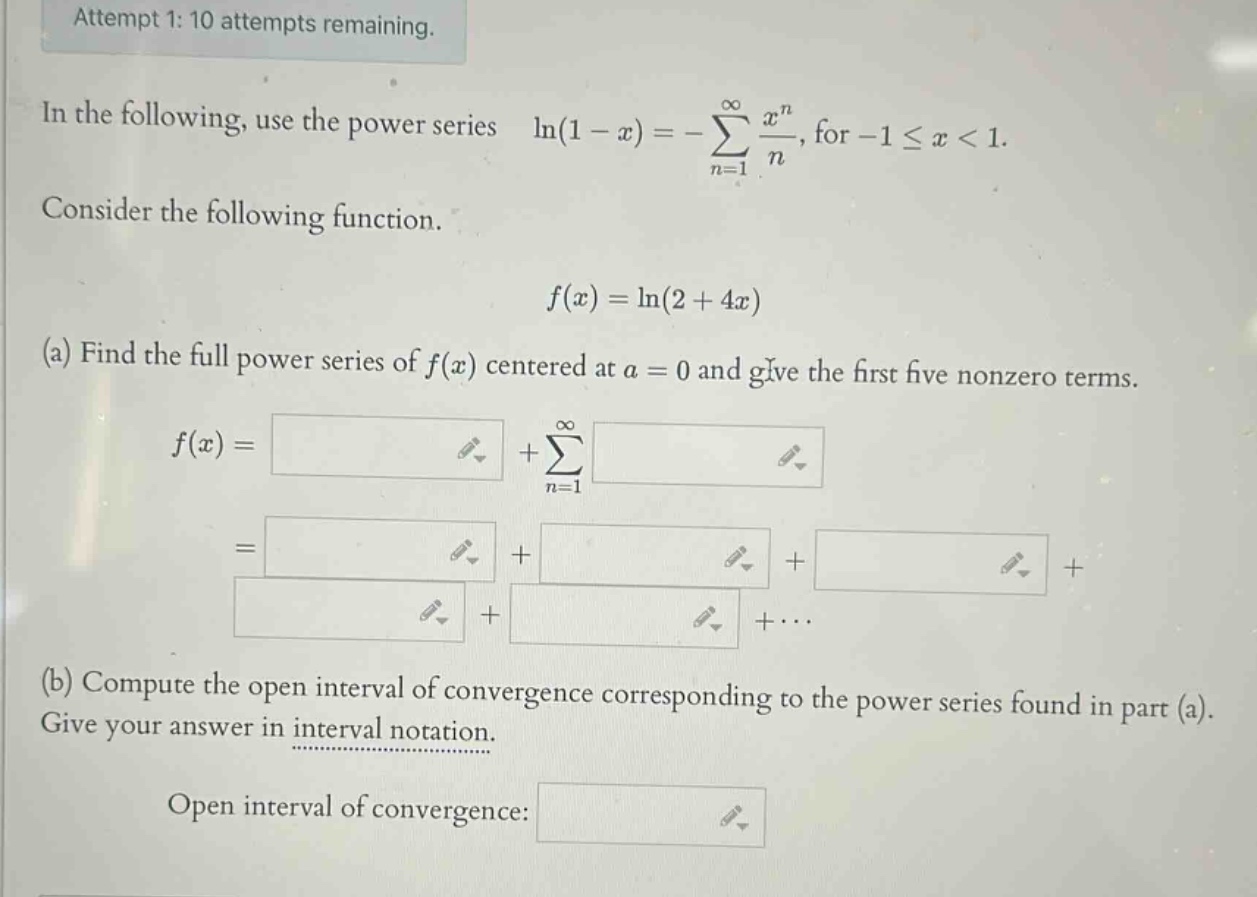
attempt 1: 10 attempts remaining. in the following, use the power series ln(1 - x)=-∑(n = 1 to ∞) x^n/n, for - 1 ≤ x < 1. consider the following function. f(x)=ln(2 + 4x) (a) find the full power series of f(x) centered at a = 0 and give the first five nonzero terms. f(x)= +∑(n = 1 to ∞) = + + + + +⋯ (b) compute the open interval of convergence corresponding to the power series found in part (a). give your answer in interval notation. open interval of convergence:
Answer
Explanation:
Step1: Rewrite the function
First, rewrite $\ln(2 + 4x)=\ln(2(1 + 2x))=\ln 2+\ln(1 + 2x)$.
Step2: Use the given power - series formula
We know that $\ln(1 - y)=-\sum_{n = 1}^{\infty}\frac{y^{n}}{n}$ for $-1\leq y<1$. Replace $y=-2x$ in the formula, then $\ln(1 + 2x)=-\sum_{n = 1}^{\infty}\frac{(-2x)^{n}}{n}=\sum_{n = 1}^{\infty}\frac{(-1)^{n + 1}(2x)^{n}}{n}$. So $f(x)=\ln 2+\sum_{n = 1}^{\infty}\frac{(-1)^{n + 1}2^{n}x^{n}}{n}$.
Step3: Find the first five non - zero terms
When $n = 1$: $\frac{(-1)^{1 + 1}2^{1}x^{1}}{1}=2x$; when $n = 2$: $\frac{(-1)^{2 + 1}2^{2}x^{2}}{2}=-2x^{2}$; when $n = 3$: $\frac{(-1)^{3 + 1}2^{3}x^{3}}{3}=\frac{8x^{3}}{3}$; when $n = 4$: $\frac{(-1)^{4+1}2^{4}x^{4}}{4}=-4x^{4}$; when $n = 5$: $\frac{(-1)^{5 + 1}2^{5}x^{5}}{5}=\frac{32x^{5}}{5}$. So $f(x)=\ln 2+2x - 2x^{2}+\frac{8x^{3}}{3}-4x^{4}+\frac{32x^{5}}{5}+\cdots$.
Step4: Find the interval of convergence
For the power series $\sum_{n = 1}^{\infty}\frac{(-1)^{n + 1}2^{n}x^{n}}{n}$, we use the ratio test. Let $a_{n}=\frac{(-1)^{n + 1}2^{n}x^{n}}{n}$. Then $\lim_{n\rightarrow\infty}\left|\frac{a_{n + 1}}{a_{n}}\right|=\lim_{n\rightarrow\infty}\left|\frac{\frac{(-1)^{n+2}2^{n + 1}x^{n+1}}{n + 1}}{\frac{(-1)^{n + 1}2^{n}x^{n}}{n}}\right|=\lim_{n\rightarrow\infty}\left|\frac{(-1)^{n+2}2^{n + 1}x^{n+1}n}{(-1)^{n + 1}2^{n}x^{n}(n + 1)}\right|=\lim_{n\rightarrow\infty}\left|\frac{-2nx}{n + 1}\right| = 2|x|$. For convergence, $2|x|<1$, so $|x|<\frac{1}{2}$. The open interval of convergence is $\left(-\frac{1}{2},\frac{1}{2}\right)$.
Answer:
(a) $f(x)=\ln 2+\sum_{n = 1}^{\infty}\frac{(-1)^{n + 1}2^{n}x^{n}}{n}=\ln 2+2x - 2x^{2}+\frac{8x^{3}}{3}-4x^{4}+\frac{32x^{5}}{5}+\cdots$ (b) $\left(-\frac{1}{2},\frac{1}{2}\right)$