attempt 1: 10 attempts remaining. in the following, use the power series ln(1 - x)=-∑(n = 1 to ∞) x^n/n, for…
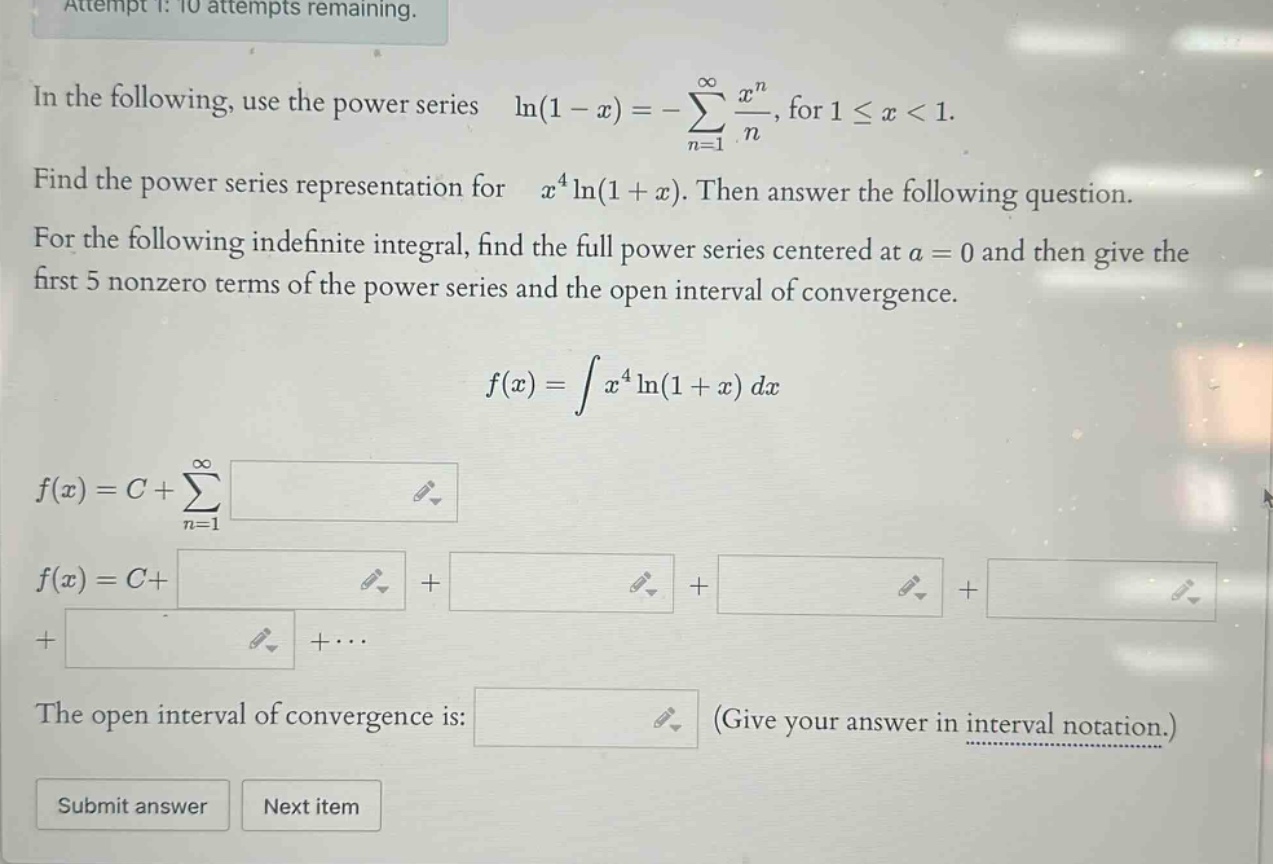
attempt 1: 10 attempts remaining. in the following, use the power series ln(1 - x)=-∑(n = 1 to ∞) x^n/n, for 1 ≤ x < 1. find the power series representation for x^4ln(1 + x). then answer the following question. for the following indefinite integral, find the full power series centered at a = 0 and then give the first 5 nonzero terms of the power series and the open interval of convergence. f(x)=∫x^4ln(1 + x)dx f(x)=c+∑(n = 1 to ∞) f(x)=c+ + + + + +⋯ the open interval of convergence is: (give your answer in interval notation.) submit answer next item
Answer
Explanation:
Step1: Recall the power - series of $\ln(1 + x)$
We know that $\ln(1 - x)=-\sum_{n = 1}^{\infty}\frac{x^{n}}{n}$ for $- 1\leq x<1$. Replace $x$ with $-x$ to get $\ln(1 + x)=\sum_{n = 1}^{\infty}\frac{(-1)^{n + 1}x^{n}}{n}$, for $-1<x\leq1$.
Step2: Find the power - series of $x^{4}\ln(1 + x)$
Multiply the power - series of $\ln(1 + x)$ by $x^{4}$: $x^{4}\ln(1 + x)=x^{4}\sum_{n = 1}^{\infty}\frac{(-1)^{n + 1}x^{n}}{n}=\sum_{n = 1}^{\infty}\frac{(-1)^{n + 1}x^{n+4}}{n}$.
Step3: Integrate the power - series of $x^{4}\ln(1 + x)$
Integrate term - by - term: $\int x^{4}\ln(1 + x)dx=C+\sum_{n = 1}^{\infty}\frac{(-1)^{n + 1}x^{n + 5}}{n(n + 5)}$.
Step4: Find the first 5 non - zero terms
When $n = 1$: $\frac{(-1)^{1+1}x^{1 + 5}}{1\times(1 + 5)}=\frac{x^{6}}{6}$ When $n = 2$: $\frac{(-1)^{2 + 1}x^{2+5}}{2\times(2 + 5)}=-\frac{x^{7}}{14}$ When $n = 3$: $\frac{(-1)^{3 + 1}x^{3+5}}{3\times(3 + 5)}=\frac{x^{8}}{24}$ When $n = 4$: $\frac{(-1)^{4 + 1}x^{4+5}}{4\times(4 + 5)}=-\frac{x^{9}}{36}$ When $n = 5$: $\frac{(-1)^{5 + 1}x^{5+5}}{5\times(5 + 5)}=\frac{x^{10}}{50}$
Step5: Find the interval of convergence
We use the ratio test. Let $a_{n}=\frac{(-1)^{n + 1}x^{n + 5}}{n(n + 5)}$. Then $\lim_{n\rightarrow\infty}\left|\frac{a_{n + 1}}{a_{n}}\right|=\lim_{n\rightarrow\infty}\left|\frac{\frac{(-1)^{n+2}x^{n+6}}{(n + 1)(n + 6)}}{\frac{(-1)^{n + 1}x^{n + 5}}{n(n + 5)}}\right|=\lim_{n\rightarrow\infty}\left|\frac{(-1)x\cdot n(n + 5)}{(n + 1)(n + 6)}\right|=\lim_{n\rightarrow\infty}\left|\frac{n^{2}+5n}{n^{2}+7n + 6}\cdot x\right|=\left|x\right|$. For convergence, $\left|x\right|<1$. When $x=-1$, the series becomes $\sum_{n = 1}^{\infty}\frac{(-1)^{n + 1}(-1)^{n + 5}}{n(n + 5)}=\sum_{n = 1}^{\infty}\frac{(-1)^{2n+6}}{n(n + 5)}=\sum_{n = 1}^{\infty}\frac{1}{n(n + 5)}$, which converges (by comparison with $\sum_{n = 1}^{\infty}\frac{1}{n^{2}}$). When $x = 1$, the series becomes $\sum_{n = 1}^{\infty}\frac{(-1)^{n + 1}(1)^{n + 5}}{n(n + 5)}=\sum_{n = 1}^{\infty}\frac{(-1)^{n + 1}}{n(n + 5)}$, which converges (alternating series test). So the interval of convergence is $[-1,1]$.
Answer:
$f(x)=C+\sum_{n = 1}^{\infty}\frac{(-1)^{n + 1}x^{n + 5}}{n(n + 5)}$ $f(x)=C+\frac{x^{6}}{6}-\frac{x^{7}}{14}+\frac{x^{8}}{24}-\frac{x^{9}}{36}+\frac{x^{10}}{50}+\cdots$ The open interval of convergence is: $(-1,1)$