attempt 1: 10 attempts remaining. the number of hours it takes for a caterer to prepare entrees for p people…
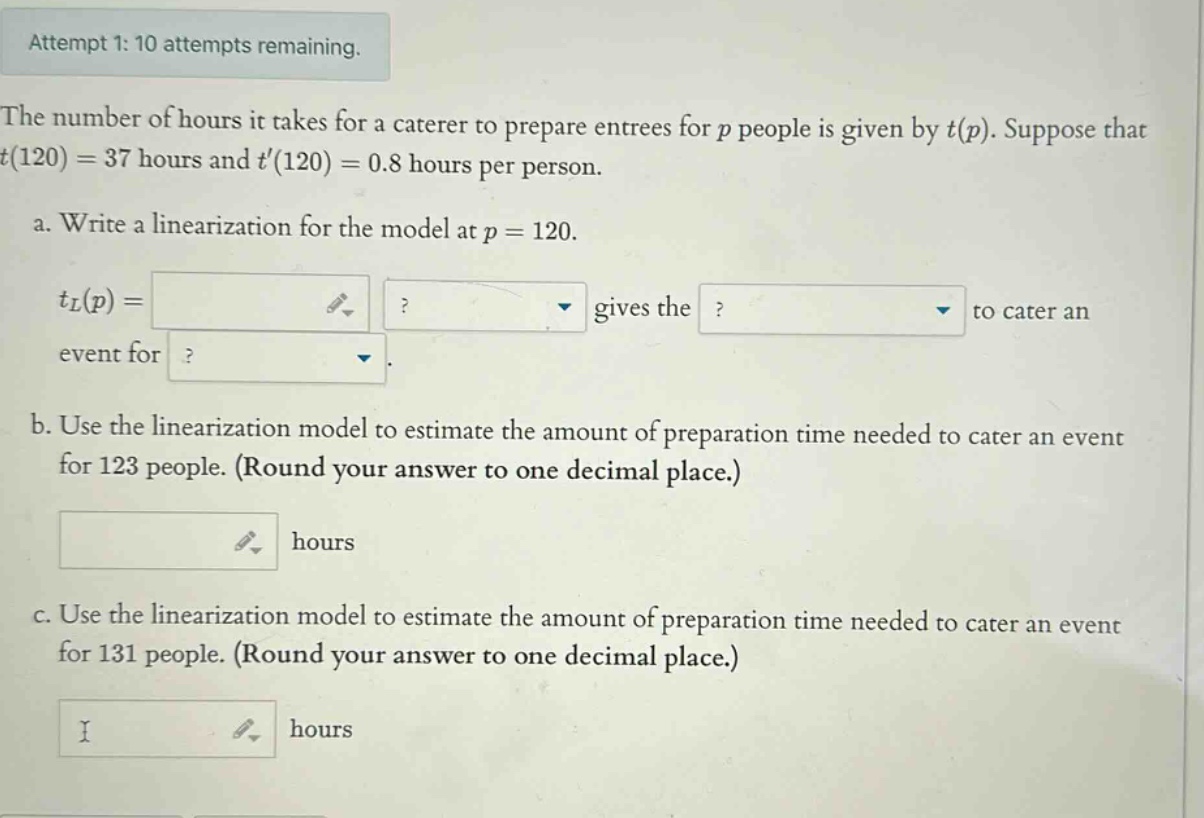
attempt 1: 10 attempts remaining. the number of hours it takes for a caterer to prepare entrees for p people is given by t(p). suppose that t(120)=37 hours and t(120)=0.8 hours per person. a. write a linearization for the model at p = 120. tl(p)= gives the to cater an event for. b. use the linearization model to estimate the amount of preparation time needed to cater an event for 123 people. (round your answer to one decimal place.) hours c. use the linearization model to estimate the amount of preparation time needed to cater an event for 131 people. (round your answer to one decimal place.) hours
Answer
Explanation:
Step1: Recall linearization formula
The linearization formula of a function $y = f(x)$ at $x = a$ is $L(x)=f(a)+f^{\prime}(a)(x - a)$. Here, $t(p)$ is the function, $a = 120$, $f(a)=t(120)=37$ and $f^{\prime}(a)=t^{\prime}(120)=0.8$. So the linearization $t_L(p)=t(120)+t^{\prime}(120)(p - 120)=37+0.8(p - 120)$.
Step2: Estimate for 123 people
Substitute $p = 123$ into $t_L(p)$. $t_L(123)=37+0.8(123 - 120)=37+0.8\times3=37 + 2.4=39.4$.
Step3: Estimate for 131 people
Substitute $p = 131$ into $t_L(p)$. $t_L(131)=37+0.8(131 - 120)=37+0.8\times11=37+8.8 = 45.8$.
Answer:
a. $t_L(p)=37 + 0.8(p - 120)$; gives the linear - approximation to cater an event for $p$ people. b. $39.4$ c. $45.8$