attempt 1: 10 attempts remaining. the number of students in an elementary school t years after 2009 is given…
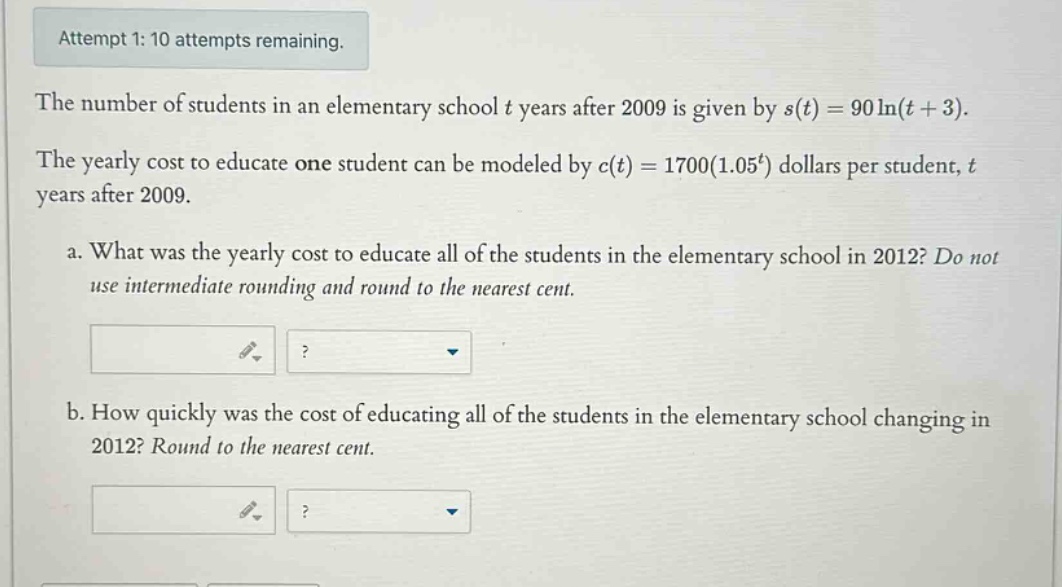
attempt 1: 10 attempts remaining. the number of students in an elementary school t years after 2009 is given by s(t)=90ln(t + 3). the yearly cost to educate one student can be modeled by c(t)=1700(1.05^t) dollars per student, t years after 2009. a. what was the yearly cost to educate all of the students in the elementary school in 2012? do not use intermediate rounding and round to the nearest cent. b. how quickly was the cost of educating all of the students in the elementary school changing in 2012? round to the nearest cent.
Answer
Explanation:
Step1: Calculate the value of t for 2012
Since t is years after 2009, for 2012, $t = 2012 - 2009=3$.
Step2: Find the number of students in 2012
Substitute $t = 3$ into $s(t)=90\ln(t + 3)$. So $s(3)=90\ln(3 + 3)=90\ln(6)$.
Step3: Find the cost per - student in 2012
Substitute $t = 3$ into $c(t)=1700(1.05^{t})$. So $c(3)=1700\times1.05^{3}=1700\times1.157625 = 1967.9625$.
Step4: Calculate the total cost to educate all students in 2012
The total cost $T(3)=s(3)\times c(3)=90\ln(6)\times1967.9625$. $90\ln(6)\approx90\times1.791759 = 161.25831$, and $T(3)=161.25831\times1967.9625\approx317399.97$.
Step5: Find the product function of total cost
The total - cost function $T(t)=s(t)\times c(t)=90\ln(t + 3)\times1700(1.05^{t})=153000\ln(t + 3)\times1.05^{t}$.
Step6: Differentiate the total - cost function using the product rule
The product rule is $(uv)^\prime=u^\prime v+uv^\prime$, where $u = 153000\ln(t + 3)$ and $v = 1.05^{t}$. $u^\prime=\frac{153000}{t + 3}$ and $v^\prime=153000\times1.05^{t}\ln(1.05)$. So $T^\prime(t)=\frac{153000\times1.05^{t}}{t + 3}+153000\ln(t + 3)\times1.05^{t}\ln(1.05)$.
Step7: Evaluate the derivative at t = 3
Substitute $t = 3$ into $T^\prime(t)$. $T^\prime(3)=\frac{153000\times1.05^{3}}{3 + 3}+153000\ln(6)\times1.05^{3}\ln(1.05)$. $1.05^{3}=1.157625$, $\frac{153000\times1.157625}{6}=29519.4375$. $153000\ln(6)\times1.157625\times\ln(1.05)\approx153000\times1.791759\times1.157625\times0.04879\approx15879.27$. $T^\prime(3)=29519.4375+15879.27\approx45398.71$.
Answer:
a. $$317399.97$ b. $$45398.71$