attempt 1: 10 attempts remaining. the population of a city in the northeast is given by p(t)=180/(1 +…
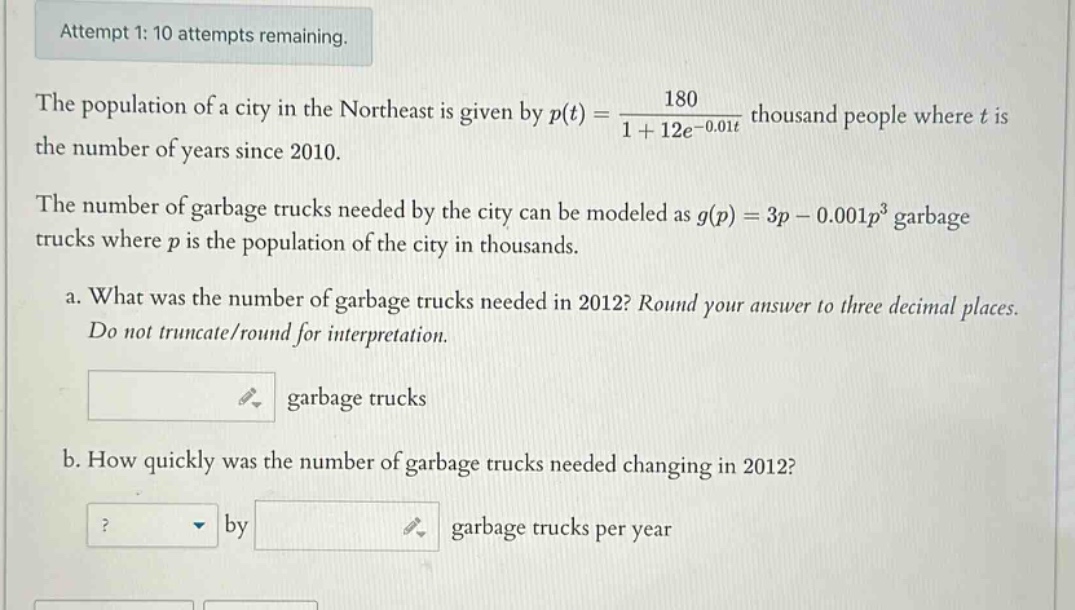
attempt 1: 10 attempts remaining. the population of a city in the northeast is given by p(t)=180/(1 + 12e^(-0.01t)) thousand people where t is the number of years since 2010. the number of garbage trucks needed by the city can be modeled as g(p)=3p - 0.001p^3 garbage trucks where p is the population of the city in thousands. a. what was the number of garbage trucks needed in 2012? round your answer to three decimal places. do not truncate/round for interpretation. garbage trucks b. how quickly was the number of garbage trucks needed changing in 2012? by garbage trucks per year
Answer
Explanation:
Step1: Calculate population in 2012
Since (t) is the number of years since 2010, for 2012, (t = 2). Substitute (t = 2) into the population - function (p(t)=\frac{180}{1 + 12e^{-0.01t}}). [p(2)=\frac{180}{1+12e^{-0.01\times2}}=\frac{180}{1 + 12e^{-0.02}}] [p(2)=\frac{180}{1+12\times0.980198}=\frac{180}{1 + 11.762376}=\frac{180}{12.762376}\approx14.1039]
Step2: Calculate number of garbage - trucks in 2012
Substitute (p(2)\approx14.1039) into the function (g(p)=3p - 0.001p^{3}). [g(p(2))=3\times14.1039-0.001\times(14.1039)^{3}] [g(p(2)) = 42.3117-0.001\times2793.977] [g(p(2))=42.3117 - 2.7940=39.5177\approx39.518]
Step3: Find the derivative of (p(t))
Using the quotient - rule ((\frac{u}{v})^\prime=\frac{u^\prime v - uv^\prime}{v^{2}}), where (u = 180), (u^\prime=0), (v = 1 + 12e^{-0.01t}), and (v^\prime=-0.12e^{-0.01t}). [p^\prime(t)=\frac{0\times(1 + 12e^{-0.01t})-180\times(-0.12e^{-0.01t})}{(1 + 12e^{-0.01t})^{2}}=\frac{21.6e^{-0.01t}}{(1 + 12e^{-0.01t})^{2}}]
Step4: Find the derivative of (g(p))
[g^\prime(p)=3-0.003p^{2}]
Step5: Use the chain - rule (\frac{dg}{dt}=g^\prime(p)\times p^\prime(t))
First, find (p^\prime(2)): [p^\prime(2)=\frac{21.6e^{-0.01\times2}}{(1 + 12e^{-0.01\times2})^{2}}=\frac{21.6\times0.980198}{(1 + 12\times0.980198)^{2}}=\frac{21.172377}{(12.762376)^{2}}=\frac{21.172377}{162.8877}\approx0.13] Then, find (g^\prime(p(2))): [g^\prime(p(2))=3-0.003\times(14.1039)^{2}=3-0.003\times198.929=3 - 0.5968=2.4032] [ \frac{dg}{dt}\big|_{t = 2}=g^\prime(p(2))\times p^\prime(2)=2.4032\times0.13\approx0.312]
Answer:
a. 39.518 b. increasing; 0.312