attempt 1: 10 attempts remaining. suppose we are given a function f(x) which can be written as a product of…
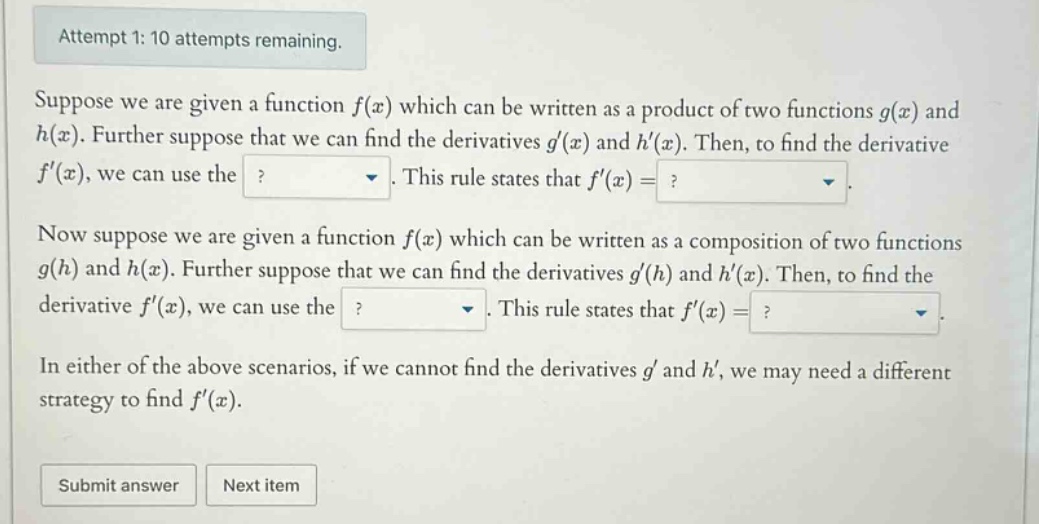
attempt 1: 10 attempts remaining. suppose we are given a function f(x) which can be written as a product of two functions g(x) and h(x). further suppose that we can find the derivatives g(x) and h(x). then, to find the derivative f(x), we can use the ?. this rule states that f(x)=?. now suppose we are given a function f(x) which can be written as a composition of two functions g(h) and h(x). further suppose that we can find the derivatives g(h) and h(x). then, to find the derivative f(x), we can use the ?. this rule states that f(x)=?. in either of the above scenarios, if we cannot find the derivatives g and h, we may need a different strategy to find f(x). submit answer next item
Answer
Explanation:
Step1: Recall product - rule
The product - rule is used for the product of two functions. If $f(x)=g(x)h(x)$, then $f^{\prime}(x)=g^{\prime}(x)h(x)+g(x)h^{\prime}(x)$.
Step2: Recall chain - rule
The chain - rule is used for the composition of two functions. If $f(x)=g(h(x))$, then $f^{\prime}(x)=g^{\prime}(h(x))h^{\prime}(x)$.
Answer:
- First blank: Product rule; Second blank: $g^{\prime}(x)h(x)+g(x)h^{\prime}(x)$
- First blank: Chain rule; Second blank: $g^{\prime}(h(x))h^{\prime}(x)$