attempt 1: the answer is correct. find the first four taylor polynomials for f(x) centered at x = a, and use…
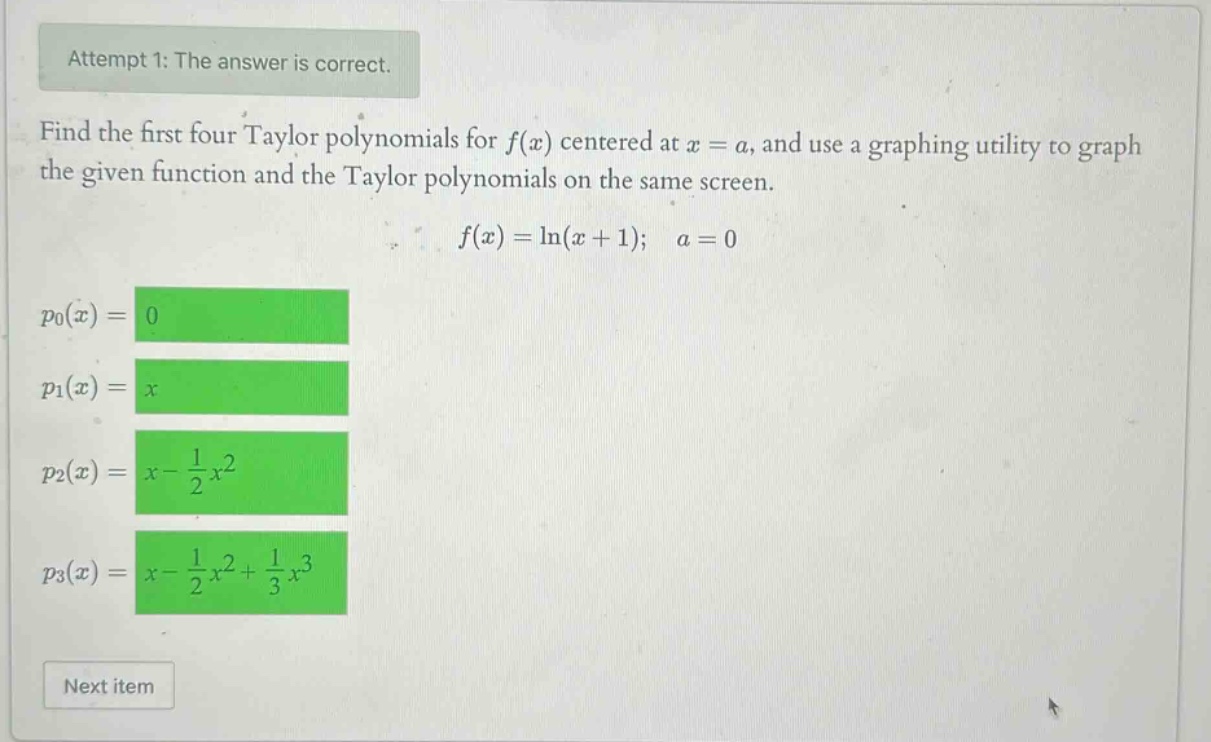
attempt 1: the answer is correct. find the first four taylor polynomials for f(x) centered at x = a, and use a graphing utility to graph the given function and the taylor polynomials on the same screen. f(x)=ln(x + 1); a = 0 p0(x)=0 p1(x)=x p2(x)=x - 1/2x^2 p3(x)=x - 1/2x^2+1/3x^3 next item
Answer
Explanation:
Step1: Recall Taylor - series formula
The Taylor series of a function $f(x)$ centered at $x = a$ is given by $f(x)=\sum_{n = 0}^{\infty}\frac{f^{(n)}(a)}{n!}(x - a)^n$, where $f^{(n)}(a)$ is the $n$-th derivative of $f(x)$ evaluated at $x = a$.
Step2: Find derivatives of $f(x)=\ln(x + 1)$
First - derivative: $f^{\prime}(x)=\frac{1}{x + 1}$, and $f^{\prime}(0)=1$. Second - derivative: $f^{\prime\prime}(x)=-\frac{1}{(x + 1)^2}$, and $f^{\prime\prime}(0)=-1$. Third - derivative: $f^{(3)}(x)=\frac{2}{(x + 1)^3}$, and $f^{(3)}(0)=2$.
Step3: Calculate Taylor polynomials
For $n = 0$: $p_0(x)=\frac{f(0)}{0!}$, since $f(0)=\ln(0 + 1)=0$, so $p_0(x)=0$. For $n = 1$: $p_1(x)=p_0(x)+\frac{f^{\prime}(0)}{1!}(x - 0)=0 + 1\times x=x$. For $n = 2$: $p_2(x)=p_1(x)+\frac{f^{\prime\prime}(0)}{2!}(x - 0)^2=x+\frac{-1}{2}x^2=x-\frac{1}{2}x^2$. For $n = 3$: $p_3(x)=p_2(x)+\frac{f^{(3)}(0)}{3!}(x - 0)^3=x-\frac{1}{2}x^2+\frac{2}{6}x^3=x-\frac{1}{2}x^2+\frac{1}{3}x^3$.
Answer:
$p_0(x)=0$, $p_1(x)=x$, $p_2(x)=x-\frac{1}{2}x^2$, $p_3(x)=x-\frac{1}{2}x^2+\frac{1}{3}x^3$