attempt 1: the answer is correct. imagine that you need to compute e^0.4 but you have no calculator or other…
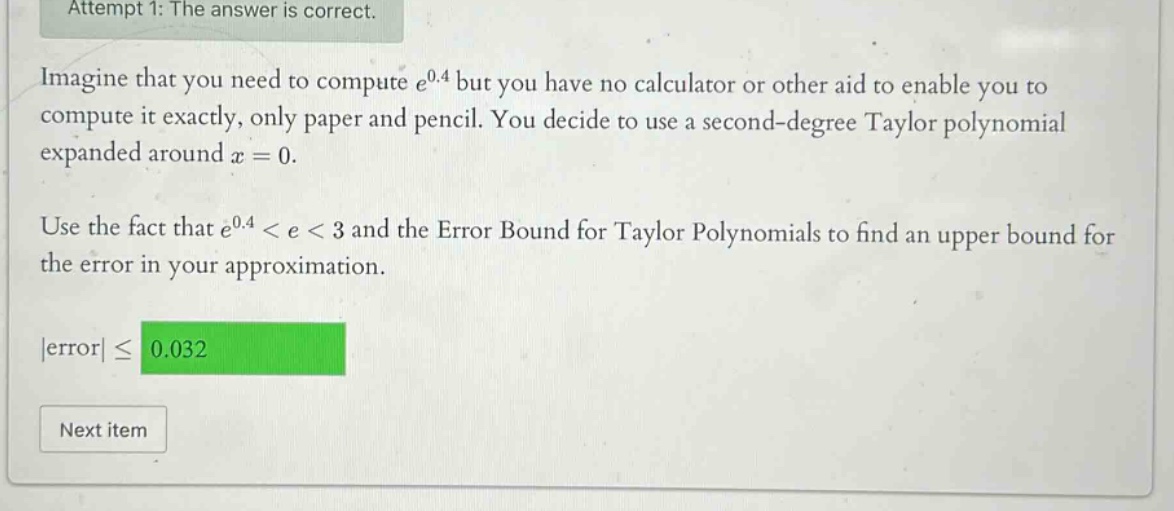
attempt 1: the answer is correct. imagine that you need to compute e^0.4 but you have no calculator or other aid to enable you to compute it exactly, only paper and pencil. you decide to use a second - degree taylor polynomial expanded around x = 0. use the fact that e^0.4 < e < 3 and the error bound for taylor polynomials to find an upper bound for the error in your approximation. |error| ≤ 0.032 next item
Answer
Explanation:
Step1: Recall Taylor - series formula
The Taylor series of $f(x)=e^{x}$ about $x = a$ is given by $\sum_{n = 0}^{\infty}\frac{f^{(n)}(a)}{n!}(x - a)^{n}$, where $f^{(n)}(x)$ is the $n$-th derivative of $f(x)$. For $a = 0$ and $f(x)=e^{x}$, $f^{(n)}(x)=e^{x}$, so $f^{(n)}(0)=1$ for all $n\geq0$. The second - degree Taylor polynomial $P_2(x)$ of $e^{x}$ about $x = 0$ is $P_2(x)=1 + x+\frac{x^{2}}{2}$.
Step2: Recall error - bound formula
The error bound for the Taylor polynomial $P_n(x)$ of a function $f(x)$ about $x = a$ is given by $|R_n(x)|=\left|\frac{f^{(n + 1)}(c)}{(n+1)!}(x - a)^{n+1}\right|$, where $c$ is some number between $a$ and $x$. Here, $n = 2$, $a = 0$, $x=0.4$, and $f(x)=e^{x}$, so $f^{(3)}(c)=e^{c}$. Since $c$ is between $0$ and $0.4$ and $e^{0.4}<e < 3$, we can take $M=\max_{0\leq c\leq0.4}|f^{(3)}(c)|=e^{0.4}<3$.
Step3: Calculate the error bound
Using the error - bound formula $|R_2(x)|=\left|\frac{f^{(3)}(c)}{3!}(x - 0)^{3}\right|$ with $x = 0.4$ and $M = 3$ (an upper - bound for $e^{c}$ where $0\leq c\leq0.4$), we have $|R_2(0.4)|=\frac{|e^{c}|}{6}(0.4)^{3}$. Substituting the upper - bound $e^{c}<3$ into the formula, we get $|R_2(0.4)|\leq\frac{3}{6}(0.4)^{3}=\frac{1}{2}(0.064)=0.032$.
Answer:
$0.032$