attempt 2: the answer is incorrect. 8 attempts remaining. given that ∑(n = 0)^∞ x^n = 1/(1 - x), for |x| <…
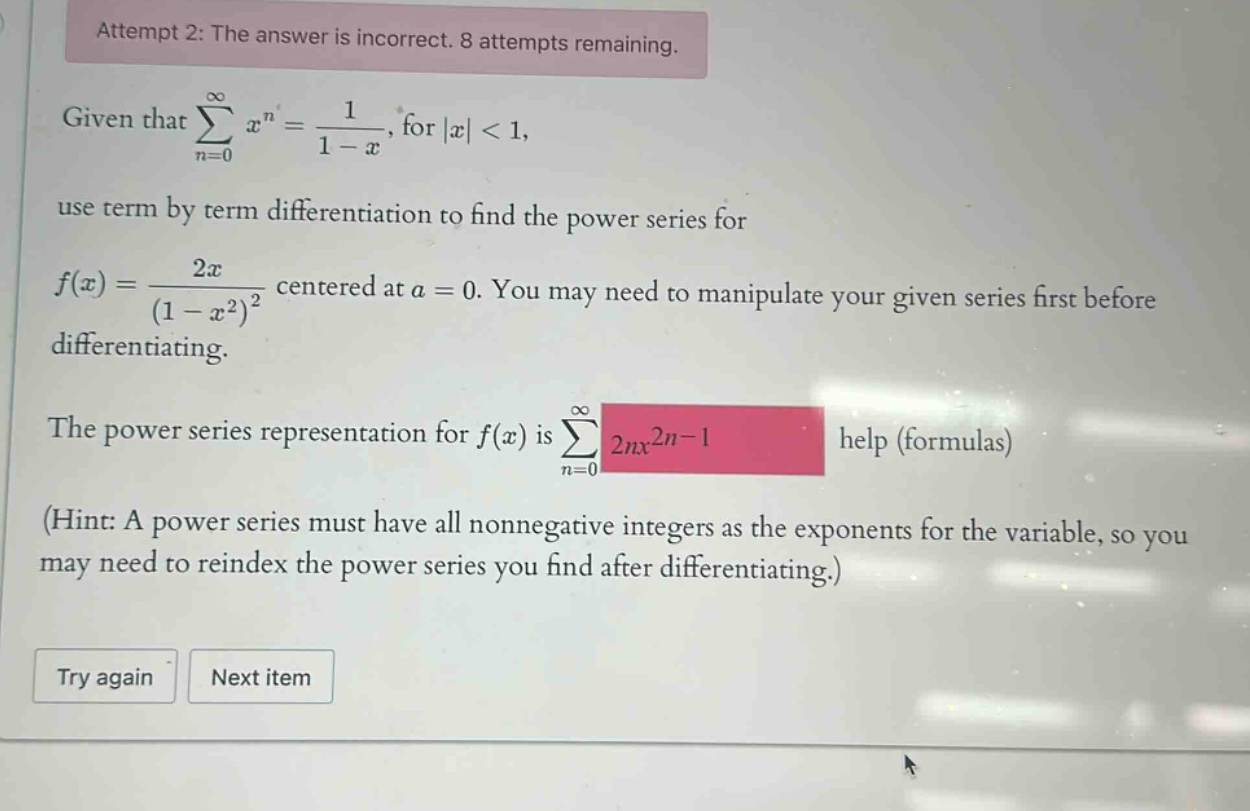
attempt 2: the answer is incorrect. 8 attempts remaining. given that ∑(n = 0)^∞ x^n = 1/(1 - x), for |x| < 1, use term by term differentiation to find the power series for f(x) = 2x/(1 - x^2)^2 centered at a = 0. you may need to manipulate your given series first before differentiating. the power series representation for f(x) is ∑(n = 0)^∞ 2nx^(2n - 1) help (formulas) (hint: a power series must have all nonnegative integers as the exponents for the variable, so you may need to reindex the power series you find after differentiating.) try again next item
Answer
Explanation:
Step1: Start with the given series
We know that $\sum_{n = 0}^{\infty}x^{n}=\frac{1}{1 - x}$, for $|x|<1$. Replace $x$ with $x^{2}$, we get $\sum_{n = 0}^{\infty}(x^{2})^{n}=\frac{1}{1 - x^{2}}$, for $|x^{2}|<1$ (i.e., $|x|<1$). So $\sum_{n = 0}^{\infty}x^{2n}=\frac{1}{1 - x^{2}}$.
Step2: Differentiate both - sides
Differentiate $\sum_{n = 0}^{\infty}x^{2n}$ and $\frac{1}{1 - x^{2}}$ with respect to $x$. The derivative of $\sum_{n = 0}^{\infty}x^{2n}$ term - by - term is $\sum_{n = 1}^{\infty}2nx^{2n - 1}$ (using the power rule $\frac{d}{dx}(x^{m})=mx^{m - 1}$). The derivative of $\frac{1}{1 - x^{2}}=(1 - x^{2})^{-1}$. Using the chain rule, if $u = 1 - x^{2}$, then $\frac{d}{dx}(1 - x^{2})^{-1}=(-1)(1 - x^{2})^{-2}(-2x)=\frac{2x}{(1 - x^{2})^{2}}$.
Step3: Re - index if necessary
The power series for $f(x)=\frac{2x}{(1 - x^{2})^{2}}$ is $\sum_{n = 1}^{\infty}2nx^{2n - 1}$. Since the index starts from $n = 1$, we can rewrite it as $\sum_{n = 0}^{\infty}2(n + 1)x^{2(n+1)-1}=\sum_{n = 0}^{\infty}2(n + 1)x^{2n+1}$.
Answer:
$\sum_{n = 1}^{\infty}2nx^{2n - 1}$