attendance at a state park throughout the year is found to be periodic and can be modeled by a sine…
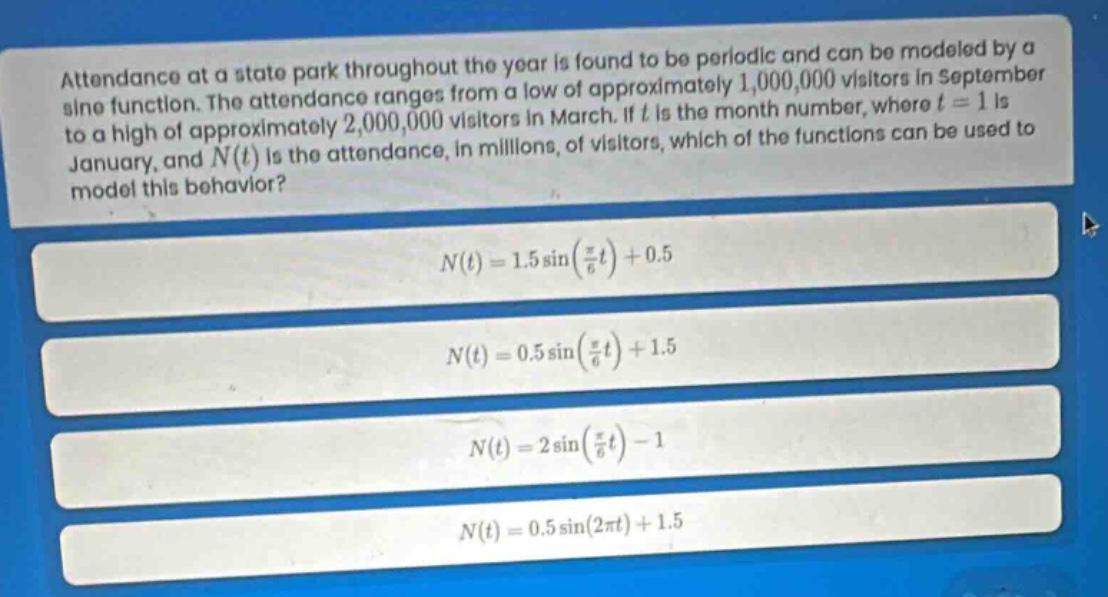
attendance at a state park throughout the year is found to be periodic and can be modeled by a sine function. the attendance ranges from a low of approximately 1,000,000 visitors in september to a high of approximately 2,000,000 visitors in march. if (t) is the month number, where (t = 1) is january, and (n(t)) is the attendance, in millions, of visitors, which of the functions can be used to model this behavior?\n\n(n(t)=1.5sinleft(\frac{pi}{6}t\right)+0.5)\n\n(n(t)=0.5sinleft(\frac{pi}{6}t\right)+1.5)\n\n(n(t)=2sinleft(\frac{pi}{6}t\right)-1)\n\n(n(t)=0.5sin(2pi t)+1.5)
Answer
Explanation:
Step1: Determine the amplitude
The amplitude $A$ of a sinusoidal function $y = A\sin(Bx - C)+D$ is given by $A=\frac{\text{max}-\text{min}}{2}$. Here, $\text{max} = 2$ (2 million visitors) and $\text{min}=1$ (1 million visitors), so $A=\frac{2 - 1}{2}=0.5$.
Step2: Determine the vertical - shift
The vertical - shift $D$ is given by $D=\frac{\text{max}+\text{min}}{2}$. So $D=\frac{2 + 1}{2}=1.5$.
Step3: Determine the period
The period of a sinusoidal function $y = A\sin(Bx - C)+D$ is $T=\frac{2\pi}{B}$. The time between the minimum (September, $t = 9$) and the maximum (March, $t = 3$) is 6 months. The period of the function is 12 months. Since $T = 12=\frac{2\pi}{B}$, we solve for $B$: $B=\frac{\pi}{6}$.
Step4: Check the function form
The general form of the sinusoidal function for the attendance $N(t)$ is $N(t)=A\sin(Bt - C)+D$. Since there is no phase - shift information given and we have found $A = 0.5$, $B=\frac{\pi}{6}$, and $D = 1.5$, the function is $N(t)=0.5\sin(\frac{\pi}{6}t)+1.5$.
Answer:
$N(t)=0.5\sin(\frac{\pi}{6}t)+1.5$