a ball is thrown directly upward from a height of 3 ft with an initial velocity of 24 ft/sec. the function…
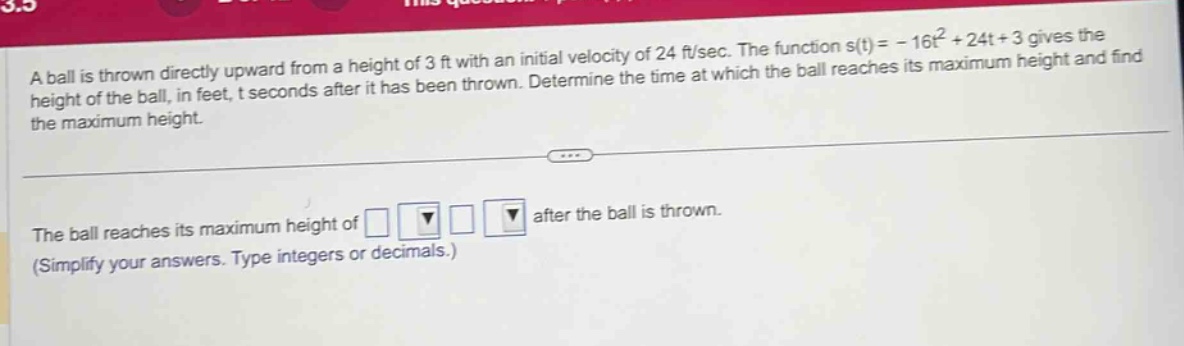
a ball is thrown directly upward from a height of 3 ft with an initial velocity of 24 ft/sec. the function s(t)= - 16t² + 24t + 3 gives the height of the ball, in feet, t seconds after it has been thrown. determine the time at which the ball reaches its maximum height and find the maximum height. the ball reaches its maximum height of after the ball is thrown. (simplify your answers. type integers or decimals.)
Answer
Explanation:
Step1: Identify the function type
The height - function $s(t)=-16t^{2}+24t + 3$ is a quadratic function in the form $y = ax^{2}+bx + c$, where $a=-16$, $b = 24$, and $c = 3$.
Step2: Find the time of maximum height
For a quadratic function $y = ax^{2}+bx + c$, the $x$ - coordinate (in our case, the time $t$) of the vertex is given by $t=-\frac{b}{2a}$. Substitute $a=-16$ and $b = 24$ into the formula: $t=-\frac{24}{2\times(-16)}=\frac{24}{32}=\frac{3}{4}=0.75$ seconds.
Step3: Find the maximum height
Substitute $t = 0.75$ into the function $s(t)=-16t^{2}+24t + 3$. $s(0.75)=-16\times(0.75)^{2}+24\times0.75 + 3$. First, calculate $(0.75)^{2}=0.5625$. Then $-16\times(0.75)^{2}=-16\times0.5625=-9$. And $24\times0.75 = 18$. So $s(0.75)=-9 + 18+3=12$ feet.
Answer:
The ball reaches its maximum height of 12 feet 0.75 seconds after the ball is thrown.