if a ball is thrown vertically upward with a velocity of 128 ft/s, then its height after t seconds is s =…
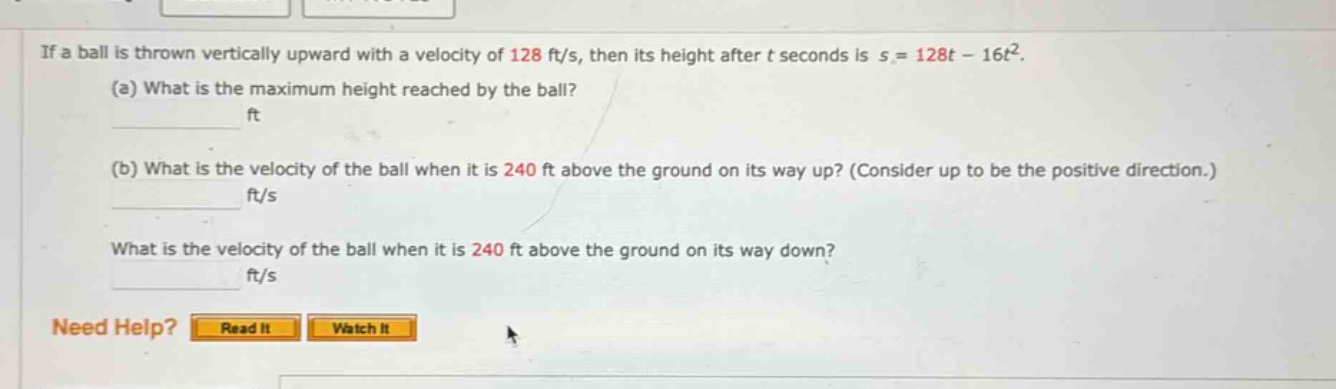
if a ball is thrown vertically upward with a velocity of 128 ft/s, then its height after t seconds is s = 128t - 16t². (a) what is the maximum height reached by the ball? ft (b) what is the velocity of the ball when it is 240 ft above the ground on its way up? (consider up to be the positive direction.) ft/s what is the velocity of the ball when it is 240 ft above the ground on its way down? ft/s need help? read it watch it
Answer
Explanation:
Step1: Find the time for maximum - height
The height function is $s(t)=128t - 16t^{2}$. The velocity function $v(t)$ is the derivative of the height function. Using the power - rule $\frac{d}{dt}(at^{n})=nat^{n - 1}$, we have $v(t)=s^\prime(t)=128-32t$. At the maximum height, the velocity $v(t) = 0$. So, set $128 - 32t=0$. Solving for $t$ gives $32t = 128$, and $t=\frac{128}{32}=4$ s.
Step2: Calculate the maximum height
Substitute $t = 4$ into the height function $s(t)$. So, $s(4)=128\times4-16\times4^{2}=512 - 256=256$ ft.
Step3: Find the time when $s(t)=240$
Set $s(t)=128t - 16t^{2}=240$. Rearrange it to the quadratic form $16t^{2}-128t + 240 = 0$. Divide through by 16 to get $t^{2}-8t + 15 = 0$. Factor the quadratic equation: $(t - 3)(t - 5)=0$. So, $t = 3$ s or $t = 5$ s. The ball is going up at $t = 3$ s and coming down at $t = 5$ s.
Step4: Calculate the velocity at $t = 3$ s
Substitute $t = 3$ into the velocity function $v(t)=128-32t$. Then $v(3)=128-32\times3=128 - 96 = 32$ ft/s.
Step5: Calculate the velocity at $t = 5$ s
Substitute $t = 5$ into the velocity function $v(t)=128-32t$. Then $v(5)=128-32\times5=128 - 160=-32$ ft/s.
Answer:
(a) 256 (b) 32 (c) - 32