the base of a solid s is the region bounded by the x - axis, the y - axis, and the line through the points…
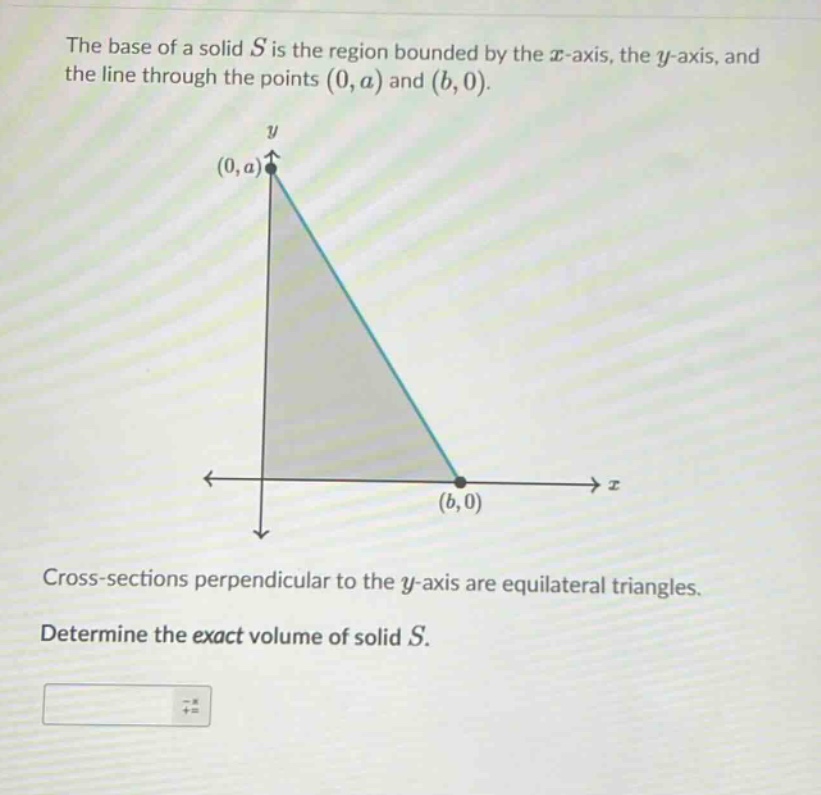
the base of a solid s is the region bounded by the x - axis, the y - axis, and the line through the points (0,a) and (b,0). cross - sections perpendicular to the y - axis are equilateral triangles. determine the exact volume of solid s.
Answer
Explanation:
Step1: Find the equation of the line
The line passing through $(0,a)$ and $(b,0)$ has the equation $y = a-\frac{a}{b}x$ or $x=\frac{b(a - y)}{a}$ using the two - point form $y - y_1=\frac{y_2 - y_1}{x_2 - x_1}(x - x_1)$. Since we are integrating with respect to $y$, we use the $x$ as a function of $y$.
Step2: Determine the side length of the equilateral - triangle cross - section
The cross - sections perpendicular to the $y$ - axis are equilateral triangles. The side length $s$ of the equilateral triangle at a given $y$ is equal to the $x$ - value at that $y$. So $s=\frac{b(a - y)}{a}$, where $0\leq y\leq a$.
Step3: Find the area of the equilateral - triangle cross - section
The area formula for an equilateral triangle with side length $s$ is $A(y)=\frac{\sqrt{3}}{4}s^{2}$. Substituting $s = \frac{b(a - y)}{a}$ into the formula, we get $A(y)=\frac{\sqrt{3}}{4}(\frac{b(a - y)}{a})^{2}=\frac{\sqrt{3}b^{2}}{4a^{2}}(a - y)^{2}$.
Step4: Calculate the volume using integration
The volume $V$ of the solid with cross - sectional area $A(y)$ from $y = 0$ to $y = a$ is given by the integral $V=\int_{0}^{a}A(y)dy$. So $V=\int_{0}^{a}\frac{\sqrt{3}b^{2}}{4a^{2}}(a - y)^{2}dy$. Let $u=a - y$, then $du=-dy$. When $y = 0$, $u = a$; when $y = a$, $u = 0$. The integral becomes $V=\frac{\sqrt{3}b^{2}}{4a^{2}}\int_{0}^{a}u^{2}du$. Using the power rule for integration $\int x^{n}dx=\frac{x^{n + 1}}{n+1}+C(n\neq - 1)$, we have $\int_{0}^{a}u^{2}du=\left[\frac{u^{3}}{3}\right]_{0}^{a}=\frac{a^{3}}{3}$. So $V=\frac{\sqrt{3}b^{2}}{4a^{2}}\times\frac{a^{3}}{3}=\frac{\sqrt{3}a b^{2}}{12}$.
Answer:
$\frac{\sqrt{3}a b^{2}}{12}$